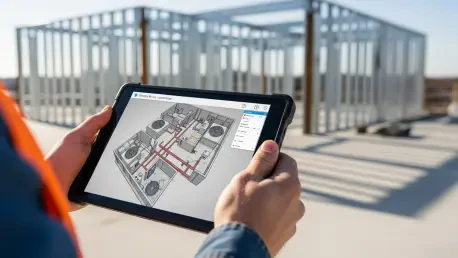

The historical disconnect between the precision of a winning financial bid and the messy reality of the actual job site has long been the primary source of profit erosion for commercial general contractors and specialized trade subcontractors who struggle to maintain their margins. While the industry has spent years digitizing the estimation process, the transition from a signed contract to a coordinated construction schedule remains fraught with technical bottlenecks and miscommunications. Beam AI, a company that established its reputation through advanced preconstruction analytics, recently introduced BIM CoPilot to address this specific operational failure known as the execution gap. This managed service represents a fundamental shift from providing software tools to delivering finished technical outcomes, effectively acting as an externalized virtual design and construction department. By focusing on the critical weeks following a project award, the platform ensures that the initial momentum generated during the competitive bidding phase is not lost to the complexities of clash detection and model coordination.
Transforming Design Documents into Actionable Models
Most modern construction firms are forced to navigate the precarious terrain of hiring expensive, specialized staff or risk falling behind in the digital race for project efficiency. BIM CoPilot functions as a comprehensive, managed solution that effectively eliminates the need for maintaining high-overhead Building Information Modeling departments in-house, which is often a burden for mid-sized players. It accomplishes this by taking standard PDF and CAD files and converting them into high-fidelity, clash-free, and construction-ready 3D models across every major trade, including structural engineering and mechanical systems. This democratization of high-level BIM management allows field supervisors and project managers to focus their energy on the physical build rather than getting bogged down in complex software interfaces. The service translates fragmented architectural intents into a unified digital reality that serves as a single source of truth for the entire team during the early phases of construction.
The primary goal of this service expansion is to provide unwavering continuity throughout the project lifecycle, from the first estimate to the final walk-through. While many contractors have successfully utilized AI-driven tools to accelerate their bidding process, that hard-won efficiency often vanishes during the transition to the coordination phase where manual errors creep back into the workflow. By offering a unified service that handles both financial estimation and technical coordination, Beam AI ensures that the speed gained during preconstruction carries all the way through to the final installation. This seamless flow of data prevents the loss of critical project intelligence that typically occurs when a project moves from the estimating team to the field operations team. Consequently, the software environment remains synchronized with the physical site requirements, reducing the time spent on administrative clarification and allowing for a more aggressive and predictable project schedule.
Resolving Field Conflicts Through Human-Vetted Workflows
One of the most persistent challenges in commercial construction is the management of cramped plenum spaces where various trade systems must coexist without interference. BIM CoPilot addresses this through a rigorous workflow that includes intensive data federation and human-vetted clash detection to ensure that no digital oversight turns into a physical disaster. Unlike purely automated tools that often generate thousands of irrelevant “noise” clashes, experienced engineers review every potential conflict within the model to determine the most practical construction solutions. This human-in-the-loop approach filters out minor overlaps and focuses on critical path issues before a single piece of equipment or ductwork arrives on-site. By resolving these conflicts in a virtual environment, the service allows for the pre-fabrication of components, which significantly speeds up the on-site assembly and minimizes the need for field adjustments that often lead to delays.
This technical process results in a suite of high-quality deliverables that includes construction-ready drawings, accurate bills of quantities, and detailed Revit families for all components. By conducting thorough constructability reviews in a digital environment, the service proactively prevents expensive rework and the dreaded cycle of change orders that can devastate a project budget. This strategic approach ensures that systems designed in isolation by different consultants are integrated into a single, cohesive environment that actually works in the real world. General contractors can then present these verified models to their clients with confidence, knowing that the spatial coordination has been vetted by professionals. The result is a dramatic reduction in field-generated Requests for Information, as most spatial questions are answered during the modeling phase. This foresight protects the profitability of the project while enhancing the professional reputation of the firm.
Strategic Flexibility and Global Industry Standards
Accessibility is a core feature of this managed service, as it does not require contractors to overhaul their existing IT infrastructure or invest in learning steep software curves. The project-based pricing model allows small-to-mid-sized firms to compete on complex commercial projects by effectively outsourcing their BIM needs on an as-needed basis. This operational flexibility makes high-end coordination available to a wider range of players in the construction market who may not have the resources for a full-time internal modeling team. By removing the barrier of high entry costs, the platform levels the playing field, allowing smaller specialists to take on larger, more lucrative contracts without increasing their permanent headcount. This scalability is particularly valuable in a fluctuating market where project volume can change rapidly, requiring firms to be lean and agile while maintaining the highest technical standards.
The service also strictly adheres to international standards, such as ISO 19650 and the AIA BIM guidelines, ensuring that all outputs are professional, standardized, and fully interoperable. By emphasizing a “human-in-the-loop” philosophy, the developers acknowledged that while AI can process vast amounts of data quickly, the high stakes of construction require expert human oversight to manage risk. This approach positioned the company as a lifecycle partner that helped contractors maintain their profit margins through precise, standard-compliant execution that met the most rigorous owner requirements. The integration of global standards meant that models produced for a project in North America were just as valid and useful as those produced for international developments. This commitment to standardization facilitated better communication between global stakeholders and ensured that the digital twin of the building remained a valuable asset for the facility managers long after the construction was completed.
Navigating the Future of Construction Coordination
The implementation of managed BIM services represented a significant leap forward in closing the gap between digital design and physical execution for many firms. Contractors who adopted this model successfully avoided the common pitfalls of fragmented data and uncoordinated trade designs that previously plagued the industry. They achieved higher levels of pre-fabrication and reduced their site waste by utilizing the precise bills of quantities generated from the vetted 3D models. The shift toward a “done-for-you” technical workflow allowed leadership teams to refocus on labor management and site safety rather than troubleshooting software compatibility issues. This transition demonstrated that the value of Building Information Modeling was not found in the software itself, but in the accuracy of the information it provided to the people performing the work. As projects became more complex, this reliance on verified data became the standard for successful delivery across the commercial sector.
Moving forward, firms should prioritize the integration of these managed services into their initial project planning phases to maximize the benefits of spatial coordination. General contractors were encouraged to mandate standardized data exchanges between subcontractors to ensure that the federated model remained the primary tool for decision-making. Future considerations included the expanded use of these high-fidelity models for automated progress tracking and augmented reality applications on the job site. By leveraging the foundation laid by professional modeling services, companies were able to explore new frontiers in construction technology without the risk of initial failure. The ultimate takeaway from this technological evolution was the realization that human expertise remains the most critical component in the digital construction process. Investing in workflows that combined AI speed with human validation proved to be the most effective strategy for ensuring long-term profitability and project success.