
Luca Calarailli is a distinguished figure in the civil engineering and architectural sectors, renowned for his ability to merge historical preservation with cutting-edge technology. With a career dedicated to navigating the complexities of construction and design, he has become a leading voice in the sustainable transformation of industrial landscapes. In this discussion, we explore the intricate details of a landmark project near Huddersfield, where a 19th-century dyeworks was reborn as a modern residential community. The conversation delves into the strategic engineering required to manage subterranean surprises, the innovative management of historic watercourses, and the broader philosophy of breathing new life into brownfield sites.
How did you approach the immense task of repurposing a site with an industrial legacy dating back to the 1830s while ensuring it met modern residential standards?
Repurposing a site like Royd Edge Mills requires a deep respect for history combined with modern ingenuity and meticulous planning. We were dealing with a location near Huddersfield that had served as a textile mill and dyeworks since the late 1830s, meaning nearly two centuries of industrial footprint had to be addressed before a single brick could be laid. Our objective was to deliver 30 new homes, ranging from two-bedroom apartments to expansive five-bedroom detached properties, which meant the land had to be completely remediated and stabilized for family living. It was not merely a matter of clearing the area; it was about reclaiming a piece of Yorkshire’s industrial heritage that had fallen into decades of decline and transforming it into a high-quality community. We had to ensure that every structural solution respected the site’s origins while meeting the rigorous safety and efficiency standards expected by today’s homeowners.
Given the complexity of what was discovered beneath the surface during investigations, what were the most demanding engineering obstacles you faced during the early stages of development?
The below-ground investigations were truly eye-opening and revealed the full extent of the site’s historical layers, including an intricate network of watercourses and structural remnants. We uncovered forgotten basements, wheelhouses, engine rooms, and even underground chimney structures that were not documented on any contemporary site maps. These discoveries were complicated by the presence of steep bedrock and areas where intensive quarrying had taken place in the past, making the ground extremely unpredictable. To address these challenges, we developed a revised site-level strategy that moved away from a uniform approach in favor of a hybrid foundation system. We implemented a combination of shallow trench, deep trench, and piled foundation systems to ensure that each building was perfectly suited to its specific ground conditions and could safely connect to existing adopted drainage.
The reconfiguration of the former mill pond stands out as a highly creative solution; could you walk us through the decision-making process and the engineering benefits of this feat?
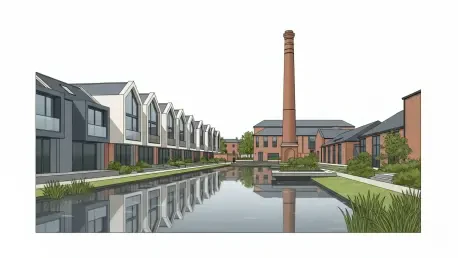
Managing the former mill pond was perhaps the most satisfying part of the civil engineering process because it allowed us to replace a conventional, resource-heavy solution with something far more elegant. Initially, one might think a massive, expensive concrete retaining wall would be necessary to manage the flood risk and contain the water drawing from Royd Edge Moor. However, our team chose to reconfigure the landscape by cutting back the pond, which significantly reduced the risk of leakage and provided a more natural way to handle surface water management. This strategic redesign did more than just solve a technical problem; it actually increased the usable garden space for the new homes and enhanced the overall visual character of the development. By integrating this water feature into the modern landscape, we were able to deliver an effective drainage solution that also feels like a deliberate, attractive part of the environment.
In what ways did the project team go beyond the structural requirements to ensure the new development harmonized with the natural environment and local community?
Sustainability and community integration were central to our philosophy from the very beginning, as we wanted the Royd Edge Mills development to feel like a natural extension of its surroundings. We made a conscious effort to preserve the character and legacy of the historic setting by incorporating new woodland walkways that encourage residents to explore the outdoors. These paths do not just provide recreational space; they help integrate the development into the wider environment and actively promote biodiversity in the area by connecting to Thick Hollins Dyke. Our engineering team also prioritized a reduction in off-site material waste during the remediation phase, which lessened the environmental impact of the construction process. The result is a high-quality residential community that honors its industrial roots while providing lush, green, and sustainable spaces for its future residents to thrive.
What is your forecast for the future of brownfield site redevelopment in historical industrial regions?
I believe we are entering a period where the redevelopment of difficult brownfield sites will become the gold standard for sustainable urban growth across the country. As the demand for housing continues to rise and greenfield land becomes increasingly protected, the ability to unlock these complex, historical locations through collaborative design and intelligent remediation will be essential. We will likely see a shift toward engineering solutions that prioritize the adaptation and “re-use” of existing landscape features, much like the way we reconfigured the mill pond rather than relying on massive infrastructure. This approach not only preserves the unique character and legacy of our industrial towns but also creates lasting commercial and social value by turning neglected liabilities into vibrant neighborhoods. The success of such projects proves that with enough innovation, even the most challenging sites can be transformed into high-quality environments for the next generation.