
South Australian construction sites are currently undergoing a profound transformation as the margin for error regarding worker safety narrows to unprecedented levels under the state’s latest mandated protocols. For decades, the industry operated under a framework where falls from heights under three meters were treated with less regulatory scrutiny, but a sudden shift in policy has permanently altered the landscape for residential and commercial contractors alike. This evolution reached a critical point during the HIA SA State of the Nation Luncheon, where industry leaders gathered to dissect the implications of a high-profile partnership between the Housing Industry Association and Buildsafe. This collaboration serves as a direct response to the Work Health and Safety Amendment Regulations 2025, which officially took effect on July 1, 2026. As the state moves to close historical loopholes that left many tradespeople vulnerable, builders are now required to navigate a complex environment of heightened oversight and mandatory physical protection.
Strengthening Workplace Safety Standards
The Legislative Shift: Redefining High-Risk Construction
The legislative centerpiece of this overhaul is the significant reduction of the fall height threshold from three meters to a much stricter two-meter limit. This adjustment effectively redefines the legal definition of high-risk construction work across the state, mandating that any personnel operating at or above the two-meter mark must be protected by a comprehensive Safe Work Method Statement and compliant physical fall protection measures. This is not merely a suggestion but a strict legal requirement that brings South Australian laws in line with modern safety expectations. For many contractors, this means that activities once considered routine now require formal planning and specialized equipment. The move reflects a broader commitment by the state government and safety regulators to eliminate the ambiguities that often lead to workplace incidents, ensuring that every worker returns home safely regardless of the project’s scale or complexity.
Targeted Safety: Closing the Two-Meter Window
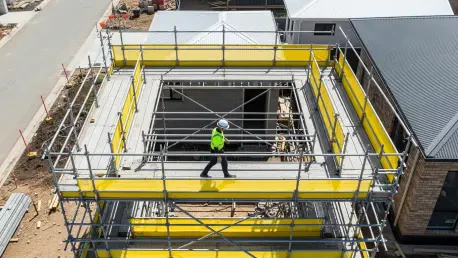
This specific regulatory adjustment creates a massive ripple effect for single-story residential builders who previously functioned within a window that did not necessitate intensive scaffolding or perimeter protection. Under the old rules, many residential projects could proceed with minimal height safety infrastructure, but the new two-meter rule brings the vast majority of single-story construction activities under the umbrella of high-risk work. Consequently, the reliance on ladders or unprotected edges has been replaced by a demand for robust, engineered scaffolding systems that ensure continuous protection. This shift requires a fundamental reassessment of site logistics, as the physical footprint of safety equipment now competes for space on increasingly dense residential lots. Builders must now integrate these safety requirements into their initial site plans to avoid costly delays and potential fines, marking a transition toward a structured approach.
Statistical Evidence: Analyzing the Frequency of Falls
Statistical evidence provided by SafeWork SA and ReturnToWorkSA serves as the primary justification for this legislative pivot, highlighting a glaring discrepancy in previous safety protocols. Analysis of historical incident data revealed that a staggering 68 percent of all recorded falls occurring from heights above two meters actually took place within the specific two-to-three-meter range. This range was previously a regulatory blind spot where physical protection was not always mandatory, yet it was precisely where the majority of injuries were being sustained. By lowering the threshold, the government is targeting the specific height range that has historically been the most dangerous for tradespeople. This data-driven approach ensures that the new regulations are not just bureaucratic hurdles but are instead tailored to address the actual risks present on modern construction sites. The focus remains on closing the safety gap that allowed preventable accidents to occur far too frequently.
Economic Accountability: Mitigating the Financial Burden
Beyond the human toll, the financial impact of fall-related incidents on the South Australian construction sector has been immense, necessitating a more rigorous economic perspective on safety. Since the 2016 financial year, the industry has contended with 1,585 compensation claims related to falls from height, leading to total costs that exceed $64 million in payouts and associated expenses. These figures do not even account for the lost productivity, project delays, and administrative burdens that follow a serious workplace injury. By implementing the new mandate, the state aims to mitigate this financial drain on the building industry while reducing the long-term insurance premiums that affect all contractors. The reduction in the fall height threshold is therefore seen as a strategic investment in the industry’s economic stability. Transitioning to higher safety standards is expected to pay dividends by creating a more resilient workforce and reducing the litigation cycles.
Navigating the Financial and Logistical Landscape
Operational Pressure: Adapting to Market Realities
South Australian builders are currently facing a convergence of challenges that make the implementation of new safety rules particularly complex to manage. The industry is navigating significant economic headwinds, characterized by persistent labor shortages, high inflation for raw materials, and an intense demand for new housing stock. These factors have created a pressurized environment where independent and volume builders must balance the need for speed with the necessity of strict compliance. In light of the latest state budget, which prioritizes the rapid delivery of new homes to address regional shortages, contractors are tasked with integrating the added costs of fall protection without compromising their project timelines. The logistical burden of coordinating scaffolding deliveries and professional installations adds another layer of complexity to an already crowded construction schedule. Successfully managing these variables requires a sophisticated understanding of both site economics.
Strategic Logistics: Establishing Localized Resource Hubs
To assist local builders in navigating this transition, significant investments have been made in regional infrastructure to ensure the availability of safety equipment. Buildsafe has established an expansive operational hub in Lewiston, providing a critical logistical link for construction sites across South Australia. Located strategically on Boundary Road, this facility functions as a centralized distribution point, ensuring that both urban and regional builders have immediate access to the scaffolding and fall protection systems required by the new laws. The proximity of this hub to major growth corridors reduces lead times and transportation costs, which are essential factors in maintaining project momentum. By positioning resources closer to the points of demand, the industry can better manage the surge in requirements for physical protection. This localized approach is vital for ensuring that the new safety rules do not become a bottleneck for the state’s ambitious housing targets.
Structural Excellence: Load-Bearing Scaffolding Requirements
Modern safety management in South Australia has evolved far beyond the simple delivery of equipment, now requiring high-level engineering and specialized infrastructure. The scaffolding systems currently being deployed to meet the new two-meter standards are engineered for high-capacity loads, capable of supporting up to 675 kilograms per bay. This robust design is necessary to accommodate the heavy demands of contemporary construction trades, including bricklayers, roofers, and cladding installers who often require significant material storage on working platforms. Every installation must be backed by professional engineering sign-offs, ensuring that the fall protection systems meet the rigorous structural standards now required for even the most basic residential builds. This focus on structural integrity ensures that safety measures are not just present, but are actually capable of performing under real-world conditions. This level of professional engineering elevates the entire industry.
Digital Governance: Automating Safety Documentation
Digital integration is playing an increasingly vital role in helping South Australian builders manage the administrative complexities introduced by the new regulations. Proprietary technology solutions, such as the BuildCam system, allow site managers to perform real-time monitoring of safety conditions without needing to be physically present on every lot. This remote oversight is crucial for volume builders who may have dozens of active sites across the state at any given time. These digital tools provide a continuous stream of data, allowing for the early identification of potential safety breaches before they result in accidents. Additionally, specialized compliance services assist in the generation of mandatory Safe Work Method Statements and engineering documentation, which are now required for all work above the two-meter threshold. By automating these processes, builders can significantly reduce the manual workload associated with safety compliance. This digital transition ensures that documentation is accurate.
Industry Transformation and Strategic Next Steps
Professional Evolution: Integrating Safety into Workflows
The transition toward the two-meter fall rule reflected a broader trend toward the professionalization of the South Australian construction industry. By treating safety as an integrated component of the building process rather than a mere regulatory hurdle, companies aimed to create a more sustainable and secure environment for the entire workforce. This evolution ensured that as the state continued to expand its residential footprint, the physical well-being of the tradespeople on the ground remained the primary priority. Builders who embraced these changes early found themselves better positioned to manage the logistical and financial shifts that accompanied the new regulations. They moved away from reactive site management and toward a proactive model where safety was engineered into the project from day one. This shift not only protected workers but also stabilized the industry against the rising costs of compensation and legal disputes. The initial friction eventually gave way to a new standard.
Proactive Compliance: Actionable Roadmaps for Contractors
Moving forward, the industry learned that success under the new framework required a commitment to continuous education and the adoption of collaborative safety models. Contractors sought out specialized partners who offered not just equipment, but a full suite of compliance and engineering services to mitigate risk. They also invested in digital training programs to ensure that every worker was fully aware of the new two-meter threshold and the technical requirements for site access. To maintain this momentum, builders were encouraged to conduct regular audits of their safety protocols and to integrate the costs of physical protection into their initial bidding processes. By standardizing these practices, the industry successfully reduced the incidence of serious falls and established a more predictable economic environment for residential development. The proactive steps taken during this period provided a clear roadmap for navigating future regulatory changes, ensuring the sector remained safe.