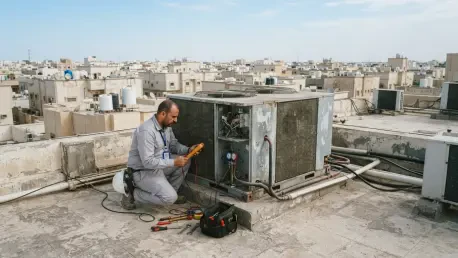

Developing a rigorous thermal fingerprint for each building is essential for the effective calibration of physics-informed HVAC management systems. In the sprawling urban landscape of Jeddah, Saudi Arabia, the intersection of extreme humidity and soaring temperatures defines the daily energy landscape. This environment necessitates a heavy reliance on residential air conditioning, which currently accounts for more than seventy percent of total household electricity consumption during peak summer months. As households operate multiple cooling units simultaneously, the strain on the local electrical grid becomes severe, leading to potential instability and increased maintenance costs for utility providers. Furthermore, the economic structure of electricity pricing in the region imposes a significant burden on high-volume consumers, with costs jumping by sixty-seven percent once a household surpasses the second-tier tariff threshold of six thousand kilowatt-hours. To address these interconnected challenges, the implementation of sophisticated coordination frameworks has become a priority for modern energy researchers looking to harmonize human comfort with infrastructure stability and financial feasibility.
Innovative Frameworks for Smart Thermal Management
Physics-Informed Neural Networks: System Design
The integration of physics-informed neural networks into HVAC control represents a major technological leap beyond traditional, physics-blind reinforcement learning models. By embedding fundamental heat-balance equations directly into the reward function of the learning agent, the system develops an intrinsic understanding of thermal dynamics. This approach ensures the AI recognizes how heat is conducted through various building materials and how internal heat sources, such as lighting and kitchen appliances, influence room temperature over time. Unlike older models that might suggest cooling strategies that violate physical laws, this “soft constraint” methodology penalizes the system if its temperature predictions deviate from reality. This ensures that the resulting policies are not only efficient but also physically grounded and reliable for long-term residential use. This level of sophistication allows the system to maintain indoor comfort with unprecedented precision while operating within the complex constraints of a modern energy grid and varying external weather patterns.
Beyond the physical accuracy, the Physics-Informed Proximal Policy Optimization (PI-PPO) framework offers a significant computational advantage for real-world deployment. The system creates what is known as a stationary policy, meaning it learns a robust set of operational rules during the training phase that remain effective throughout an entire season. Once the training is complete, the AI can make complex cooling decisions in under a millisecond using standard hardware found in typical smart home hubs. This eliminates the need for the heavy, real-time recalculations required by older model-predictive control systems, which often demand high-end server support to function effectively. Because the logic is pre-calculated into a streamlined mapping from sensor data to action, the system is perfectly suited for low-power edge devices. This efficiency makes it possible to deploy advanced, AI-driven energy management across a vast range of residential properties without requiring expensive infrastructure upgrades for the individual homeowner.
Simulation Methodology: Performance Benchmarking
To validate the effectiveness of this AI, researchers utilized a lumped-parameter thermal simulation designed to model the specific environmental conditions found in coastal Saudi Arabia. This modeling approach treats building components as thermal resistors and stores heat as capacitors, effectively capturing the intricate thermal coupling that occurs between different rooms. For instance, cooling one bedroom inherently impacts the temperature of an adjacent hallway through shared internal walls, a factor that simple thermostats often ignore. The simulation analyzed two primary structures: a five-zone villa and a larger twenty-zone residential compound, ensuring that the findings were applicable to different housing scales. By running these models through representative months, including the extreme heat of July and the milder conditions of January, the researchers gathered a comprehensive dataset on how the AI handles seasonal volatility while maintaining a consistent and comfortable indoor climate.
The AI framework underwent rigorous benchmarking against standard industry controls to determine its relative efficiency and reliability. These benchmarks included basic hysteretic thermostats, which operate on simple on-off logic, and traditional scheduling algorithms that attempt to stagger cooling cycles without predictive intelligence. The results demonstrated that while standard reinforcement learning models often struggle with “unphysical” behaviors or high computational costs, the physics-informed approach maintained a steady performance profile regardless of the complexity of the building layout. By accurately reflecting the thermal coupling and seasonal shifts of Jeddah’s climate, the simulation proved that a coordinated AI strategy could effectively manage the cooling load without the erratic cycling that often leads to premature equipment wear. This methodological rigor provides a clear pathway for transitioning these AI models from virtual environments into the actual smart home ecosystems that define the current urban landscape.
Analyzing Energy Savings and Tariff Benefits
Coordination Constraints: Peak Summer Heat
A critical realization from the research is that environmental factors strictly limit the potential for energy coordination during periods of extreme thermal saturation. In the peak heat of July, the outdoor temperature and humidity are so intense that residential air conditioning units must run almost continuously to keep indoor spaces within a standard comfort band. In this scenario, the “thermal slack” within the system effectively disappears, leaving the AI with very few opportunities to stagger power usage without causing an immediate rise in room temperature. Consequently, the actual energy savings achieved during these peak months are modest, ranging from approximately one to four percent. However, even these small reductions are vital for grid management. By preventing the simultaneous activation of every compressor in a large compound, the AI acts as a sophisticated stabilizer that reduces the risk of localized brownouts and eases the burden on the electrical distribution infrastructure.
While the volumetric savings during the height of summer may seem limited, the strategic value of coordination remains high for the overall health of the utility network. Without an intelligent coordinator, residential neighborhoods experience massive, uncoordinated power spikes that force utility providers to maintain expensive, high-capacity standby plants. The PI-PPO system mitigates these spikes by ensuring that cooling units are activated in a sequence that respects the total power limit of the building. Even if the total kilowatt-hours consumed do not drop dramatically, the “smoothness” of the demand curve is significantly improved. This type of demand-side management is increasingly important as urban populations grow and the existing grid faces the dual challenges of higher temperatures and increasing density. The research underscores that in extreme climates, the primary role of AI-driven HVAC coordination is often as much about structural resilience as it is about individual household energy conservation.
Financial Gains: Leveraging Comfort Flexibility
The most substantial financial benefits for residents occur when there is a synergy between comfort flexibility and the specific structure of the local electricity tariff. When the acceptable temperature range was expanded from a narrow two-degree band to a four-degree band, the savings potential increased dramatically. This wider range provides the AI with the temporal window it needs to keep specific cooling units offline for longer periods without violating the occupant’s comfort preferences. By exploiting this thermal inertia, the system can more effectively stagger the operation of multiple units to keep the total household demand below critical thresholds. This flexibility is essential for navigating the complex pricing tiers where a small reduction in total energy volume can lead to a disproportionately large reduction in the monthly utility bill, particularly for larger villas with high cooling requirements.
The economic leverage provided by the system is rooted in its awareness of the Saudi two-tier tariff system, which imposes heavy penalties on consumption exceeding six thousand kilowatt-hours. By “shaving” the peak demand and utilizing the building’s thermal mass to shift consumption patterns, the AI provides a financial benefit that far outweighs the actual volume of electricity saved. In the July simulations, this intelligent management allowed some households to avoid the expensive second-tier pricing bracket entirely, resulting in significant cost reductions that would be impossible with a standard thermostat. This highlights that the AI serves as an essential economic tool, allowing residents to benefit from market-aware cooling strategies without having to manually monitor their meters. As electricity prices continue to evolve, the ability of physics-informed systems to adapt to tariff changes will remain a cornerstone of sustainable and affordable residential living in the region.
Scalability and Future Implementation Challenges
Residential Compounds: Scalability at Volume
Scaling the PI-PPO framework from a single-family villa to a twenty-zone residential compound demonstrated that the complexity of coordination increases alongside the potential for grid-level impact. In larger structures, the likelihood of consistently operating within the higher price brackets is much greater, making the AI’s ability to prioritize demand thresholds even more valuable for property managers. The research showed that while more zones create more variables to manage, the stationary nature of the learned policy allows the system to scale without a linear increase in computational overhead. This is a vital finding for the future of smart cities, where massive apartment blocks and compounds require centralized but efficient energy management. The AI’s capability to handle multi-zone interactions and shared thermal boundaries ensures that cooling one part of a large building does not inadvertently lead to energy waste in another.
The deployment of these systems in large-scale residential environments also highlights the benefits of edge computing and low-power hardware compatibility. Because the learned policy does not require constant connection to a centralized cloud server for basic decision-making, it is more resilient to local network outages and provides better data privacy for residents. This local processing capability allows the system to react instantly to sensor data, ensuring that cooling is delivered exactly when and where it is needed. As the focus of energy policy shifts toward decentralized management, the ability to deploy sophisticated AI on simple, localized hubs will be a key differentiator in the adoption of smart home technology. The research confirmed that the PI-PPO framework is robust enough to handle the increased complexity of large compounds while remaining efficient enough for widespread commercial use in existing residential infrastructure.
Future Directions: Drivers and Systemic Limitations
The final analysis of the research identified the primary drivers of efficiency while also acknowledging the systemic limitations that current models must overcome. A “waterfall analysis” revealed that the single most powerful lever for energy savings remains the relaxation of occupant comfort settings, with the AI acting as the critical enabler that allows residents to exploit this flexibility automatically. However, the study also noted that current simulations do not fully account for humidity dynamics or high-frequency radiative heat transfer, which are significant factors in coastal environments. These elements can drastically affect the perceived temperature and the actual energy required to maintain comfort. Addressing these gaps will require more complex sensors and a deeper integration of environmental data into the neural network’s training phase to ensure the system remains effective in the face of increasingly volatile weather patterns.
Future developments for the PI-PPO framework established a clear path toward integrating renewable energy sources and enhancing operational safety. The research team suggested that the next iteration of the system should include logic for managing solar photovoltaic generation, allowing households to synchronize their heaviest cooling loads with periods of peak solar production. This would further reduce the reliance on the national grid and maximize the financial return on green energy investments. Additionally, the implementation of formal safety guarantees was identified as a necessary step to ensure that indoor temperatures never exit the desired comfort zone during the AI’s initial learning phase. By focusing on these actionable improvements, the study provided a realistic template for the next generation of climate-aware energy management systems that are expected to play a central role in the transition toward smarter, more sustainable urban infrastructures.