
The physical evolution of a university campus often mirrors the growth of its intellectual ambitions, transforming from a simple backdrop of brick and mortar into a dynamic environment that fosters discovery and community. For over twenty-five years, the spatial identity of Duke University has been meticulously crafted under the steady hand of Mark Hough, the institution’s inaugural University Landscape Architect, who is now concluding a career defined by visionary stewardship. Since the late 1990s, he has overseen the development and restoration of more than 130 acres, moving beyond mere aesthetic improvements to create a cohesive landscape that meets the rigorous demands of a leading research institution. His work signifies a profound transition where the outdoor environment is no longer treated as secondary to the architecture but as an essential component of the educational mission. As he prepares for retirement, the campus stands as a testament to the power of long-term vision in shaping how thousands of people interact with nature and history daily.
Professional Background and Design Philosophy
Stewardship and Foundational Philosophy
Mark Hough’s professional trajectory was significantly influenced by his academic foundation at North Carolina State University, where he began to appreciate the complex relationship between designed environments and public utility. This perspective was further sharpened during his formative tenure at the Central Park Conservancy in New York City, a world-renowned laboratory for urban landscape management and restoration. Working within such a high-traffic, historic setting taught him that a landscape’s success is measured by its resilience and its ability to serve a diverse population over many decades. It was here that he embraced the concept of stewardship, a principle that prioritizes the long-term health and maintenance of a site over the fleeting allure of contemporary design trends. This experience prepared him to view the Duke campus not as a collection of static monuments but as a living organism that requires constant care and strategic intervention to remain both beautiful and functional for future generations.
Central to his philosophy was the belief that stewardship should never be confused with a rigid, stagnant form of protectionism that prevents necessary changes to meet modern institutional goals. Instead of viewing historical landscapes as untouchable museum pieces, he utilized historical precedents to inform a smart, modern evolution that respected the past while addressing the contemporary needs of students and faculty. This approach allowed for the integration of new technologies and social patterns without eroding the classic character that defines the university’s prestige. By advocating for a balance between preservation and progress, he ensured that the physical grounds could adapt to the changing pressures of campus life, including increased density and evolving pedagogical styles. His methodology proved that a landscape can be deeply rooted in tradition while simultaneously serving as a high-performing platform for modern research and social interaction, demonstrating that true stewardship involves the courage to change when it serves the greater mission.
Restoring Tradition and Community Hubs
When the restoration efforts began in the early years of the new millennium, many of the university’s historic quads were struggling with the physical toll of decades of heavy use and inconsistent maintenance. These central academic areas, which are the heart of the undergraduate experience, had lost much of their original horticultural luster, leaving behind spaces that felt more like transit zones than destination points. Hough recognized that these quads were essential to the university’s brand and student morale, prompting a comprehensive initiative to restore their dignity and functional utility. By analyzing archival photos and original design intents, he sought to recapture the lushness and order that had defined the campus in its earliest days. This was not merely an exercise in nostalgia; it was a strategic effort to reclaim the outdoors as a vital part of the learning environment. The restoration process involved complex soil remediation, the selection of durable plant species, and the installation of infrastructure capable of supporting modern events without damaging the soil.
Beyond the restoration of traditional spaces, Hough emerged as a pioneer in the concept of social placemaking, a strategy that prioritizes human interaction over purely utilitarian or ornamental infrastructure. This shift is most visible in the radical transformation of the Bryan Center Plaza and Crown Commons, areas that were once dominated by stark, uninviting concrete surfaces and rigid layouts. Recognizing that students needed more flexible environments to relax and congregate, he led the effort to replace these harsh materials with vibrant green lawns, groves of trees, and an array of comfortable, movable seating options. These renovations effectively softened the hard edges of the campus core, turning cold transit corridors into warm, inviting outdoor “living rooms.” By focusing on the human scale, he created zones that invite people to linger rather than just pass through, acknowledging that some of the most significant learning on a campus happens outside the classroom in the unplanned meetings between peers from different disciplines.
Environmental Innovation and Strategic Legacy
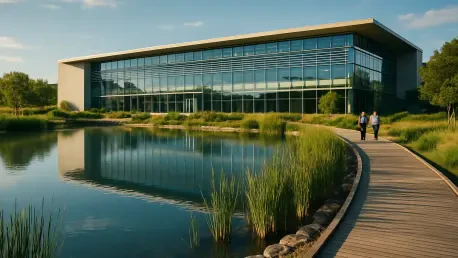
Perhaps the most significant achievement of Hough’s tenure is the creation of the Duke Pond, a five-acre site that has gained national recognition as a model for sustainable “green infrastructure.” This area was once a neglected and often overlooked swampland that served little purpose beyond basic drainage, yet Hough envisioned it as a dual-purpose asset that could solve environmental challenges while providing a stunning new amenity. The project involved a massive reconfiguration of the landscape to capture and naturally filter stormwater runoff from nearly a quarter of the entire campus, preventing pollutants from entering local watersheds. This focus on performance over mere decoration represents a sophisticated evolution in landscape design, where every element of the site is engineered to provide tangible ecological benefits. By integrating sophisticated engineering with natural beauty, the project demonstrated that industrial-scale environmental solutions do not have to be hidden behind fences but can instead be celebrated as beautiful parts of the public realm.
The university community worked to ensure the continued evolution of these social hubs, adapting them to the shifting demographics and collaborative needs of a new generation of students. The successful integration of technology into outdoor learning spaces and the expansion of inclusive design principles remained essential priorities throughout the recent leadership transition. Hough’s career concluded with a portfolio that transformed the campus into a resilient ecosystem where sustainability and beauty were inseparable, and the ongoing maintenance of this legacy required a persistent institutional commitment to quality. Stakeholders worked to expand these placemaking principles to secondary campus zones, ensuring that every acre provided opportunities for engagement and environmental stewardship. By viewing the landscape as a dynamic asset, the university honored the groundwork laid over the past years. This transition provided an ideal moment to audit existing resources and set ambitious new goals for carbon neutrality and site-specific ecological restoration.