
James Rose remains one of the most enigmatic figures in the history of environmental design, often referred to as the James Dean of landscape architecture for his persistent refusal to follow established conventions or bureaucratic rules. While his contemporaries often sought to impose a rigid order on the natural world, Rose viewed the landscape as a dynamic, unfolding narrative that required a deeply personal and experiential approach. His career was defined by a series of radical departures from the norm, starting with his famous dismissal from a prestigious university and culminating in the creation of a home that defied every standard of mid-century suburban development. By treating the built environment as a form of architectural origami, he managed to fold the exterior and interior worlds into a single, cohesive unit. This legacy is not merely a collection of gardens but a profound shift in how humans perceive their relationship with the space they inhabit, prioritizing the sensory journey over formal aesthetic perfection in a way that continues to resonate today.
Evolution of Modern Landscape Design and Spatial Theory
Breaking From Academic and Corporate Tradition
Rose’s journey toward revolutionizing his field began with a famous expulsion from Harvard’s Graduate School of Design in 1937, a moment that defined his professional identity as a rebel. He refused to adhere to the rigid, Beaux Arts style of formal watercolor renderings, insisting instead on modernistic principles that prioritized function and spatial experience over antiquated decorative traditions. This academic dismissal served as a powerful catalyst rather than a setback, leading him to collaborate with visionary peers like Garrett Eckbo and Dan Kiley. Together, they authored influential articles that challenged the prevailing status quo, effectively steering landscape architecture away from being a mere ornamental art and toward a rigorous, modern discipline. Their collaborative manifestos argued that the landscape was a three-dimensional volume of space rather than a flat plan. This radical stance forced the entire industry to reconsider the fundamental relationship between human movement and the site.
After a successful but ultimately unfulfilling stint in the corporate world of Manhattan, Rose pivoted toward a more autonomous residential practice where he could exercise greater creative control. He felt that the true medium of his craft—rocks, soil, and vegetation—was frequently lost in the bureaucracy of large-scale projects and sterile office environments. By focusing on private homes, he was able to treat the environment as a three-dimensional sculpture meant to be moved through rather than a flat backdrop to be admired from afar. This shift allowed him to experiment with the raw, physical reality of the land, laying the groundwork for his most influential theories on spatial integration and sensory engagement. He believed that the design process should be an intimate dialogue between the architect and the earth itself. Consequently, his residential work became a laboratory for testing how structural materials could blend into organic forms without losing their inherent functional utility for the resident.
Challenging Suburban Norms Through the Ridgewood Experiment
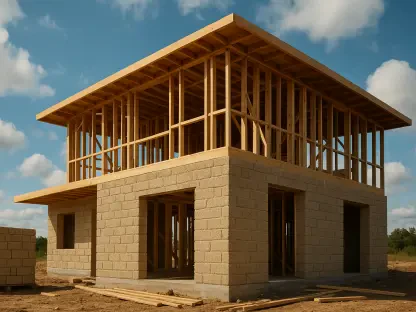
The Ridgewood residence was a direct critique of the post-war suburban development model, which Rose found unimaginative, wasteful, and socially isolating for the modern family. He despised the standard practice of centering a house on a lot, leaving a useless front lawn as a mere social trophy that served no ecological or personal function. Instead, he utilized a modest corner lot to build a small village composed of three distinct pavilions for himself, his mother, and his sister, creating a communal living environment. Using unconventional materials like cinder blocks, wood, and fiberglass, he proved that a home could be functional and beautiful without adhering to the stifling aesthetic expectations of the 1950s era. This project demonstrated that spatial luxury did not require massive acreage, but rather a sophisticated understanding of how to enclose and reveal views. His use of humble materials challenged the notion that high-quality design was reserved for the wealthy elite.
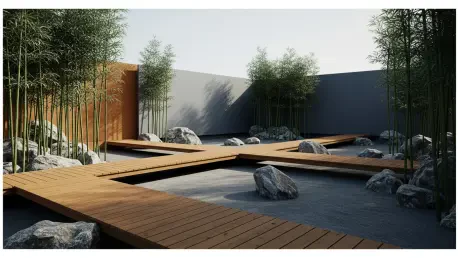
Central to the revolution of the Ridgewood site was its choreographed connective tissue, which seamlessly merged the interior with the exterior through a series of tactical interventions. Rather than acting as static barriers, the walls served as garden boundaries, creating a layout where it was difficult to tell where the building ended and the landscape began. This design realized the midcentury modern ideal of indoor-outdoor living on a profound level, turning the entire property into a series of interconnected courtyards and meditation spaces. The result was a spatial experience that felt expansive despite the limited footprint of the lot, demonstrating that thoughtful design could transcend physical constraints. By treating the garden as a roofless room, Rose expanded the living area of the home into the natural world, creating a sanctuary that felt both private and open. This fluidity allowed the changing light and seasons to become an active part of the daily domestic experience.
Establishing a Living Legacy of Sustainable Improvisation
Rose’s philosophy was defined by a rejection of the finished product, a state he famously equated with death because it lacked the potential for growth. He viewed architecture as a continuous metamorphosis, believing that a site should evolve alongside its inhabitants through constant improvisation and structural adjustment. This was evident in his refusal to import decorative materials, choosing instead to work with the rocks already present on the site to maintain an authentic connection to the local geology. His willingness to modify his own home over several decades, including the addition of a roof deck and a Buddha garden, reflected his belief that a landscape is a living organism rather than a static monument. By avoiding static blueprints, he allowed the site to dictate its own development, ensuring that the design remained relevant to the changing needs of the residents. This approach celebrated the beauty of imperfection and the passage of time as essential components of the narrative.
The architectural community eventually integrated Rose’s defiant principles into a standard framework for sustainable and flexible urban design. By adopting his methods of site-specific improvisation, developers solved the problem of rigid, inefficient land use in high-density areas. Practitioners recognized that the separation between interior shelter and outdoor space was an artificial barrier that limited human well-being and ecological health. The James Rose Center preserved his Ridgewood site as a functional laboratory, providing actionable insights into how recycled materials and native plantings could reduce maintenance costs. This transition allowed modern designers to move away from the static landscape models toward more resilient, changing environments. The success of these integrated sites proved that a home could function as an ecosystem rather than a detached object. Ultimately, Rose’s work provided the blueprint for a future where the built environment lives in a state of dialogue.