
Integrated pultrusion and pullwinding machines enable the high-volume production of hybrid composite bolts that can withstand the chemical demands of tunnel environments. As the global engineering community pushes for infrastructure that lasts over a century, the limitations of traditional materials like carbon steel have become increasingly apparent. In the massive Rogfast project in Norway, which spans 27 kilometers and reaches depths of 392 meters below sea level, the durability of every single fastening component is critical. Traditional steel bolts, while providing high initial strength, are inherently vulnerable to the saline-rich, humid conditions of subsea tunnels. These environments trigger rapid oxidation and corrosion, often limiting the functional life of steel reinforcements to a few decades. In contrast, the emergence of advanced polymer composites offers a paradigm shift in civil engineering, providing a corrosion-free alternative that aligns with the 120-year service life required for modern subterranean arteries.
The transition toward sustainable tunneling is not merely about material longevity but also encompasses the logistical and environmental costs of construction. Moving away from heavy steel components toward lightweight composite systems like BasaBolt significantly reduces the physiological strain on installation crews and the energy required for transport. By utilizing hybrid basalt and glass fiber reinforcements, manufacturers can achieve mechanical properties that exceed those of steel while maintaining a much lower carbon footprint. This evolution is supported by the integration of low-emission resin systems, such as the Litestone epoxy series, which utilize mass-balanced feedstocks to lower the overall environmental product declaration of the system. As tunneling projects grow in ambition and scale throughout 2026 and beyond, these composite innovations are proving essential for meeting rigorous climate targets and reducing long-term maintenance cycles that otherwise paralyze transport networks.
1. Insert Specialized Fixing Plugs: Preparing the Substrate
The initial phase of tunnel reinforcement begins immediately after the “drill and blast” excavation process has cleared a new section of the rock face. Once the primary rock structure is stabilized with a foundational layer of shotcrete—often reinforced with chopped fibers to manage early-stage settlement—the installation team identifies precise anchor points along the tunnel arch. Using automated drilling rigs, specialized fixing plugs or rock bolts are driven into the geological substrate at standardized 1.2-meter intervals. This grid pattern is essential for providing a uniform distribution of load across the entire inner surface of the tunnel. The precision of this spacing ensures that subsequent layers of waterproofing and structural reinforcement can be applied without gaps or mechanical weaknesses that might lead to localized failures under the immense hydrostatic pressure found in deep-sea environments.
In high-performance tunneling, these anchoring points serve as the primary mechanical link between the raw rock and the finished interior vault. By utilizing composite-compatible plugs, engineers eliminate the risk of galvanic corrosion that often occurs when dissimilar metals meet in moist conditions. The selection of the anchoring depth and the resin-based bonding agents used to secure these plugs are determined by the specific geological characteristics of the Norwegian or Scandinavian bedrock. As these plugs are set, they create a reliable matrix of attachment points that will eventually support the entire weight of the waterproofing membrane and the secondary concrete lining. This systematic preparation is a prerequisite for moving away from traditional heavy-duty steel fixtures, allowing the project to proceed with a lightweight, high-strength composite framework that drastically improves the efficiency of the following installation stages.
2. Position the Waterproof Liner: Establishing the Barrier
Once the anchor points are secured, the focus shifts to the installation of the polymer waterproofing membrane, which is arguably the most critical component for protecting the tunnel against water ingress and frost damage. In modern projects like the Sandoy or Eysturoy tunnels, these membranes are delivered in massive rolls, often exceeding four meters in width, to minimize the number of seams required during installation. These sheets are pre-cut to match the dimensions of the tunnel vault and are carefully draped over the installed bolts by specialized crews using hydraulic lift platforms. The move toward white membranes rather than traditional black materials has significantly improved safety and precision, as the lighter surface reflects the limited tunnel lighting, allowing technicians to spot imperfections or misalignments more effectively during the hanging process.
The positioning of this liner is a delicate operation that requires precise alignment with the pre-drilled bolt grid. The membrane must sit flush against the primary shotcrete layer to prevent the formation of air pockets or water channels that could undermine the structural integrity of the final vault. Because the BasaBolt system uses lightweight composite materials, the entire handling process is more ergonomic for the workers, who must manage thousands of square meters of material in confined, often cold subterranean spaces. This barrier is designed not just to keep water out, but to protect the internal structural elements from the corrosive effects of salt and mineral-rich groundwater. By establishing this continuous shield, engineers ensure that the interior climate of the tunnel remains stable, which is vital for preventing the freeze-thaw cycles that can rapidly degrade concrete and mechanical equipment over time.
3. Attach the First Set of Securing Washers: Anchoring the System
To secure the draped membrane against the tunnel wall, the installation team utilizes a series of thermoplastic fixing disks that function as high-performance washers. These disks are the first components in the assembly to interact directly with the bolt and the liner, creating the initial mechanical bond that keeps the waterproofing system in place. Unlike traditional steel washers, which are heavy and prone to early-stage rust at the point of penetration, these polymer disks are designed to be completely corrosion-resistant. They are injection-molded from engineering-grade plastics that maintain their structural integrity even under constant pressure. The geometry of these washers is optimized to distribute the clamping force over a wide area of the membrane, preventing tears or stresses that could compromise the watertight seal at the entry point of the bolt.
The replacement of steel with thermoplastic washers represented one of the first major steps in the industry’s shift toward fully composite fastening systems. By using two washers for each bolt—one on either side of the membrane—the BasaBolt system ensures that the point where the bolt pierces the liner is effectively sealed against moisture. This dual-washer configuration creates a “sandwich” effect that prevents water from migrating along the bolt shaft and reaching the internal concrete layers. Furthermore, the use of recycled ocean plastics or in-house recycled polymers in the production of these disks aligns with the broader sustainability goals of modern infrastructure projects. These components are not only more durable than their metallic predecessors but also contribute to a lower overall environmental impact, proving that even small mechanical parts play a significant role in the greening of the construction industry.
4. Seal the Membrane Joints: Creating a Monolithic Shield
With the individual sheets of the polymer membrane securely pinned by the initial washers, the construction team must address the overlaps between adjacent rolls to ensure a continuous moisture barrier. This is achieved through advanced thermal welding techniques, where the edges of the sheets are fused together using hot-plate or hot-air welding equipment. The goal is to create a monolithic shield that covers the entire length of the tunnel without a single point of failure. This process requires a high degree of skill and environmental control, as the quality of the weld is dependent on consistent temperature and pressure. The white color of the membrane once again proves beneficial here, as it allows inspectors to more easily identify the quality of the weld line and ensure that the fusion is complete and uniform across the entire overlap.
The integrity of these seams is what ultimately determines the success of the waterproofing strategy. In the rough conditions of the Rogfast or Faroe Islands projects, the membranes must withstand significant hydrostatic loads as groundwater attempts to penetrate the vault. Thermal welding creates a bond that is often stronger than the base material itself, ensuring that the joints do not pull apart during the secondary concrete application or as the mountain shifts over time. By moving away from mechanical adhesives or tapes, which can degrade over decades, the tunneling industry has adopted a solution that matches the century-plus life expectancy of the composite bolts. This cohesive barrier is essential for maintaining the dry, stable environment required for modern traffic and high-speed rail systems, reducing the need for costly emergency repairs and tunnel closures that disrupt regional transportation.
5. Verify the Integrity of the Seams: Ensuring Long-Term Durability
Following the completion of the thermal welding process, every centimeter of the joined membrane must undergo rigorous testing to verify its integrity. Construction teams employ specialized pressure-testing equipment that injects air into the gaps between the dual-weld seams, monitoring for any drop in pressure that would indicate a leak. This quality assurance step is non-negotiable in subsea tunneling, where a minor defect could lead to significant water ingress hundreds of meters below sea level. The testing protocol ensures that the waterproofing system is a “closed” environment before any additional structural layers are added. By identifying and repairing potential leaks at this stage, engineers prevent the long-term degradation of the internal concrete vault and the mechanical systems that will eventually be installed within the tunnel.
This verification process is also a critical component of the environmental product declaration and the overall safety certification of the project. A perfectly sealed membrane ensures that the chemical resistance of the composite bolts and the structural integrity of the final shotcrete layer are not compromised by groundwater exposure. In the past, the failure of steel-based systems was often accelerated by undetected leaks that allowed salt-rich water to reach the metal reinforcements, leading to hidden corrosion. The combination of composite components and verifiable thermal welds eliminates this risk, providing a high degree of confidence in the 120-year design life of the system. This proactive approach to maintenance—addressing potential failures before they are buried under tons of concrete—is a hallmark of the sophisticated engineering standards practiced in Scandinavia and throughout the modern global tunneling industry.
6. Mount the Distance-Keeping Wheels: Managing Structural Geometry
To prepare for the final structural layers, the installation team must maintain a precise gap between the waterproofing membrane and the upcoming reinforcement grid. This is accomplished by mounting twelve-sided spacer wheels, also known as distance keepers, onto the protruding ends of the composite bolts. These wheels are injection-molded from recycled thermoplastic polymers and are designed to provide a stable, consistent standoff distance across the entire arch of the tunnel. Their multi-sided geometry prevents them from rolling or shifting during the application of the secondary shotcrete layer, ensuring that the reinforcement mesh remains perfectly centered within the concrete vault. This geometric precision is vital for maximizing the structural efficiency of the lining and ensuring that the load is distributed evenly across the rock anchors.
The use of recycled materials for these spacers underscores the commitment of manufacturers like Oldroyd to zero-waste production. By utilizing in-house recycling systems and adaptive process control in their injection molding machines, they can turn manufacturing waste back into high-performance structural components. These spacer wheels must be robust enough to support the weight of the rebar mesh and the initial impact of the high-velocity shotcrete spray without deforming. Because they are made from the same families of polymers as the fixing disks and the membrane, they are naturally resistant to the alkaline environment of the wet concrete. This material compatibility ensures that the spacers do not create “weak points” or paths for moisture to travel within the finished wall, maintaining the integrity of the moisture barrier and the structural reinforcement throughout the tunnel’s operational life.
7. Lay the Composite Reinforcement Grid: Shifting From Steel to Fiber
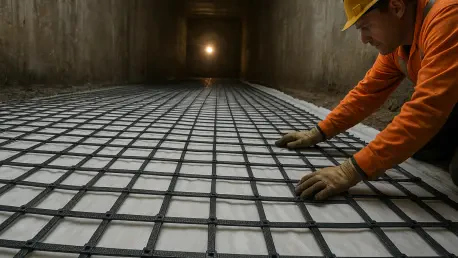
The transition from steel to composite reinforcement is perhaps most visible during the installation of the rebar mesh. In the BasaBolt system, the traditional heavy steel grids are replaced with lightweight meshes made from glass fiber-reinforced polymer or a hybrid basalt-glass fiber composite. These grids are sized to match the full width of the tunnel arch, which is a major departure from steel practices. Because steel is so heavy, workers can typically only handle small sections of mesh at a time, leading to numerous overlaps and a significant amount of wasted material. Composite mesh, however, is light enough that a single roll can cover the entire circumference of the tunnel vault, which dramatically speeds up the installation process and reduces the physical burden on the construction crew.
The material properties of these composite grids are specifically tailored for the harsh realities of subterranean environments. By utilizing basalt fibers on the outer skin of the grid, manufacturers provide a high degree of fire resistance and chemical stability, while the glass fiber core offers the necessary tensile strength at a lower cost. This hybrid construction ensures that the reinforcement is not only corrosion-proof but also capable of withstanding the thermal stresses encountered during a tunnel fire. Furthermore, the reduced weight of the composite mesh means that transport logistics are simplified; a single truck can carry three times as much composite reinforcement as it could steel, significantly lowering the carbon emissions associated with material delivery. This efficiency is a key driver for the adoption of composite systems in the massive infrastructure projects slated for the coming years.
8. Install the Weight-Bearing Cross-Piece: Distributing Structural Loads
The connection between the reinforcement mesh and the primary rock bolts is facilitated by a specialized component known as a load carrier, or weight-bearing cross-piece. This device is designed to transfer the structural loads from the final concrete lining directly to the anchors embedded in the rock. The load carrier consists of two pieces of high-strength basalt/glass hybrid composite rebar and a central nut plate made from short-fiber reinforced thermoplastic. When mounted onto the bolt, it forms a “cross” that spans across the sections of the reinforcement grid, locking the entire assembly together. This configuration is essential for managing the sheer weight of the final shotcrete layer, especially in the “crown” or the highest point of the tunnel arch where gravity exerts the most pressure.
The engineering behind the load carrier is focused on ensuring that the tensile forces are managed without the risk of brittle failure. By utilizing Olin’s Litestone epoxy resin in the production of the hybrid rebar pieces, the carrier achieves the chemical resistance and mechanical durability needed to survive decades of subterranean service. This component effectively bridges the gap between the flexible waterproofing membrane and the rigid concrete lining, providing the structural continuity required for a safe and stable tunnel vault. The move to a fully composite load-bearing system eliminates the final “weak link” in the chain of traditional tunneling, as every element from the bolt to the washer to the carrier is now immune to the corrosion that plagued earlier generations of subterranean infrastructure. This holistic approach to design ensures that the entire system ages at the same rate, matching the 120-year lifespan of the membrane.
9. Tighten the System Components: Finalizing the Mechanical Bond
The final mechanical step in the assembly process involves tightening the nut plate onto the composite bolt to lock all the components into their permanent positions. This nut plate, often injection-molded from high-strength engineering polymers, is designed to provide the necessary clamping force to keep the membrane, spacers, and reinforcement mesh securely fixed against the rock face. The threading on the composite bolts is specifically engineered to handle the torque required for a secure fit without stripping or compromising the fiber alignment of the bolt shaft. This final tightening ensures that there is no movement within the system during the high-pressure application of the secondary shotcrete layer, which is critical for maintaining the intended geometric tolerances of the tunnel lining.
The use of composite nuts and bolts represents a significant achievement in material science, as these parts must balance high tensile strength with the precision required for reliable threading. By integrating pullwinding techniques, manufacturers can add circumferential reinforcements to the pultruded bolts, which dramatically improves their resistance to the shear forces encountered during tightening and subsequent structural loading. This mechanical bond is the culmination of the entire BasaBolt installation process, creating a rigid framework that is ready to be encased in concrete. The speed at which these components can be finalized allows installation crews to cover hundreds of meters of tunnel per shift, which is a vital metric for maintaining the ambitious timelines of projects like the Rogfast link. The reliability of this final bond provides the structural assurance that the tunnel will remain safe for traffic for over a century.
10. Apply the Final Concrete Coating: Minimizing Material Intensity
The final stage of the tunneling process is the application of the secondary concrete layer, or shotcrete, over the composite reinforcement grid. In traditional steel-reinforced tunnels, a significant portion of the concrete thickness is required simply to protect the metal from environmental moisture and eventual corrosion. Because the BasaBolt composite components are inherently rust-proof, engineers can design the vault with a much thinner layer of concrete. Reducing the thickness of the vault by even one centimeter across a 500-meter section of tunnel results in a 12% reduction in concrete volume. This equates to over 225 tons of concrete saved, which significantly reduces the material costs and the carbon footprint of the project by eliminating dozens of truck deliveries and reducing the overall cement consumption.
This reduction in material intensity is one of the most compelling arguments for the adoption of composite bolts in sustainable infrastructure. Shotcrete application is a time-consuming and energy-intensive process; by requiring a thinner layer, the project can proceed faster, and the total energy consumed by the spraying equipment is reduced. Furthermore, the absence of steel eliminates the risk of “spalling,” where rusting metal expands and causes the concrete to crack and fall away. The resulting tunnel vault is not only more environmentally friendly but also safer and more durable, requiring far less maintenance over its long operational life. This synergy between advanced material science and efficient construction techniques demonstrates how composite innovations are transforming the economics and sustainability of modern tunneling, paving the way for a more resilient global transport network.
Advancing Sustainable Subterranean Infrastructure
The implementation of the BasaBolt system throughout regional infrastructure projects successfully demonstrated the viability of replacing traditional steel with high-performance composites. Engineers and contractors alike observed that the shift toward hybrid basalt and glass fiber materials addressed the long-standing challenge of corrosion in high-salinity tunnel environments. By utilizing Olin’s low-carbon resin systems, the industry reached new benchmarks for sustainability, significantly lowering the environmental impact of massive subterranean links. The integration of pultruded bolts and recycled polymer components proved that high-volume production could meet the rigorous safety and durability standards required for 120-year service lives. These advancements effectively neutralized the primary causes of structural degradation, ensuring that the new generation of tunnels remained operational with minimal maintenance requirements.
The transition toward these lightweight, corrosion-resistant systems also yielded immediate practical benefits for the workforce and the environment. Workers experienced a significant reduction in physical strain due to the lighter weight of the composite materials, which allowed for faster installation cycles and improved on-site safety. Furthermore, the ability to use thinner concrete linings resulted in a substantial decrease in CO2 emissions and material waste, aligning perfectly with global climate goals. As the industry moved forward, the lessons learned from the Rogfast and Faroe Islands projects established a new standard for infrastructure design. These successes encouraged broader adoption of composite technologies across the globe, proving that material innovation remained the most effective tool for building resilient, sustainable, and cost-effective transportation networks for the decades to come.