
While prefab construction accounts for eighty percent of the market in Sweden, the Australian sector currently sits at a mere eight percent. This staggering disparity highlights a significant opportunity for growth in a nation grappling with an acute housing shortage. As urban populations swell and traditional building methods struggle to keep pace with demand, the shift toward industrializing residential construction has become a matter of national priority. By transitioning from the artisanal, one-off approach of on-site building to the precision and scale of factory-based manufacturing, the industry aims to redefine what is possible in terms of speed and quality. The integration of advanced robotics and streamlined logistics is no longer just a theoretical concept; it is an active strategy being deployed to stabilize the market. To meet current completion targets, particularly in regions where the gap between supply and demand continues to widen, a fundamental transformation in how homes are conceived and delivered is essential.
The Automation Shift: Modscape and Robotic Precision
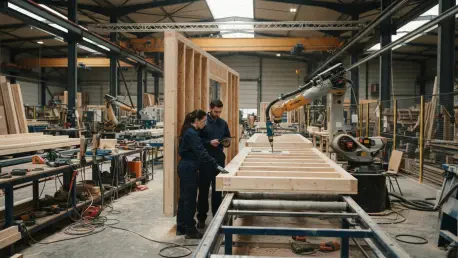
At the forefront of this technological pivot is the collaboration between Modscape and Modbotics in Melbourne, where a 120-meter robotic production line has redefined the limits of architectural manufacturing. This facility operates with a degree of precision that traditional construction sites simply cannot replicate, treating the assembly of a dwelling with the same rigor as an automotive assembly line. The primary objective of this automated system is to output a completed two-bedroom home every two hours, a feat that would take months under conventional circumstances. By utilizing high-tech robotics for structural framing and component assembly, the company effectively minimizes material waste while ensuring that every module meets exact specifications. This shift toward a factory-based product provides clients with unprecedented certainty regarding both project costs and delivery schedules, effectively shielding them from the price fluctuations and labor shortages that often derail standard builds.
The efficiency gap between conventional on-site construction and the modular model is largely driven by the ability to utilize parallel processing. In a traditional setting, weather delays and the sequential nature of trade work mean that one group of contractors must often wait for another to finish before moving forward. Conversely, the modular approach allows site preparation—such as foundation pouring and utility installation—to occur simultaneously with the fabrication of the house structure in a controlled environment. This synergy drastically compresses the project timeline, often reducing the total construction period to a window of eight to twelve weeks. Such rapid deployment is vital for meeting the housing targets in Victoria, where current completion rates have fallen short of the 61,200 homes required annually to satisfy national objectives through 2030. Without this accelerated manufacturing pace, the backlog of unbuilt homes will continue to place immense pressure on the rental market.
Building Momentum: Financial and Cultural Integration
Despite the undeniable technological advantages offered by automation, a significant cultural barrier remains a hurdle for widespread adoption across the Australian continent. While recent research indicates that roughly fifty-five percent of the population is open to the idea of factory-built homes due to lower costs and faster timelines, a large portion of potential buyers remains hesitant. This reluctance often stems from an outdated perception that prefabricated housing is synonymous with temporary or lower-quality structures, rather than the high-end architectural products being delivered today. Bridging this familiarity gap requires more than just showing off new machines; it demands a concerted effort to demonstrate the durability and aesthetic versatility of modern modular units. As more successful projects are integrated into suburban landscapes, the stigma surrounding non-traditional builds is slowly eroding, but the transition requires consistent public education and visible success stories.
Success in this sector requires a three-pronged approach involving increased factory capacity, a skilled workforce, and robust financial support. Major institutions like the Commonwealth Bank collaborated with industry bodies such as prefabAUS to standardize contracts and lending processes, ensuring that buyers could finance modular homes as easily as traditional ones. This financial integration allowed the market to stabilize and provided the necessary capital for manufacturers to scale their operations. Leaders in the field moved beyond the pilot phase and focused on establishing a sustainable ecosystem that prioritized long-term supply over short-term gains. By moving away from the inefficiency of building one home at a time, the industry embraced the scale of modern manufacturing to deliver housing at a volume previously thought impossible. Ultimately, the transition to robotic production lines provided the necessary framework for a more resilient and accessible housing market that addressed the nation’s urgent needs.