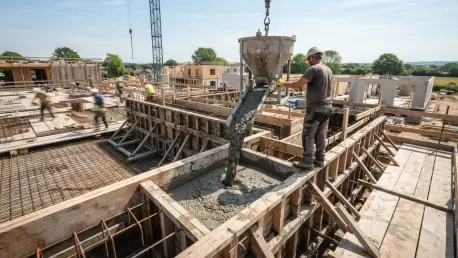

The global construction industry faces a significant environmental challenge as traditional Portland cement production releases roughly 0.87 tons of carbon dioxide for every ton manufactured. This massive carbon footprint has accelerated the search for alternative binders that can meet the rigorous demands of modern infrastructure while adhering to increasingly strict environmental regulations. Geopolymer concrete (GPC) has emerged as a primary contender in this transition, utilizing industrial byproducts like fly ash from power plants and slag from steel production to create a durable, stone-like material. Unlike conventional concrete, which relies on the hydration of calcium silicates, geopolymers are formed through the chemical activation of aluminosilicate materials with alkaline solutions. This process can reduce carbon emissions by up to eighty percent compared to traditional methods. However, the sheer complexity of the chemical reactions involved—influenced by molarity, curing temperature, and mineral composition—has historically required years of tedious trial-and-error experimentation. As the industry moves further into 2026, the integration of artificial intelligence is fundamentally changing this dynamic, offering a high-speed, data-driven approach to material design that was previously unimaginable.
Breaking the Data Barrier in Green Construction
Solving the Small Data Problem: Generative AI and CTGAN
A persistent hurdle in materials science is the scarcity of high-quality, comprehensive datasets for emerging technologies like geopolymer concrete. Machine learning models typically require thousands of data points to achieve high accuracy, but experimental results for specific fly ash compositions are often limited to a few hundred observations. To bridge this gap, researchers have implemented Conditional Tabular Generative Adversarial Networks, known as CTGAN, to augment existing experimental records. Unlike standard generative models used for images, CTGAN is specifically engineered to handle the nuances of tabular data, which include a mix of discrete categories and continuous physical measurements. By using a mode-based normalization scheme and Gaussian mixture models, the AI can learn the underlying statistical distributions of a small dataset and synthesize new, realistic observations. This process effectively expanded a base of 624 experimental results to a robust database of 744 observations, allowing the models to cover a much wider range of potential mixture designs without the immediate need for hundreds of additional physical laboratory tests.
The implementation of CTGAN does more than just increase the volume of data; it enhances the diversity of the training set, which is crucial for the model to generalize well to new, unseen scenarios. In the context of concrete design, this means the AI can better predict how a mixture might behave under unusual curing temperatures or with specific chemical ratios that were underrepresented in the original studies. The use of a training-by-sampling strategy ensures that rare but critical experimental conditions are not ignored by the model. This data-driven “stretching” of human knowledge allowed the research team to identify patterns in the geopolymerization process that are often obscured by the noise of small-scale studies. By 2026, this approach has become a cornerstone for rapid material prototyping, enabling engineers to explore the vast “design space” of sustainable concrete with a level of precision that ensures the resulting material is both reliable and environmentally superior.
Identifying the Best Predictive Algorithms: Comparing Machine Learning Paradigms
Selecting the right mathematical engine is vital for accurately predicting the compressive strength of geopolymer concrete, as different algorithms possess unique strengths and weaknesses when handling physical data. Researchers evaluated four prominent paradigms: Optimized Gaussian Process Regression (OGPR), Decision Trees, CatBoost, and Random Forest. The evaluation revealed that the performance of these models is inextricably linked to “input selection,” or the specific set of variables provided to the system. When the models were fed a comprehensive suite of data—including curing age, activator molarity, fly ash content, and aggregate distribution—their predictive power surged. Among these, CatBoost stood out as the superior performer, achieving a correlation coefficient of 0.9607. This high level of accuracy indicates that the model can predict the final strength of a concrete mix with remarkable precision, effectively serving as a virtual laboratory that pre-screens thousands of potential formulas before a single drop of water is mixed.
The study also uncovered a fascinating relationship between the type of algorithm used and the benefit derived from synthetic data. While ensemble methods like CatBoost and Random Forest saw significant boosts in accuracy and stability from the CTGAN-augmented dataset, simpler probabilistic models like OGPR actually experienced a slight decline in performance. This suggests that while data augmentation is a powerful tool, it must be paired with an architecture capable of processing complex, non-linear relationships without over-fitting to the synthetic noise. This nuance is critical for the ongoing development of AI in construction, as it highlights the necessity of a tailored approach rather than a one-size-fits-all solution. By 2026, the ability to match specific generative techniques with the most compatible predictive algorithms has become a specialized skill set within structural engineering, ensuring that the digital tools used to design our cities are as sophisticated as the materials they create.
Ensuring Transparency and Structural Safety
Moving Beyond the Black Box: Implementing SHAP Analysis
A major barrier to the widespread adoption of AI in the engineering sector is the “black box” nature of many advanced models, where the reasoning behind a prediction remains hidden from the user. To build trust among structural engineers, the research team employed SHAP (SHapley Additive exPlanations) analysis, a method rooted in cooperative game theory. SHAP allows researchers to deconstruct a model’s prediction and quantify exactly how much each input variable—such as the amount of sodium silicate or the curing duration—contributed to the final result. This transparency is not just an academic exercise; it is a safety requirement. By visualizing the impact of each ingredient, the analysis confirmed that curing age and the molarity of the alkaline activator were the most influential factors in determining strength. This perfectly aligns with the established chemical principles of geopolymerization, where longer curing times allow for a more complete formation of the aluminosilicate matrix, and higher molarity increases the alkalinity required to dissolve the raw materials.
This level of interpretability ensures that the AI is making decisions based on sound physical logic rather than coincidental statistical correlations. For example, the SHAP analysis revealed that within the ranges studied, the specific amount of sodium hydroxide had a much smaller impact on strength than the overall ratio of the activator solution to the fly ash. Such insights allow engineers to focus their optimization efforts on the variables that truly matter, streamlining the design process. Furthermore, the ability to provide an “explanation” for every predicted megapascal of strength makes it much easier to gain regulatory approval for new, AI-designed materials. In a field where the consequences of failure are catastrophic, the transition from opaque algorithms to explainable AI represents a fundamental shift toward a more responsible and scientifically grounded use of technology in the built environment.
Testing Reliability: Ensuring Safety for Real-World Infrastructure
In the world of civil engineering, a prediction that is “right on average” is not sufficient; a model must be consistently safe across all possible applications to prevent structural disasters. To address this, the researchers utilized the first-order reliability method to stress-test their models against strict engineering failure criteria. In this context, a “failure” was defined as any instance where the AI’s prediction of concrete strength deviated from the actual experimental result by more than a specific margin, such as five or ten megapascals. The study proved that the integration of CTGAN-augmented data significantly improved the “engineering robustness” of the models, effectively narrowing the distribution of errors and shifting the mean closer to zero. CatBoost, in particular, demonstrated a high reliability rate, maintaining a narrow error margin that meets the rigorous standards required for designing high-rise buildings and bridges.
This reliability assessment provides a bridge between the digital world of machine learning and the physical world of construction sites. By understanding the probability of a model being “wrong,” engineers can build in appropriate factors of safety, just as they do with physical material properties. The research highlighted that while AI can find incredibly efficient mixtures, those mixtures must still fall within a predictable “safety envelope.” The use of reliability methods ensures that as we push the boundaries of sustainable material design from 2026 to 2030, we are not introducing unforeseen risks into our infrastructure. This focus on robustness over mere accuracy marks a maturation of AI in construction, where the goal is no longer just to prove that the technology works, but to prove that it can be trusted with human lives and long-term societal investments.
Balancing Performance with Environmental Impact
Achieving the Triple Bottom Line: Maximizing Strength and Sustainability
The ultimate utility of AI in geopolymer design lies in its ability to perform multi-objective optimization, balancing the often-conflicting goals of high strength, low cost, and minimal carbon emissions. In traditional engineering, these three factors frequently work against one another: the strongest concrete typically requires the most expensive and chemically intensive activators, which in turn drive up both the price and the environmental impact. By using a specialized optimization framework, the AI can navigate this complex landscape to find the “Pareto front”—a set of optimal solutions where one factor cannot be improved without degrading another. This allows the system to identify “sweet spot” mixtures that offer near-peak structural performance while drastically reducing the ecological and financial toll of the project.
This holistic approach to design is essential for achieving the “triple bottom line” of sustainable development. The AI considers the entire chemical profile of the mix, adjusting the ratios of fine and coarse aggregates and the concentration of the alkaline liquid to find efficiencies that a human researcher might overlook. For instance, the system can identify a mixture that utilizes a specific grade of fly ash and a lower molarity activator to achieve a strength of 75 MPa at a fraction of the cost of a 80 MPa mix. This capability is transforming the role of the materials engineer from a manual tester to a strategic designer who sets high-level goals and lets the AI determine the optimal path to reach them. As we look toward the infrastructure projects of the late 2020s, this multi-dimensional optimization is the only viable way to meet global net-zero targets without compromising the quality of our built environment.
Quantifying the Gains: The Economic and Ecological Benefits of Optimization
The concrete results of this AI-driven optimization are nothing short of transformative for the green building sector. The research demonstrated that the most sustainable mixture identified by the framework could reduce carbon dioxide emissions by a staggering 63.5% compared to the highest-strength alternative. Remarkably, this massive environmental gain came with only a minor 5.8% reduction in compressive strength, still resulting in a high-performance material capable of exceeding 75 MPa. Furthermore, the optimized mix reduced material costs by 23.4%, proving that sustainable construction can be more affordable than traditional, carbon-intensive methods. These figures represent a total shift in the narrative surrounding green materials, which have long been viewed as more expensive or less capable than their conventional counterparts.
The ability of AI to act as a “digital chemist” allows for the rapid identification of these high-efficiency mixtures, bypassing years of physical testing and accelerating the adoption of low-carbon technology. By 2026, these computational tools have enabled the construction industry to begin scaling geopolymer applications from small-scale pavements to major structural elements like columns and beams. The staggering reductions in cost and carbon footprint provide a clear economic incentive for developers to choose geopolymer concrete over Portland cement. This convergence of ecological responsibility and financial viability is the primary driver behind the current revolution in material science. As the industry continues to refine these AI models, the gap between “green” and “standard” construction will continue to close, leading to a future where high-performance infrastructure no longer carries a high-carbon price tag.
Transitioning from Research to Reality
Addressing Limitations: The Path Toward Standardized Implementation
Despite the significant leaps forward provided by generative AI and explainable models, the transition from a laboratory setting to global job sites requires addressing several critical limitations. The researchers maintained a grounded perspective, noting that the synthetic data generated by CTGAN is ultimately a reflection of the original experimental studies from which it was derived. If those initial studies contained biases or lacked standardized reporting on microstructural descriptors, the AI models might inherit those gaps in knowledge. For instance, the chemical composition of fly ash can vary significantly depending on the source of the coal, and current models are only as good as the chemical data provided to them. Standardizing how experimental results are reported across the global scientific community is therefore an essential next step to ensure that AI-driven designs remain accurate across different regions.
Furthermore, while the computational results are highly promising, they represent a “digital twin” of a physical reality that still requires rigorous validation. The AI-optimized mixtures identified in the 2026 research must undergo independent laboratory testing and long-term durability assessments before they are used in critical structural components. The industry is currently moving toward a hybrid workflow where AI identifies the most promising candidates, and automated high-throughput testing verifies them in the real world. This collaborative approach between human experts and machine learning models ensures that the speed of AI is balanced by the caution of traditional engineering. By focusing on these practical hurdles, the research team has provided a roadmap for moving geopolymer concrete out of the realm of experimental curiosity and into the mainstream of the global construction market.
From Laboratory to Construction Site: Future Practical Applications
The practical implementation of AI-optimized geopolymer concrete was successfully advanced by focusing on location-specific factors and life cycle assessments. Industry leaders established a central database of material properties, which allowed the AI to adapt its recommendations based on the local availability and chemical profile of regional fly ash and slag supplies. This localized approach ensured that the cost-saving benefits of the optimization framework were realized regardless of the project’s geographic location. Regulatory bodies also played a key role by adopting the SHAP explainability framework to create new, performance-based standards for concrete mixtures, moving away from prescriptive codes that had previously mandated the use of Portland cement. This change in policy encouraged the rapid adoption of geopolymer technology in municipal infrastructure projects and large-scale commercial developments.
Actionable progress was further achieved by integrating real-time feedback loops from construction sites back into the machine learning models. As new structures were completed, data regarding the actual performance and curing behavior of the geopolymer mixes were used to refine the predictive accuracy of the algorithms. This created a self-improving system that became more reliable with every cubic yard of concrete poured. Engineers and architects were then able to use these refined tools to design buildings with a significantly lower environmental impact, meeting the urgent demands of global climate goals. The successful transition of these technologies from the research lab to the construction site proved that the combination of generative AI and rigorous engineering analysis was the key to unlocking a sustainable future for the world’s most widely used building material.