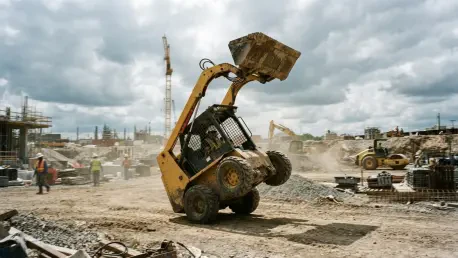

The challenge of training heavy machinery is heightened by the extreme costs and safety risks associated with physical trial-and-error testing on five-ton equipment. This technical hurdle has long relegated construction automation to simple, repetitive movements, but a recent collaboration between the Robotic Systems Lab at ETH Zurich and Intel has pushed the boundaries of what these machines can achieve. By focusing on a five-ton John Deere 332G skid-steer loader, the researchers demonstrated that artificial intelligence can master complex “stunt driving” maneuvers previously reserved for elite human operators. The machine was trained to balance and drive on its two front wheels, representing a major leap in the effort to automate heavy-duty construction equipment. This breakthrough signals a departure from rigid programming toward dynamic, intelligent control systems capable of managing the immense weight and unpredictable nature of large-scale industrial machinery in real-time scenarios.
Overcoming the Technical Barriers of Hydraulics
The Complexity: Why Is Automating Heavy Machinery Difficult?
Controlling a massive five-ton loader presents unique physical challenges that differ significantly from the operation of smaller, electric-powered robots commonly seen in research labs. Heavy construction vehicles rely almost entirely on hydraulic drivetrains, which introduce high degrees of nonlinear complexity due to the movement of internal fluids and friction within mechanical joints. Unlike the immediate response of electric motors, hydraulic systems are characterized by inherent delays between a control command and the actual physical movement of the machine. These delays, combined with the elasticity of mechanical components under heavy loads, create a level of unpredictability that makes traditional programming nearly impossible. Furthermore, real-world trial and error is far too dangerous for such large equipment, as a single failed maneuver could result in catastrophic damage or permanent mechanical failure. To address this, the researchers had to model these volatile dynamics in a digital space.
Dynamic Stability: Moving Beyond Traditional Repetitive Tasks
The ultimate goal of this research was to move beyond the automation of simple, repetitive tasks like moving dirt from one point to another. Instead, the team focused on achieving dynamic stability, which is the ability of a machine to maintain balance and control during high-intensity maneuvers. By teaching the loader to balance on its front wheels, the researchers proved that artificial intelligence can manage the machine’s immense weight and nonlinear hydraulic responses with extreme precision. This capability is essential for the future of construction, where machines must navigate unpredictable and often treacherous environments that require more than just basic locomotion. Mastering such a difficult “stunt” indicates that the AI has developed a sophisticated understanding of the machine’s physical limits. This level of control allows the equipment to perform tasks that would typically require the intuition and specialized skill of a human operator who has spent decades mastering the nuances of heavy machinery control.
A Systematic Approach to AI Training
The Methodology: How Did the AI Learn the Maneuvers?
The training methodology followed a rigorous four-step pipeline designed to bridge the gap between simulation and reality efficiently. The process began with 90 minutes of high-intensity data collection, where the researchers measured the physical properties and hydraulic responses of the actual loader. This data was then used to develop a neural network capable of predicting the machine’s motion with high accuracy, serving as the foundation for the virtual training environment. Within this digital simulation, the AI agent underwent millions of iterations, learning through reinforcement how to achieve the goal of two-wheeled balance. By using reinforcement learning, the system could explore various control strategies without the risk of damaging the physical hardware. This phase allowed the agent to refine its movements and develop a robust control policy that could handle the specific nuances of the John Deere loader’s hydraulic system before the model was ever uploaded to the physical vehicle for testing.
Bridging the Gap: Solving the Sim-to-Real Problem
To ensure the AI could perform in the messy physical world, the researchers utilized a technique known as domain randomization during the virtual training phase. This involved varying parameters such as the vehicle’s center of mass, mechanical inertia, and sensor noise levels so that the AI would not become reliant on the “perfect” conditions of a computer simulation. Furthermore, the complex task of balancing was broken down into four distinct behavioral segments: lifting the machine into position, maintaining a stable balance, maneuvering with speed and direction control, and landing safely on all four wheels. This behavioral segmentation allowed the AI to master each individual phase of the operation before attempting the full sequence. By accounting for these real-world variations during the simulation phase, the researchers successfully crossed the “sim-to-real gap,” ensuring that the policy learned in the computer would remain effective when applied to the five-ton loader, despite the inevitable differences between simulation and reality.
Testing Performance and Real-World Reliability
Precision Testing: How Well Did the Loader Perform?
During the physical trials, the loader demonstrated remarkable precision, shifting its center of mass by moving its bucket arm while simultaneously balancing on its two front wheels. The results indicated a high level of reliability, as the AI achieved a 100% success rate when the bucket arm was positioned at angles within the primary training parameters. Even when the researchers pushed the machine to extreme bucket angles of 34 degrees—exceeding what the AI had primarily practiced—the system still maintained a success rate of nearly 79%. This performance suggests that the AI-driven control system is not only accurate but also robust enough to handle conditions that push the limits of its initial training data. The machine was able to spin in place and drive both forward and backward with a level of steadiness that mirrored the movements of a human expert. These findings confirm that reinforcement learning is a viable pathway for controlling heavy machinery in ways that were previously thought to be exclusive to the most skilled and experienced operators.
Autonomous Resilience: Navigating Unseen Terrain Without Cameras
One of the most impressive feats achieved during the study was the loader’s ability to navigate a 75-centimeter-high mound of dirt while maintaining its balance on two wheels. Remarkably, the machine performed this task without the assistance of external perception sensors like LiDAR or cameras. Instead, the AI relied solely on internal data from onboard sensors, such as tilt angles and wheel speeds, to interpret the environment and adjust its movements in real time. This proved that the control system had developed a functional “intuition” regarding the machine’s physics and its interaction with the ground. Despite being trained exclusively on flat virtual surfaces, the AI-driven loader successfully managed the uneven and unpredictable terrain of the dirt mound. This resilience is a critical factor for real-world construction applications, where surfaces are rarely level and environments change constantly. The ability to maintain stability through internal feedback alone ensures the machine can continue to operate safely even if external sensors are obscured by dust or debris.
Hardware Efficiency and the Path Forward
Optimization: Low-End Hardware for High-Level Control
A significant technical takeaway from the project was the efficiency of the final control system. While the initial training phase required substantial computational power to run millions of simulations, the execution of the maneuvers on the physical loader did not require high-end specialized hardware. The researchers successfully ran the AI on a standard laptop equipped with an Intel Core i7 processor and 16 gigabytes of RAM. This suggests that advanced autonomous control can be integrated into existing construction machinery without the need for massive infrastructure upgrades or expensive, specialized onboard computers. By utilizing standard hardware, the industry can more easily adopt these intelligent systems, paving the way for widespread implementation across various types of heavy equipment. This efficiency demonstrates that the true power of the system lies in the sophisticated software architecture and the quality of the training data rather than raw processing power, making the technology more accessible for immediate deployment in current industrial contexts.
Next Steps: The Future of Autonomous Construction
The successful completion of these trials established a new baseline for what autonomous heavy machinery can achieve in complex environments. The research team proved that AI-driven systems could replicate and eventually exceed the intuition of human operators by mastering dynamic balance on a massive scale. Future development was projected to focus on the integration of external perception sensors, such as computer vision and advanced LiDAR, to allow the machine to fully “see” and interpret its surroundings. This work laid the foundation for a generation of truly intelligent vehicles capable of navigating treacherous sites, climbing onto transport trailers without ramps, and recovering from potential tip-overs automatically. By combining high-level motor skills with environmental awareness, the industry moved closer to a future of fully autonomous labor. The research demonstrated that the integration of artificial intelligence into heavy equipment was not just about efficiency, but about enhancing the safety and versatility of the machinery that builds the modern world.