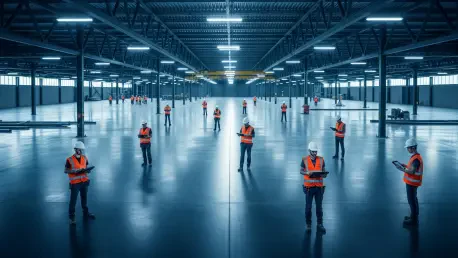

Luca Calarailli is a visionary in the construction sector, blending a deep background in architectural design with a relentless focus on the technological innovations that streamline large-scale builds. Having navigated the complexities of modern megaprojects, he understands that the difference between a profitable delivery and a contractual nightmare often hinges on the flow of information across the jobsite. In this conversation, he explores the hidden costs of communication gaps and how universal connectivity is shifting from a luxury to a logistical necessity for the modern workforce.
Large projects often see frontline workers losing significant time waiting for critical information. How does this downtime compound when communication lines are restricted?
When you have an ironworker harnessed to a steel beam two levels up, and he spots a connection that isn’t seated properly, the clock starts ticking immediately. In a high-noise environment where shouting is useless against the echo of heavy equipment, that worker is forced to unclip and climb down just to find someone with a radio. By the time he relays the issue, perhaps eleven minutes have passed, and the next beam is already swinging into place directly above the faulty connection. On a megaproject with 300 people, these individual delays are not isolated; they ripple through the entire schedule. When workers cannot self-coordinate and must route every decision up and back down a narrow chain of command, you end up losing roughly 120 hours of productivity every single shift.
Communication gaps are frequently cited as a safety risk, but how does the standard hierarchy of radio distribution actually create hazards on a 500,000-square-foot site?
The current model of giving radios only to supervisors assumes that information flows perfectly through word of mouth, which is a dangerous gamble. If dangerous weather rolls in mid-shift, a worker without a radio has no way to receive that update until someone physically tracks them down in a massive, multi-level shell. A 2025 survey highlighted that 53% of frontline workers lose at least 5% of their workday just waiting for safety-critical information. This delay in passing hazard data from person to person introduces errors at the worst possible moments, significantly increasing liability exposure. Relying on an architecture where only a handful of people are connected means that most of the crew is operating in a vacuum during an emergency.
Since the industry lost its primary communication standard over a decade ago, why have personal smartphones and traditional walkie-talkies failed to fill the void?
The loss of the Sprint Nextel iDEN network in 2013 left a massive hole in how contractors communicate, forcing a fallback to consumer smartphones that aren’t fit for the job. Most general contractors have actually started banning personal devices on active sites because they are a distraction and a security risk. Beyond that, a standard smartphone isn’t drop-rated or weatherproof enough to survive the rigors of a hyperscale data center build. We need purpose-built hardware that lacks consumer applications but offers dedicated, secure channels that can withstand the dust and noise of a site. Moving to a subscription-based model for this equipment turns a massive capital purchase into a manageable operating expense, finally making it affordable to put a device in every hand.
Modern construction crews are increasingly diverse and multilingual. How does the lack of universal communication tools exacerbate language barriers on a busy site?
It is very common today to see a workforce that speaks four or more different languages, and that diversity can lead to massive bottlenecks if the communication infrastructure is lagging. Usually, a Spanish-speaking ironworker has to find a bilingual supervisor who is already managing four other conversations just to ask a simple question to an English-speaking foreman. However, when you integrate AI translation into the comms system, those two workers can exchange vital information in real-time, each speaking their own language. This level of instant translation in high-noise environments allows for better coordination at scale without the need for a human intermediary. It turns a dozen separate subcontractor teams into a single, unified workforce with shared situational awareness.
When managing megaprojects with tight margins, how do these communication improvements translate into financial or contractual wins?
On a massive distribution center or data center project, the build schedule is incredibly aggressive, and a single day’s delay can trigger heavy contractual penalties. General contractors are operating on thin margins for coordination failure, so they are looking for anything that can compress phase timelines. When you close the communication gap, you allow different trades—electrical, mechanical, and structural—to coordinate their own sequencing without waiting for a relay from the central office. This isn’t just about being “tech-forward” for safety credit; it is a calculated move to protect the bottom line. Those who choose to maintain “radio silence” are essentially choosing a more expensive and risky way to build, as the math of a 300-person crew simply doesn’t support the old way of doing things.
What is your forecast for the evolution of jobsite connectivity over the next decade?
I believe we are moving toward a reality where “radio silence” will no longer be an acceptable management choice on any project valued over a certain threshold. Within the next ten years, universal communication devices will be as standard as hard hats and safety vests, driven by the need to integrate real-time AI data and multilingual support directly into the workflow. We will see the complete disappearance of personal smartphones from the active “hot zones” of a site, replaced by ruggedized, purpose-built tools that provide a digital twin of every conversation and safety alert. Eventually, the connectivity itself will become the backbone of the project’s productivity data, allowing GCs to see exactly where bottlenecks are forming before they ever result in a 11-minute delay or a missed commissioning date.