
The traditional boundaries of the corporate workspace have dissolved into a dynamic network of environments that prioritize the physical health and digital connectivity of a mobile workforce. Current facility management focuses on creating environments that are as flexible as the schedules of the people who inhabit them. This transition is not merely about aesthetics but involves a fundamental shift toward inclusivity and high-tech integration. Modern professional spaces now function as curated ecosystems designed to support deep focus, casual social interaction, and global collaboration simultaneously.
Navigating the Shift Toward Fluid Work Ecosystems
The concept of a static desk has become increasingly obsolete as organizations adopt more fluid operational models. Professionals now require a variety of settings to accommodate different tasks, from high-intensity solo work to large-scale virtual meetings. This shift demands furniture and infrastructure that can be reconfigured at a moment’s notice. Consequently, the role of office design has moved away from rigid floor plans toward adaptable zones that provide specific utilities without sacrificing a cohesive brand identity.
Flexibility is the primary driver in modern real estate management. By utilizing modular components, facilities can scale their operations up or down based on daily attendance or project needs. This adaptability ensures that the physical office remains a valuable asset rather than a sunk cost. Moreover, the integration of smart sensors and automated systems allows for more efficient energy use, ensuring that the workplace is not only functional but also environmentally responsible.
The Pillars of Productivity in the New Professional Landscape
Productivity in the modern era is built upon a foundation of employee well-being and technological accessibility. When workers feel supported by their physical environment, engagement levels naturally rise. This necessitates a move toward ergonomic solutions that adjust to the individual rather than forcing the individual to adapt to the furniture. Organizations are finding that small investments in comfort yield significant returns in long-term retention and overall output.
Sustainability has also transitioned from a peripheral concern to a core requirement for any professional setting. Modern products are expected to meet rigorous environmental standards while maintaining high performance. By selecting materials that are recycled or low-emission, facility managers demonstrate a commitment to corporate social responsibility that resonates with the values of the contemporary workforce. This holistic approach ensures that the office remains a healthy and inspiring place for all team members.
Elevating Well-Being Through Human-Centric Ergonomic Innovation
Task seating has undergone a radical transformation to support the dynamic movements of a worker throughout the day. Advanced chairs now feature frameless, suspended backs that utilize structural knitting to contour perfectly to the user’s body. This design eliminates the pressure points commonly found in traditional rigid structures, providing continuous support regardless of posture. Such innovation recognizes that a person rarely sits still, offering a responsive experience that mirrors natural human movement.
To further personalize the experience, modern seating incorporates weight-activated systems that automatically adjust lumbar support based on the user’s weight and shift in position. High-degree arm rotation and intuitive controls allow for seamless transitions between typing and brainstorming. These ergonomic advancements are often paired with high-level environmental certifications, proving that human comfort and ecological health can coexist within the same design framework.
Engineering Privacy and Quiet in Shared Collaborative Spaces
The persistent challenge of noise in open-plan offices has led to the widespread adoption of specialized acoustic solutions. Private booths now serve as essential retreats for focused work or confidential calls, providing significant noise reduction in busy environments. These units are engineered to create a sanctuary of silence, featuring integrated ventilation systems that maintain air quality without contributing to ambient noise. They represent a critical balance between the openness of modern design and the necessity of individual privacy.
Beyond simple isolation, these acoustic pods are fully equipped workspaces featuring built-in desks, lighting, and comprehensive connectivity options. Many are constructed from sustainable materials, such as recycled plastic insulation, reflecting a broader commitment to circular design. By providing these specialized zones, facility managers can effectively manage the “acoustic deficit” of open layouts, ensuring that collaboration does not come at the expense of concentrated labor.
Integrating Comfort and Utility via Resimercial Modular Systems
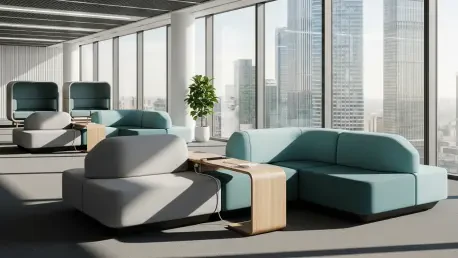
The convergence of residential comfort and commercial utility has given rise to the “resimercial” design trend. Modular lounge systems are now being used to create inviting spaces in lobbies and break rooms that are still fully functional for work. These systems use soft aesthetics and varied seat heights to create a relaxed atmosphere that encourages spontaneous interaction. This approach recognizes that some of the most productive conversations happen outside of formal meeting rooms.
To ensure these lounge areas remain viable workstations, technology is often embedded directly into the furniture. Charging stations and USB ports are integrated into customizable bases, allowing mobile employees to stay powered while working from a sofa or a bench. This modularity allows for endless configurations, giving facility managers the ability to tailor seating arrangements to the specific footprint and needs of their unique office environment.
Optimizing Global Interaction Through High-Tech Seamless Connectivity
Meeting spaces are being redesigned to ensure that every participant, whether in-person or remote, has an equal presence. Modern conference tables emphasize inclusivity by offering a wide range of heights and shapes to accommodate diverse team needs. These tables are often designed with a “light-scale” aesthetic that prevents the furniture from feeling imposing while still housing advanced wire management and wireless charging capabilities. This ensures a clean, focused environment for high-stakes decision-making.
Furthermore, dedicated architectural frames are now used to house the hardware necessary for high-quality video conferencing. These units conceal unsightly cables and hardware, turning a functional necessity into a sophisticated design element. By supporting single or dual displays and versatile camera mounting, these solutions bridge the gap between physical and virtual participants. This level of technological integration is essential for maintaining seamless communication in a professional world that operates across time zones.
Actionable Strategies for Building a Future-Proof Office Environment
Building a resilient workspace requires a strategic focus on modularity and long-term utility. Organizations should prioritize furniture and infrastructure that can be easily updated or reconfigured as their needs evolve. This involves selecting pieces that offer a variety of finishes and customizable features, allowing for a consistent aesthetic even as the floor plan changes. Investing in high-quality, durable materials reduces the frequency of replacements and lowers the total cost of ownership.
Sustainability must be integrated into every procurement decision. Facility managers should look for products with recognized certifications that guarantee low environmental impact. Beyond the materials themselves, the efficiency of the office can be improved through the use of motion-sensing lighting and smart climate controls. By creating an environment that is both efficient and comfortable, companies can foster a culture of excellence that attracts and retains top-tier talent.
The Strategic Role of the Workplace as a Growth Catalyst
The successful integration of these systems proved that the workplace served as more than just a destination for tasks. Facility managers who embraced these innovations observed a marked increase in both operational efficiency and staff engagement. The decision to invest in high-quality, adaptable infrastructure provided a foundation for long-term resilience and cultural cohesion. Successful organizations treated the physical environment as a tool for empowerment rather than a mere requirement for business.
The transition to a fluid ecosystem turned the physical office into a powerful growth catalyst that unified a diverse and distributed workforce. By prioritizing the human experience and technological seamlessness, companies managed to stay ahead of the curve in a competitive landscape. Actionable next steps for leaders involved the continuous assessment of space utilization and a commitment to ongoing ergonomic improvements. This proactive approach ensured that the workplace remained a vibrant hub of innovation and shared success.