
Luca Calarailli joins us to discuss the seismic shift occurring in the industrial landscape as digital infrastructure reaches an unprecedented scale. With Meta’s staggering $50 billion commitment to its Louisiana operations, the conversation shifts toward how the construction industry is adapting to the demands of artificial intelligence and massive energy consumption. This interview explores the logistical triumphs of multi-firm collaboration, the revitalization of the regional workforce through targeted training, and the complex interplay between massive private investments and public utility stability.
With a $50 billion investment supporting 10 million square feet and five gigawatts of capacity, how does a project of this magnitude redefine the standard for “mega-projects” in the modern construction era?
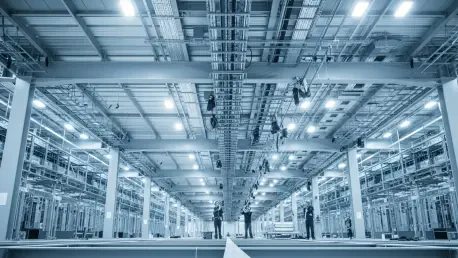
The sheer footprint of 10 million square feet across Richland Parish represents a monumental leap in how we view industrial capacity and physical scale. To put this $50 billion investment in perspective, we are looking at the largest facility in Meta’s global fleet, a project that has evolved rapidly from an initial $10 billion plan to this historic, multi-phase expansion. Seeing the groundbreaking back in December 2024 was just the beginning of what is now one of the largest data centers ever conceived by a private entity. It is a testament to the insatiable hunger for artificial intelligence infrastructure that is currently driving the entire construction market, making traditional industrial builds look modest by comparison. The hum of five gigawatts of IT capacity is not just a technical spec; it is the heartbeat of a new era where data is the most valuable commodity we build for.
The project is expected to support 7,500 construction jobs at its peak, alongside a $115 million workforce academy; what does this mean for the long-term development of skilled trades in the region?
Coordinating 7,500 workers at peak construction requires more than just logistics; it requires a complete rethinking of the local talent pipeline and how we sustain such a massive labor force. The $115 million America’s Workforce Academy is a critical component here, acting as a pilot to ensure that the skilled trades are prepared for the precision these high-tech facilities demand. Walking onto a site of this scale, you can feel the energy of thousands of people working in unison to meet the aggressive timelines of a tech giant. Louisiana is positioning itself as a hub for this specialized labor, creating an environment where high-scale projects can move with incredible speed and efficiency. It is about more than just filling temporary roles; it is about the long-term legacy of a highly trained industrial workforce that will remain in the region long after the last beam is set.
With industry leaders like Turner, Mortenson, and DPR all involved in different phases, how do you manage the collaborative challenges of such a high-stakes, multi-firm environment?
Having industry titans like Turner, Mortenson, and DPR on the same project is like watching an elite ensemble performance where every move must be perfectly synchronized to avoid catastrophic delays. DPR is handling the initial phase of the build, while Turner and Mortenson are leading the massive expansion efforts to reach that 10-million-square-foot goal. This collaboration is born out of pure business necessity because the complexity of a project this size exceeds the capacity and risk appetite of almost any single firm. The sheer volume of materials and the complexity of the mechanical and electrical systems require a level of coordination that is rarely seen outside of the most complex global infrastructure projects. It’s a masterclass in modern construction management, where competitors become partners to deliver a project that is fundamental to the world’s digital future.
Meta is funding seven new natural gas plants and 240 miles of transmission lines to support the site; how does this self-funded infrastructure model address the growing community concerns we are seeing in other states?
The infrastructure requirements for a five-gigawatt facility are so vast that Meta is essentially building its own utility ecosystem to avoid overwhelming the existing grid. By funding seven new natural gas-fueled generating plants and approximately 240 miles of new 500 kV transmission lines, they are taking a proactive stance on energy independence. This strategy is a direct response to the kind of utility strain that recently led New York to issue a statewide moratorium on data center permits due to rising costs for residents. While other regions are pulling back, Louisiana has leaned into a strategy that has secured more than $150 billion in new investment over the last two years. It is a delicate balance between industrial progress and community impact, and providing dedicated power sources is one way to mitigate the friction between big tech and local taxpayers.
What is your forecast for the data center construction industry?
I believe we are entering an era of “sovereign-scale” infrastructure where data centers will move away from being simple buildings to becoming fully integrated energy and technology hubs. As companies like Meta continue to fund their own power plants, battery storage across multiple locations, and massive transmission networks, we will see a decoupling of high-tech industrial growth from the traditional municipal grid. However, the contrast between pro-growth states like Louisiana and states like New York will create a fragmented landscape where the “haves” and “have-nots” are defined by their energy policies. Developers will increasingly prioritize regions that offer not just land, but a clear, frictionless path to massive energy independence and rapid scaling. The next five years will likely see a race to secure these energy-rich corridors, making the role of the infrastructure specialist the most vital position in the entire construction sector.