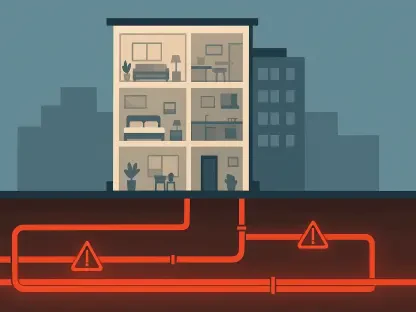

The sprawling network of federal office buildings across the United States currently stands as a silent testament to a bygone era of workplace culture, where massive granite structures once buzzed with activity but now face a stark reality of chronic underutilization and soaring maintenance costs. As taxpayers continue to foot the bill for heating, cooling, and securing millions of square feet of nearly empty hallways, the pressure on lawmakers to address this systemic inefficiency has reached a boiling point. Government Accountability Office reports have consistently highlighted that some agencies utilize as little as nine percent of their headquarters space, yet the process of offloading these assets remains bogged down by legislative inertia and complex disposal requirements. The challenge lies in navigating the intricate web of environmental regulations and historic preservation laws that complicate any attempt to divest from the federal portfolio. Moving forward requires a rethinking of how the government interacts with its physical footprint in a permanent hybrid work environment.
The Fiscal Drain: Maintenance Costs and Resource Allocation
Maintenance costs for federal real estate have skyrocketed as aging infrastructure requires constant repairs regardless of how many employees are actually badge-ing into the building each morning. Every day that a building sits at ten percent occupancy, the government is essentially burning capital on specialized security details, high-speed networking for ghosts, and climate control systems that are inefficiently heating empty cubicles. For instance, the Department of Veterans Affairs and the Department of Agriculture maintain vast campuses that were designed for thousands of staff members who now primarily work from home three to four days per week. The fiscal drain is not merely a rounding error. It represents billions of dollars in annual waste that could be redirected toward high-impact technology modernization or direct public services. Congress faces the task of auditing these expenditures while balancing agency needs even when operational reality no longer justifies the massive square footage.
Beyond the immediate fiscal impact, the persistence of these cavernous, empty structures contributes significantly to the carbon footprint of the federal government, which remains one of the largest property owners in the world. Modernizing these buildings to meet updated environmental standards is often prohibitively expensive, leading to a situation where the government is trapped with stranded assets that are neither green nor useful. Furthermore, the presence of massive, inactive federal blocks in downtown areas like Washington, D.C., creates a dead zone effect that stifles local small businesses and reduces tax revenue for municipal governments. These cities rely on the foot traffic of federal employees to sustain lunch spots, retail shops, and transit systems, all of which have suffered as the federal footprint remains frozen in time. Resolving this crisis requires a coordinated effort to ensure that federal properties are integrated back into the local economy through adaptive reuse or wholesale divestment to private developers.
Strategic Divestment: Legislative Reform and Adaptive Reuse
Divesting federal property is notoriously difficult due to the Federal Assets Sale and Transfer Act, which was intended to streamline disposals but often creates its own layer of bureaucratic friction. Lawmakers must contend with competing interests, such as the requirement to offer surplus property to homeless assistance providers or other public entities before it can be sold on the open market. While these social goals are laudable, the resulting delays can span years, during which the asset’s value depreciates and maintenance costs continue to mount. Private developers are often wary of engaging with the federal government because of these long timelines and the unpredictable nature of Congressional appropriations. To fix this, Congress needs to empower the General Services Administration with greater authority to fast-track sales and keep a portion of the proceeds to fund relocations. Without a clear financial incentive for agencies to shrink their footprints, many will continue to hold onto excess space as a hedge against future growth.
Looking back at the initial efforts to mitigate this crisis, it became clear that a multi-pronged approach involving rezoning and public-private partnerships offered the most viable path forward for federal real estate reform. Legislators eventually recognized that converting underused office towers into residential housing or mixed-use tech hubs provided a double benefit by addressing the national housing shortage while offloading government liabilities. This shift required a fundamental change in how the federal government viewed its role as a landlord, moving away from ownership toward flexible leasing models that could scale with shifting agency missions. By prioritizing the sale of high-value urban assets and reinvesting in localized, high-tech hubs, the government finally began to align its physical footprint with the realities of the modern workforce. These actions demonstrated that fixing the real estate crisis was not simply about selling old buildings, but about strategically repositioning the federal government to be more agile and fiscally responsible.