
The global housing deficit has reached a critical tipping point where traditional construction methods simply cannot keep pace with the exploding demand for affordable shelter in urban centers around the world. Current data suggest that by the end of this decade, billions of people will require new housing, a figure that translates to building tens of thousands of homes every single day. Conventional masonry and timber framing are constrained by supply chain volatility and a shrinking pool of skilled labor, leading many urban planners to look toward additive manufacturing as a viable alternative. This technology, which involves extruding layers of concrete through a gantry-mounted nozzle, promises to condense months of work into mere days. Beyond the speed of execution, the precision of computer-aided design allows for structural complexities that were once cost-prohibitive. As cities grapple with homelessness, the ability to deploy automated building systems represents a shift in how societies view permanent infrastructure.
Technological Evolution and Robotics
Material Science: High-Performance Mortars
The development of high-performance printable mortars has fundamentally changed the physical possibilities of modern architecture by allowing for fluid, organic forms that enhance structural stability. In the period from 2026 to 2030, researchers are focusing on carbon-neutral geopolymer binders that replace traditional Portland cement, which is a significant contributor to global carbon emissions. These advanced mixtures are engineered to set rapidly enough to support subsequent layers while remaining fluid enough to avoid clogging hardware during the printing process. This balance ensures that the printed walls possess high compressive strength and durability comparable to traditional poured concrete. Furthermore, the integration of micro-reinforcements like basalt or recycled glass fibers within the mix eliminates the need for manual rebar placement. By automating the layering of these materials, developers can achieve thermal insulation properties that exceed standard building codes.
Site Integration: Autonomous Systems
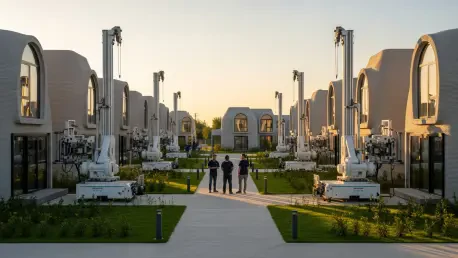
Building upon the chemical breakthroughs in material science, the actual deployment of these materials relies on sophisticated robotics that can operate in diverse environmental conditions. Mobile robotic arms and expansive gantry systems now feature self-leveling capabilities and real-time sensor feedback to adjust for wind or temperature fluctuations on-site. These systems are designed to operate autonomously, reading digital blueprints directly to translate complex architectural visions into physical reality with minimal human intervention. This precision reduces errors that typically lead to rework, ensuring that every centimeter of the structure adheres to the engineering specifications. As these machines become more portable, the logistics of transporting a printing rig to a remote area become more manageable for organizations and private developers alike. The capability to print a complete shell of a house in under forty-eight hours provides a rapid response mechanism to crises.
Economic and Environmental Viability
Labor Savings: Reducing Overall Costs
The economic landscape of home building is undergoing a transformation as 3D printing significantly reduces the total man-hours required to complete a residential structure. While a typical house might require a dozen different subcontractors for framing, insulation, and masonry, a 3D-printed home can be largely completed by a small crew of three to four technicians who oversee the machinery. This reduction in labor costs is vital in regions where skilled trade shortages have inflated construction prices beyond the reach of the average citizen. Moreover, the streamlined nature of additive manufacturing minimizes the financial overhead associated with lengthy project timelines and equipment rentals. By condensing the construction schedule, developers can turn over projects faster, freeing up capital for further investment in affordable housing initiatives. This efficiency does not just lower the entry price for homeowners but also allows municipalities to maximize their budgets when commissioning public works.
Strategic Scaling: Global Implementation
The transition toward a fully automated construction industry required more than just technological prowess; it demanded an overhaul of building codes and regulatory frameworks that were initially designed for wood and brick. Policymakers and engineers worked in tandem to establish new safety standards that accounted for the unique properties of layered concrete, ensuring that printed structures remained resilient against seismic activity. Looking ahead, the focus shifted toward the mass production of modular components that could be printed off-site in controlled environments and then assembled quickly in dense urban corridors. This hybridized approach allowed for greater quality control and further reduced the disruption to local communities during the construction phase. By integrating smart sensors directly into the printed walls, these homes became active participants in energy grids, optimizing electricity usage in real-time. This model proved the scalability of high-tech housing.