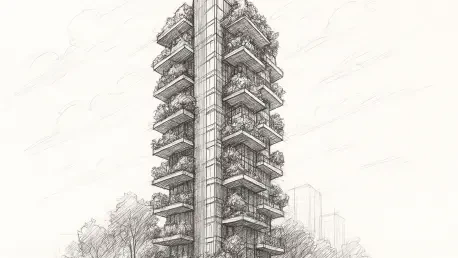

The skyline of Vancouver is undergoing a radical transformation as the Squamish Nation executes a development plan that defies traditional North American urban planning norms. Rising on a ten-acre plot of reclaimed ancestral land, the Senakw project represents one of the most significant shifts in property rights and urban density seen in decades. Because the site falls under the direct jurisdiction of the First Nation rather than the municipal government, it exists as a sovereign enclave where the typical “labyrinthine” land-use controls do not apply. This legal autonomy has allowed the Squamish people to move forward with a high-density vision that includes roughly 6,000 residential units, a density level more commonly associated with international hubs like Hong Kong than with the Pacific Northwest. By circumventing the standard public hearing processes and restrictive bylaws that often stall similar projects for years, the Nation is demonstrating how sovereign land rights can be leveraged to address a chronic shortage of housing supply in one of the most expensive cities on the continent today.
The Legal Authority: Indigenous Sovereignty and Land Use
The path to this development was paved by a landmark 2002 Canadian court decision that returned a portion of the Kitsilano Indian Reserve No. 6 to the Squamish Nation after it had been illegally seized a century earlier. This restoration of property rights effectively removed the parcel from the city’s jurisdiction, creating a regulatory vacuum that the Nation filled with its own governance. In 2019, a community referendum saw an overwhelming majority of Squamish members vote in favor of the development, signaling a collective desire to utilize their land for long-term economic self-sufficiency. This move effectively bypassed the “Not In My Backyard” opposition that usually characterizes Vancouver’s urban planning sessions, as the municipal council has no authority to veto or even significantly modify the plans. The result is a streamlined approval process that stands in sharp contrast to the years of litigation and bureaucratic red tape that developers typically face when building high-density units in the region.
This independence from municipal oversight has turned the Senakw site into a real-world experiment in radical deregulation within a highly regulated environment. While traditional developers are often forced to include extensive parking facilities or limit building heights to appease local homeowners, the Squamish Nation has opted for a transit-oriented model with minimal vehicle parking and soaring heights. The project incorporates sustainable infrastructure and communal ownership structures that appeal to a wide range of political interests, from environmentalists to housing advocates. For those who view existing zoning laws as the primary barrier to affordability, the Senakw project serves as a “deregulatory white pill,” proving that high-density housing can be built rapidly when the standard thicket of restrictions is cleared away. This unique positioning allows the Nation to act as both a developer and a regulator, ensuring that the project meets specific cultural and economic needs for all its members.
Strategic Growth: Economic Power and Future Models
The success of Senakw is not an isolated event but rather the vanguard of a systemic shift in how Indigenous groups are participating in the modern real estate market. The MST Development Corporation, a strategic partnership between the Musqueam Indian Band, Squamish Nation, and Tsleil-Waututh Nation, currently oversees six additional large-scale projects spanning approximately 160 acres of prime urban land. By pooling their resources and legal advantages, these Nations have become some of the most influential developers in the region, possessing the land and the authority to reshape the city’s urban fabric. These developments are not merely symbolic gestures of land return; they are massive capital investments that synthesize private financing with sovereign land rights. This model allows for the creation of mixed-income housing, commercial spaces, and cultural facilities that are funded by market rents, creating a sustainable financial cycle that supports Indigenous social programs and infrastructure.
The Senakw project established a precedent that shifted the focus from theoretical housing debates to tangible, large-scale implementation. Urban planners and policy makers began looking at these sovereign developments as blueprints for how to decouple essential housing growth from local political interference. The actionable takeaway for other jurisdictions was the realization that significant density increases required a fundamental reimagining of land-use authority. By analyzing the Squamish model, municipal leaders identified the necessity of creating “special development zones” that mimicked the sovereign autonomy of Indigenous lands to facilitate faster construction. This approach encouraged a more market-responsive construction pipeline that focused on high-capacity transit corridors rather than sprawling suburban developments. The integration of private capital with a streamlined regulatory framework ultimately provided a scalable solution that addressed both historical land grievances and modern urban affordability.