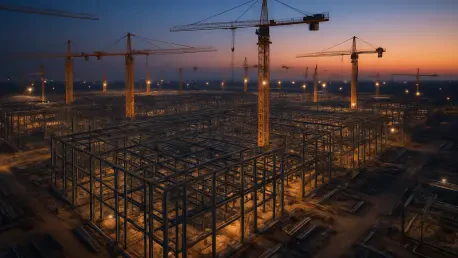

The global technology landscape is currently witnessing an unprecedented expansion of physical infrastructure that challenges conventional economic models, specifically regarding the long-term feasibility of a capital expenditure strategy that demands trillions of dollars in upfront investment. As 2026 progresses, the industrial sector is grappling with a capital surge driven by artificial intelligence that has no historical equivalent in terms of speed and intensity. This massive deployment of resources is not merely about building larger warehouses for servers; it represents a fundamental shift in the global industrial fabric, where the ability to construct and power massive compute clusters has become the primary metric of corporate and national competitiveness.
The current state of the industry is defined by a frantic race among hyperscalers to secure the land, power, and specialized labor required to host the next generation of large language models. This year, the primary market players are allocating budgets that dwarf the infrastructure spending of many mid-sized nations, creating a ripple effect across the supply chain. From advanced cooling systems to high-voltage electrical components, every segment of the construction industry is adapting to the specific, high-density requirements of modern artificial intelligence. However, as the cumulative investment figures climb toward the multi-trillion dollar range, analysts are increasingly focused on whether the resulting economic utility can keep pace with such staggering costs.
The $6 Trillion Infrastructure Paradox: An Analysis of the AI Construction Boom
The central dilemma facing the industry today is the widening gap between the capital required to build AI environments and the immediate revenue generated by the applications they host. While the physical construction of data centers is accelerating, the economic justification relies on future projections of AI-driven productivity that have yet to materialize on a global scale. This paradox is intensified by the fact that the shelf life of the hardware within these facilities is shrinking, meaning that the underlying infrastructure must not only be built at record speed but also designed for rapid, iterative upgrades that could occur every few years.
Moreover, the significance of this boom extends far beyond the technology sector, acting as a massive stimulus for the broader construction and engineering services industry. We see a significant shift in how projects are managed, with a move away from traditional competitive bidding toward strategic, long-term partnerships between developers and contractors. This evolution is necessary because the complexity of these facilities has reached a point where standard construction practices are no longer sufficient. The integration of high-density liquid cooling and massive power redundancies requires a level of precision and expertise that is currently in short supply across the global labor market.
The Road to $1.5 Trillion Annual Capital Expenditure
The trajectory of annual capital expenditure is currently on a path to reach approximately $1.5 trillion by the turn of the decade, driven by an insatiable demand for more powerful compute clusters. In 2026 alone, the leading hyperscale firms are projected to spend nearly $800 billion on infrastructure, marking a dramatic escalation in their financial commitments. This trend is fueled by the transition from general-purpose cloud computing to specialized AI environments, which require significantly higher power densities and more complex cooling architectures than previous generations of data centers.
Emerging technologies in the power sector are playing a critical role in supporting this expenditure surge. Developers are increasingly exploring onsite power generation, including small modular reactors and large-scale battery storage, to bypass the constraints of the traditional electrical grid. As consumer behaviors shift toward more compute-intensive tasks, such as real-time video synthesis and autonomous agentic workflows, the pressure to maintain this level of annual spending remains high. This massive infusion of capital is creating new opportunities for manufacturers of specialized electrical equipment, who are seeing order backlogs stretch several years into the future.
Projecting the Path to a $6 Trillion Cumulative Investment by 2030
When looking at the cumulative landscape, the total investment in AI-related infrastructure is expected to cross the $6 trillion threshold by 2030. This projection is based on the current rate of project starts and the increasing cost per megawatt of capacity. As the industry scales, the sheer volume of material required—ranging from structural steel to specialized copper cabling—is creating a new baseline for global industrial demand. This forward-looking perspective suggests that the AI construction boom is not a temporary bubble but a structural re-alignment of the global economy toward a more compute-centric model.
Market data indicates that the regional distribution of this investment is also shifting, with a significant increase in projects located in areas with favorable access to renewable energy and water. Performance indicators for the sector are increasingly tied to “speed to power,” as the financial cost of a delayed project launch is measured in millions of dollars of lost compute potential per day. While the growth projections are aggressive, they are supported by a continuous stream of hardware innovations that demand ever-larger facilities to house them, creating a cycle of constant physical expansion that shows no signs of slowing down before the end of the decade.
Navigating the Physical and Economic Bottlenecks of AI Infrastructure
Despite the availability of capital, the industry is currently hitting significant physical walls, primarily in the form of electrical labor shortages and power grid congestion. The specialized nature of AI data centers requires electricians who are comfortable with high-voltage systems and mechanical contractors skilled in advanced fluid dynamics. In the current 2026 market, the competition for these tradespeople is so intense that it has become a primary driver of project cost inflation. Without a significant influx of new talent into the mission-critical construction trades, the pace of expansion may be dictated by human capacity rather than financial resources.
Another critical bottleneck is the time required to secure grid connections, which can often take twice as long as the actual construction of the building shell. In response, many developers are adopting strategies such as “power first” development, where they secure energy commitments years before the final design of the facility is even completed. Additionally, the industry is looking toward modularity as a way to circumvent local labor constraints. By shifting more of the assembly process to offsite factories, contractors can produce standardized units of compute capacity that are simply plugged in on-site, significantly reducing the headcount needed at the actual construction location.
The Regulatory Landscape and the Quest for Social License
The regulatory environment for data center construction is becoming increasingly complex as governments react to the massive power and water consumption of these facilities. New laws are being introduced in 2026 that mandate higher levels of energy efficiency and more transparent reporting on carbon footprints. Compliance is no longer an optional aspect of project management; it is a fundamental requirement for securing the necessary permits to break ground. These standards are forcing the industry to innovate in areas like heat reuse, where the waste energy from servers is captured and diverted to local district heating systems or industrial processes.
Beyond formal regulation, the concept of a social license to operate has become a major hurdle for large-scale developments. Local communities are expressing concern over the environmental impact and the strain on local utilities, leading to an increase in project delays due to public opposition. To overcome these challenges, industry leaders are prioritizing community engagement and investing in local infrastructure improvements as part of their project scope. Security measures have also been heightened, as these facilities are now recognized as critical national infrastructure, bringing additional layers of oversight and more stringent requirements for physical and cybersecurity resilience.
Future Horizons: Chip-to-Grid Integration and Modular Industrialization
The future of the industry lies in a more integrated approach to design, where the characteristics of the AI silicon and the design of the electrical grid are co-developed. This chip-to-grid model represents a departure from the traditional silos of hardware engineering and facility construction. By understanding the specific power profiles of upcoming chip architectures, engineers can design buildings that are more efficient and responsive to the fluctuating energy demands of AI workloads. This level of innovation is expected to be a major differentiator for the firms that can successfully master the intersection of digital and physical design.
Modular industrialization is also set to transform the construction landscape, turning what were once bespoke architectural projects into standardized industrial products. As the industry moves toward 2030, we can expect to see the emergence of fully prefabricated data center modules that can be deployed in weeks rather than months. This shift will likely disrupt traditional construction business models, favoring firms that invest in manufacturing capabilities and advanced logistics. Global economic conditions, particularly the cost of energy and raw materials, will continue to influence these trends, but the underlying momentum toward a highly industrialized and integrated construction model appears irreversible.
Strategic Outlook: Balancing Capital Ambition With Operational Reality
The analysis of the current AI construction landscape demonstrated that the industry entered an era of unprecedented scale and complexity. It was found that while the financial commitments from hyperscalers reached historic highs in 2026, the success of these investments remained contingent on solving persistent physical bottlenecks. The findings suggested that the focus for developers and contractors shifted from mere capacity expansion to the strategic management of power and labor resources. Stakeholders recognized that the traditional methods of project delivery were no longer sufficient to meet the demands of the AI revolution, necessitating a move toward modularity and integrated design.
Looking forward, the industry must prioritize the long-term sustainability of its infrastructure to ensure continued growth. It was observed that the firms that successfully navigated the regulatory and social challenges of the past few years were those that integrated community interests into their operational strategies. Moving forward, the industry should focus on standardizing the “chip-to-grid” interface to maximize efficiency and reduce the environmental footprint of massive compute clusters. The transition from building individual assets to managing industrial-scale programs provided a roadmap for stabilizing the supply chain and ensuring that the $6 trillion cumulative investment could be realized. Future success will depend on the industry’s ability to maintain this balance between aggressive capital ambition and the practical realities of the physical world.