
Unlike many plastics or composite materials, aluminium maintains its full structural and chemical integrity regardless of how many times it undergoes the recycling process. This characteristic places the metal at the center of an intense debate within the construction industry regarding its long-term environmental viability versus its initial ecological cost. While critics often point to the high energy requirements of primary smelting, supporters emphasize its role as a permanent resource that never truly leaves the industrial cycle. As architectural designs become increasingly complex, the need for a material that offers both immense strength and total recyclability has never been more pressing. Evaluating this metal requires a shift away from examining single-point data toward a comprehensive whole-life analysis that accounts for extraction, usage, and eventual recovery. This perspective reveals that the sustainability of the metal is not an inherent quality but a variable determined by how it is sourced.
The Primary Production: Energy Intensity and Regional Impacts
The most significant environmental hurdle for aluminium lies in its primary production phase, where refining bauxite into alumina requires intense electrical energy through the Hall-Héroult process. This smelting stage is the primary driver of the material’s total carbon footprint, yet the actual environmental impact is not a fixed value. Because the process is so electricity-intensive, the carbon intensity is fundamentally linked to the energy grid of the region where the smelting occurs.
Metal produced in regions dependent on coal-fired power plants carries a heavy carbon debt that is difficult to offset. Conversely, aluminium smelted using hydroelectric, solar, or wind power achieves a footprint that is a fraction of the global average. Consequently, modern specifiers must move beyond broad labels and demand transparency regarding the energy sources used during smelting to ensure that the material contributes to decarbonization goals rather than hindering them.
The Circular Economy: Sustainable Cycles and Urban Mining
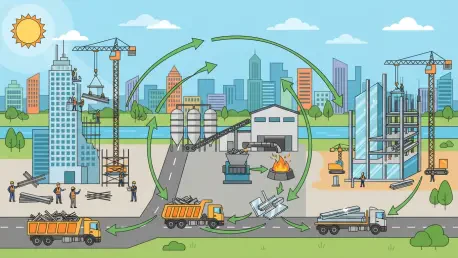
The environmental cost of primary production is mitigated over time by the material’s exceptional recyclability. Remelting scrap aluminium consumes only about 5% of the energy required for primary production, representing a 95% energy saving that supports a robust circular economy. Unlike many plastics or composites that degrade during recycling, aluminium maintains its high-performance characteristics across multiple lifecycles, allowing it to be used for structural applications repeatedly.
Current industry statistics show that roughly 75% of all aluminium ever produced remains in active use, effectively turning the built environment into an “urban mine.” In this model, the metal acts as a long-term resource deposit rather than a consumable waste product. For architects, selecting aluminium is an investment in a permanent material bank. As recycling technology advances, the ability to sort diverse scrap ensures the material remains a cornerstone of sustainable development.
End-of-Life Recovery: Economic Drivers and Recycling Efficiency
A theoretical recycling rate is only effective if the material is successfully captured at the end of a building’s service life. Fortunately, aluminium components like window frames and cladding panels are large and easy to separate from demolition debris. This physical property makes them highly valuable to the scrap market, providing a financial incentive for recovery. In many developed regions, recovery rates now exceed 90%, driven by environmental policy and the high market price for scrap.
The inherent economic value ensures that aluminium rarely reaches a landfill, distinguishing it from other materials that may be technically recyclable but are economically unfeasible to recover. Because the infrastructure for metallic scrap is so mature, the process of returning old window frames to the smelting furnace is efficient. This reliable recovery loop is a critical component of whole-life carbon calculations, as it guarantees that embodied energy is repurposed for several generations.
Documentation Standards: Regulatory Compliance and Declarations
To combat greenwashing and provide verifiable data, the industry relies on Environmental Product Declarations. These third-party-verified documents offer a transparent look at a product’s impact throughout its entire lifecycle and are essential for achieving green-building certifications like LEED or BREEAM. By analyzing these documents, developers make informed decisions based on hard data rather than marketing claims. This transparency has become the standard for high-performance projects.
Furthermore, shifting regulatory landscapes, such as new directives in the European Union, are making whole-life carbon calculations mandatory for all new constructions. This transition elevates low-carbon material selection from a voluntary environmental choice to a legal necessity for modern developers. As building codes become more stringent, the availability of specific data regarding the embodied carbon of aluminium systems allows engineering teams to optimize their designs to meet carbon budgets.
Performance Metrics: Operational Efficiency versus Embodied Impact
The operational phase of a building plays a critical role in the sustainability equation, as the strength of the metal allows for slim, thermally efficient frames. These systems support high-performance glazing that significantly reduces a building’s reliance on artificial lighting and climate control systems over several decades. While the initial embodied carbon may be higher than some alternatives, the energy saved through superior thermal performance often compensates for that initial footprint.
As global energy grids become greener, the focus is shifting toward the embodied carbon of the materials themselves. This makes the choice of low-carbon or recycled metal even more vital for the overall sustainability of a project. Modern thermal break technology has also improved, allowing aluminium systems to achieve U-values that were previously only possible with bulkier materials. This combination of strength and insulation ensures that the material remains a primary choice for architects.
Material Comparison: Evaluating Alternatives and Durability
When compared to competitors like uPVC and timber, aluminium occupies a unique functional niche. While uPVC often has a lower initial production footprint, it is derived from fossil fuels and its recycling infrastructure is less mature, often resulting in material degradation. Timber offers a low production footprint and acts as a carbon sink, but its longevity depends on heavy maintenance and chemical treatments that can complicate its end-of-life disposal during the demolition phase.
Aluminium provides a balance of durability, an established recycling loop, and the high strength-to-weight ratio required for large architectural spans. Unlike timber, it does not warp or rot when exposed to the elements, and unlike plastic, it does not become brittle under UV radiation. These properties ensure a service life that can easily exceed fifty years with minimal maintenance. For large commercial projects, the ability to support massive panes of glass makes it an indispensable tool.
Final Implementation: Strategic Procurement and Deconstruction
To ensure a truly sustainable outcome, specifiers adopted a rigorous approach to procurement and design. They moved beyond accepting vague marketing claims about recyclability and instead required certified evidence of post-consumer recycled content to ensure a true circular economy. Professionals demanded specific data on the energy sources used in the smelting process, favoring metal produced through hydroelectric or solar power. These decisions ensured that the initial carbon investment was minimized.
Designers also prioritized deconstruction by ensuring that façade systems were easily dismantled at the end of their service life. This allowed for the clean separation of metal components from glass and gaskets, which guaranteed that high-value alloys were returned to the production cycle without contamination. By treating the metal as a long-term asset, the industry successfully leveraged its properties to meet the rigorous demands of a carbon-constrained world. These steps established a new benchmark for sustainable construction.