
While the traditional construction industry has long been tethered to the slow pace of manual brick-laying and the unpredictability of the English climate, a quiet revolution is taking place in the factory-controlled environments of modern timber engineering. The housing sector is currently witnessing a pivot toward precision-led assembly that promises to redefine how families live and how developers build. This transition is not merely about speed; it is a fundamental shift in the philosophy of residential architecture, prioritizing long-term energy performance and carbon reduction over antiquated building habits.
The recent £1.1 million partnership between TALO and Lucy Developments represents more than just a commercial agreement; it is a strategic response to the dual pressures of a housing shortage and rising environmental standards. By selecting a nine-home development in Wilstone, Hertfordshire, as their flagship project, these two entities are demonstrating that high-quality, sustainable housing can be delivered without the financial volatility that often plagues conventional sites. This collaboration serves as a critical test case for a model that moves the bulk of the construction work away from the mud and rain into a dry, high-tech facility.
A Strategic Shift Toward Offsite Timber Construction
The conventional “wet” construction method, which relies heavily on on-site labor and favorable weather, is increasingly viewed as an obstacle to the rapid delivery of homes. By formalizing a long-term alliance, TALO and Lucy Developments are bypassing these traditional bottlenecks through the use of advanced offsite manufacturing. This approach allows for a level of precision that is virtually impossible to achieve in an open-field setting, where moisture and temperature fluctuations can compromise the integrity of building materials before a roof is even installed.
Central to this partnership is the goal of eliminating the guesswork associated with residential development. Moving the manufacturing process to a factory allows for tighter quality control and a significant reduction in waste, as materials are cut and assembled using digital designs that optimize every inch of wood. This transition toward a manufacturing mindset helps stabilize costs, providing developers with a predictable financial framework that is often missing in the world of traditional ground-up construction.
Addressing the Challenges of Modern Residential Development
In the current economic landscape, developers are forced to navigate a complex environment defined by fluctuating material prices and a persistent shortage of skilled tradespeople. The reliance on timber superstructures provides a viable alternative that requires fewer on-site personnel and less time to reach structural completion. This efficiency is particularly vital for projects that aim to balance premium build quality with the need for competitive market pricing, as it reduces the overhead costs associated with extended site presence.
Furthermore, the environmental expectations of modern homeowners have evolved significantly. Modern buyers are no longer satisfied with homes that simply look the part; they demand residences that are cheap to run and ethically built. By utilizing high-quality Nordic timber, the TALO and Lucy Developments partnership addresses the carbon footprint of the build itself, locking carbon away in the structure of the home rather than releasing it through the intensive manufacturing processes associated with concrete and steel.
Engineering Efficiency at The Moorings in Wilstone
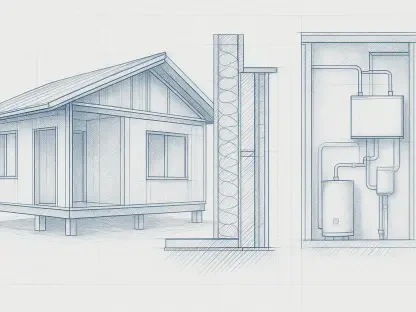
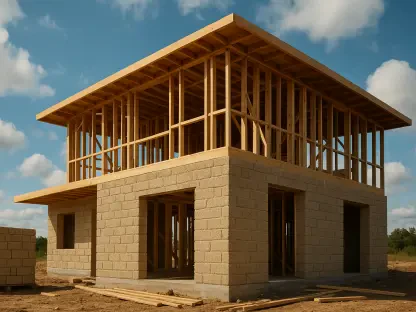
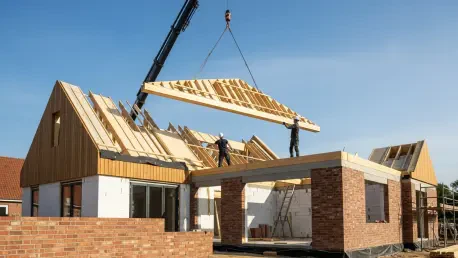
The project known as “The Moorings” serves as a technical showcase for how these timber superstructures are deployed in a real-world setting. Comprising a mix of terraced and detached homes, the site utilized a phased assembly strategy that drastically altered the typical development timeline. Because the components arrived on-site with insulation, triple glazing, and external cladding already integrated, the heavy lifting was completed in a fraction of the time required for a standard build.
The assembly process was divided into four specific stages, with each phase reaching a watertight status in just seven days. This rapid achievement of a dry internal environment meant that electricians, plumbers, and plasterers could begin their work weeks earlier than they would on a traditional site. This overlap of trades is a hallmark of offsite construction, ensuring that the period between the first ground-breaking and the final handover is as short as possible, thereby maximizing the efficiency of the developer’s capital.
Merging Technical Performance with Architectural Heritage
Sustainability at the Wilstone development is not treated as a secondary feature but is baked into the homes’ operational DNA. Each residence is equipped with a low-carbon energy strategy that includes solar battery packages designed to handle hot water and electric underfloor heating. To ensure that these airtight homes remain comfortable, Mechanical Ventilation with Heat Recovery (MVHR) systems were installed, which constantly cycle fresh air while retaining the heat generated within the building, significantly lowering the energy demand on the grid.
Architecturally, the project proves that modern performance does not have to come at the expense of local character. Designed by Lewis and Hickey, the homes feature red and buff brickwork that mirrors the historic aesthetic of Hertfordshire, complemented by sleek metal roofing and projecting bays. The layout was specifically engineered to capitalize on the unique canalside location, incorporating first-floor balconies that provide residents with a direct connection to the surrounding natural landscape.
Scaling Sustainability Through Offsite Strategic Partnerships
The success of this collaboration provides a clear roadmap for the future of the UK housing market, highlighting the necessity of shifting toward more resilient construction models. For the industry to meet its ambitious targets, it must move toward partnerships that favor long-term stability and technological integration over one-off, disconnected projects. This alliance has effectively positioned TALO as a preferred provider for future ultra-low energy schemes, demonstrating that the future of the family home lies in the intersection of high-performance engineering and thoughtful architectural design.
To replicate these results across larger portfolios, stakeholders should prioritize the adoption of modular and timber-based systems that mitigate the risks of labor shortages and climate disruption. Moving forward, the industry must look to integrate these offsite methodologies earlier in the planning stages to fully realize the benefits of shortened build cycles and reduced operational costs. By focusing on these scalable solutions, developers ensured that the next generation of housing was not only built faster but was also fundamentally better for both the occupant and the environment.