
The challenge of moving two hundred thousand commuters daily through a facility built during the Truman administration has finally reached a critical turning point with the launch of one of the most ambitious infrastructure projects in New York City history. The Port Authority of New York and New Jersey has officially selected a joint venture between STV and Turner Construction to oversee the management of the first phase of the ten-billion-dollar Midtown Bus Terminal replacement. This decision marks a significant commitment to modernizing the busiest bus hub in the world, which has remained largely unchanged since its initial opening in 1950. Navigating the dense urban fabric of Manhattan while maintaining active transit operations requires a level of precision and coordination rarely seen in civil engineering. By integrating advanced construction management techniques and real-time logistics monitoring, the team aims to deliver a facility that serves as a cornerstone for regional mobility and economic resilience for decades to come.
Technical Foundations: Navigating Phase 1 Requirements
The initial stage of this massive overhaul is centered on the construction of a nine-hundred-thousand-square-foot interim terminal that will rise seven stories above the street level. This temporary structure is not merely a placeholder but a sophisticated engineering feat designed to handle the full capacity of the existing terminal while the main building undergoes a total transformation. The STV and Turner joint venture must ensure that this interim facility provides a seamless experience for travelers, incorporating modern ticketing systems, enhanced security protocols, and efficient boarding gates. The logistical complexity of erecting such a large-scale building in the heart of Midtown cannot be overstated, as it requires the constant movement of materials and labor through some of the most congested streets in the United States. Success in this phase is predicated on maintaining the delicate balance between aggressive construction schedules and the daily needs of thousands of commuters.
Furthermore, the project involves the development of an intricate new ramp system that will connect the terminal directly to the Lincoln Tunnel. This infrastructure is essential for removing commuter buses from local city streets, thereby reducing traffic congestion and improving air quality in the surrounding Hell’s Kitchen neighborhood. Under a one-point-eight-seven-billion-dollar guaranteed maximum price contract, Tutor Perini will serve as the primary contractor for the ramps and the interim terminal, working under the direct oversight of the STV and Turner team. The integration of these ramps requires precision drilling and structural reinforcement to ensure long-term durability under the heavy loads of constant bus traffic. By streamlining the flow of vehicles directly from the tunnel into the terminal complex, the Port Authority seeks to create a more reliable and predictable transit experience that mitigates the delays frequently caused by the current outdated and restrictive street-level access points.
Urban Integration: Creating Public Value and Green Spaces
A unique aspect of the project involves the creation of permanent “deck-overs” positioned over Dyer Avenue and the Lincoln Tunnel Expressway. These elevated platforms are being managed by a partnership between AECOM Tishman and MLJ Contracting, representing a significant investment in the local community’s physical environment. During the height of the construction process, these decks will serve a vital functional purpose as staging areas for bus operations, ensuring that service remains uninterrupted even as the old terminal is dismantled. This temporary utility, however, is only the beginning of their life cycle. Once the primary construction objectives are met, these platforms will be converted into three-and-a-half acres of public green space. This transformation will provide much-needed parkland for residents and visitors, effectively stitching back together a neighborhood that has long been divided by the sunken roadways of the tunnel approaches.
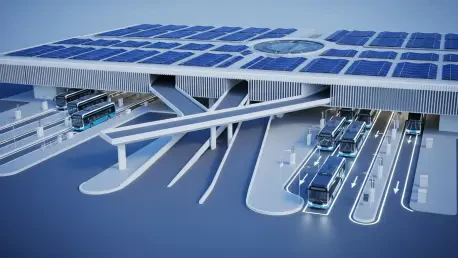
Beyond the immediate benefits of new parkland, the project is designed with a forward-looking commitment to environmental sustainability and carbon reduction. The ultimate goal for the second phase of development is the construction of a state-of-the-art, net-zero-emissions gateway that sets a new standard for urban transportation hubs. This new terminal will utilize advanced energy-efficient technologies, including high-performance building envelopes, solar arrays, and electrified bus charging infrastructure. By shifting the terminal’s operational footprint toward carbon neutrality, the Port Authority is aligning its infrastructure goals with broader regional climate mandates. The transition from the aging, fossil-fuel-dependent facility of the mid-twentieth century to a modern, electrified hub represents a major step toward a cleaner future. The interim terminal will eventually be repurposed for permanent bus storage and staging, creating a highly efficient ecosystem that minimizes idle time and maximizes the utility of every square foot of the site.
Collaborative Execution: Future-Proofing New York Transit
The selection of STV and Turner as construction managers was informed by their extensive history of successful collaboration on high-stakes New York infrastructure projects. Their previous work on the LaGuardia Airport redevelopment and the Ruth Bader Ginsburg Hospital demonstrated a capacity to handle extreme logistical challenges and multi-billion-dollar budgets with high levels of accountability. This project requires the synchronization of multiple top-tier firms, including Tutor Perini, AECOM Tishman, and various local subcontractors, all of whom must operate within a unified safety and quality framework. The construction management team is responsible for ensuring that each phase of the project adheres to strict environmental regulations and community impact mitigation strategies. By leveraging their deep understanding of the local regulatory landscape and their experience with complex metropolitan projects, the joint venture provides the necessary stability to guide this ten-billion-dollar investment through its most vulnerable stages of development.
Looking ahead, the successful completion of this project required a relentless focus on proactive risk management and clear communication between all stakeholders involved in the process. The transition from Phase 1 to Phase 2 was handled with a focus on modular construction techniques that allowed for the rapid assembly of the new terminal components once the old site was cleared. Project managers utilized integrated digital twins and real-time data analytics to monitor structural integrity and worker safety throughout the demolition process. For future developments of this magnitude, the industry should prioritize the early establishment of community advisory boards to ensure that public amenities, like the Dyer Avenue green spaces, reflect the actual needs of the neighborhood. Furthermore, the adoption of flexible design principles allowed the facility to adapt to changing transit technologies, such as autonomous bus fleets and enhanced biometric passenger processing. By treating the construction site as a living laboratory for urban innovation, the Port Authority established a model for how major cities can replace crumbling infrastructure without paralyzing the vital transit arteries that sustain them.