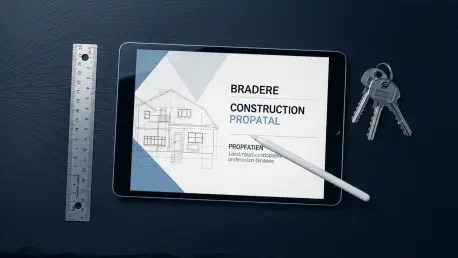

The current construction landscape has evolved into an environment where the ability to generate precise and professional project estimates often dictates whether a small-scale contractor can survive the intense pressure of fluctuating material costs and labor shortages. For many independent general contractors and specialized remodelers, the traditional “estimating bottleneck” remains a formidable barrier that prevents business expansion and personal life balance. These professionals are frequently forced to navigate a high-stakes trade-off between physically supervising field crews on active job sites and managing the exhausting administrative demands of sales, procurement, and bid preparation. The manual methods of the past, characterized by stacks of paper blueprints, neon highlighters, and static spreadsheets, are no longer capable of keeping pace with the rapid volatility of the modern supply chain. Consequently, there is an urgent and undeniable need for streamlined digital processes that allow a solo practitioner or a small crew leader to produce data-driven, professional proposals without sacrificing the high quality of their hands-on craftsmanship. Bridging the gap between antiquated manual labor and overly complex enterprise-grade software has become the primary goal for those seeking to maintain a competitive edge while preserving their operational agility.
Identifying the Friction: Corporate Software Versus Field Reality
There exists a significant and often frustrating mismatch between the design philosophy of major enterprise software platforms and the functional reality of small-scale contracting firms. Most high-end construction technology is engineered to satisfy the requirements of massive corporations that employ dedicated preconstruction departments and full-time IT support staff. These systems are typically feature-heavy, emphasizing deep data mining, multi-user permissions, and complex integration layers that offer very little value to a solo operator or a small family-owned business. For a contractor who is the primary estimator, project manager, and lead carpenter all at once, the inclusion of hundreds of tertiary features acts as digital clutter rather than a productivity booster. This excess of functionality often obscures the core tools needed to get a bid out the door, making the software feel more like a secondary job than a helpful utility. When a platform is designed for a firm with an IT department, it rarely translates effectively to the dashboard of a pickup truck or the small office of a residential remodeler who needs speed and clarity over comprehensive data analytics.
The steep learning curve associated with sophisticated enterprise tools represents a tangible financial liability for contractors who operate with minimal overhead and zero margin for error. Every hour a business owner spends navigating a multi-week onboarding process or attending mandatory technical training webinars is an hour taken away from billable work or critical site supervision. Small firms do not have the luxury of the “onboarding downtime” that larger organizations can absorb as a necessary cost of growth. As a result, the most effective estimating solutions in the current market are those that respect the user’s limited time and provide a high degree of usability right out of the box. These platforms emphasize an intuitive user interface that feels familiar to a tradesperson rather than a software engineer, allowing for immediate adoption and a rapid return on investment. By removing the technical barriers to entry, modern technology can finally fulfill its promise as an empowerment tool that simplifies the bidding process rather than a source of administrative friction that hinders daily operations and long-term business expansion.
Selection Standards: Core Criteria for Evaluating Estimating Solutions
Finding the right fit in a crowded marketplace requires a disciplined approach that prioritizes pricing transparency and functional efficiency over flashy marketing promises or excessive feature lists. Many software providers utilize opaque pricing models that include hidden costs, such as fees per estimate, mandatory support packages, or escalating subscription tiers that can quickly erode the narrow profit margins of a typical kitchen remodel or basement finishing project. For a contractor managing a rotating handful of active jobs, a flat-rate or simple tiered subscription model that allows for unlimited bids is significantly more sustainable than a system that effectively penalizes them for high volume. Furthermore, the ability to generate a professional and branded proposal quickly is essential for securing client trust in a competitive bidding environment. Modern homeowners and commercial clients often equate the professionalism of the bid document with the quality of the work they can expect on-site, making the appearance and clarity of the estimate a vital component of the sales process itself.
Effective software should also be evaluated on its ability to provide workflow connectivity, ensuring that an estimate is never a dead-end document in the project lifecycle. The most successful small contractors are those who can seamlessly transition their initial bids into subsequent phases such as material procurement, real-time budgeting, and job costing. This level of integration is often achieved through the implementation of trade-specific templates and material “assemblies” that automate the most repetitive aspects of data entry. For example, a finish carpenter might use a pre-configured assembly for a specific trim package that automatically calculates the necessary linear footage, the count of fasteners, the volume of adhesive, and the total labor hours based on a single measurement input. This type of automation ensures that no minor expenses are overlooked during the bidding phase, which is where many small contractors traditionally lose money through forgotten scope items. By utilizing these intelligent templates, contractors can achieve a level of precision that matches their larger competitors while maintaining the personal touch and specialized trade knowledge that their local clients value.
Technical Nuance: Distinguishing Measurement Functions and AI Capabilities
It is vital for contractors to develop a clear understanding of the difference between “takeoff” functions and comprehensive “estimating” software when selecting their digital toolkit. Takeoff software is primarily a measurement engine used to calculate quantities such as linear footage, area square footage, or specific item counts directly from digital plans or high-resolution photographs. This process answers the fundamental question of how much material is required for a project, but it does not, by itself, provide a complete financial picture of the contract. Full-scale estimating software takes those physical quantities and applies specific labor rates, overhead percentages, equipment rentals, and desired profit margins to arrive at a final, binding project cost. Understanding this distinction is critical because many affordable tools focus only on one half of the equation. To achieve true efficiency, a small contractor needs a solution that either provides both functions in a single interface or allows for the frictionless transfer of data between measurement tools and the final financial proposal.
Artificial intelligence has transitioned from a futuristic concept into a practical workhorse within the construction industry, particularly through the use of computer vision for automated plan review. Modern AI-powered tools are now capable of scanning digital blueprints to automatically detect structural walls, windows, doors, and electrical symbols with a level of speed and accuracy that far exceeds manual counting. This technological advancement significantly increases the “speed to lead” for contractors who are dealing with a high volume of bid requests, allowing them to return accurate quotes in hours rather than days. While these automated systems still require human oversight to account for unique site conditions or architectural anomalies, they effectively eliminate the most tedious and error-prone parts of the planning stage. By automating the grunt work of counting fixtures and measuring floor areas, AI enables the contractor to focus their energy on strategic value engineering and building client relationships. This synergy between machine speed and human trade expertise defines the current gold standard for professional project planning and bid management.
Strategic Planning: Economic Realities and Outsourcing Alternatives
The financial environment for estimating tools has reached a state of stabilization where contractors can choose from a variety of service tiers based on their specific volume and technical comfort level. It is a common misconception among small business owners that the most expensive enterprise suite is inherently the best choice for their company; in reality, lower-cost platforms designed specifically for residential work often provide more utility by stripping away unnecessary “feature bloat.” When calculating the total cost of ownership, contractors must look past the monthly subscription fee and consider the value of their own time and the potential cost of training new employees. A tool that is purpose-built for specialized trades like masonry, plumbing, or landscaping often provides a better return on investment than a generic, high-priced system designed for global infrastructure projects. By focusing on practical utility and ease of maintenance, contractors can ensure that their investment in technology actually boosts their bottom line rather than becoming a recurring administrative burden.
For some contractors, the most logical path toward optimizing their estimating process involves moving away from software ownership entirely and embracing the strategic outsourcing of the preconstruction phase. Professional services firms like ACON Engineering offer a specialized alternative by providing detailed quantity takeoffs and comprehensive bills of materials as a service, bypassing the need for the contractor to manage complex software in-house. This model allows a general contractor or a busy remodeler to send their plans to a team of experts who return a professional-grade data package that can be used to finalize a bid with absolute confidence. This approach is particularly effective for contractors who handle high-value or highly complex projects where the risk of a measurement error is financially devastating. By delegating the technical measurement work to specialized engineers, small business owners are liberated to focus on their core competencies: managing the job site, ensuring safety, and delivering high-quality craftsmanship to their clients. This shift toward “estimating-as-a-service” represents a growing trend where specialized expertise is prioritized over the mere possession of digital tools.
Future Resilience: Actionable Strategies for Sustainable Growth
The transition toward more efficient and digitized estimating practices proved to be a defining moment for small-scale contractors who sought to modernize their operations while maintaining their independent spirit. Rather than becoming overwhelmed by the technical complexity of large-scale enterprise systems, many successful firms chose to adopt streamlined, trade-specific tools that emphasized speed and usability above all else. This strategic shift allowed project managers to regain control over their daily schedules, spending significantly more time on active job sites and less time performing manual data entry behind a computer screen. The integration of artificial intelligence and automated material assemblies provided a necessary buffer against the rising costs of supplies, ensuring that every bid was grounded in accurate, real-time data rather than guesswork. These advancements helped reduce the historical stress of the “bidding season” and turned the preconstruction process into a predictable, manageable part of the business cycle.
Furthermore, the decision to leverage professional outsourcing services like ACON Engineering offered a flexible solution for those who required engineering-grade precision without the burden of ongoing software maintenance. This hybrid approach allowed small businesses to scale their bidding capacity during busy periods without the need to hire additional full-time administrative staff. By focusing on the total cost of ownership and the quality of their proposals, contractors successfully elevated their market position and secured larger, more profitable contracts. Ultimately, these improved estimating strategies empowered independent operators to compete on a level playing field with much larger regional organizations, securing their long-term viability in a rapidly changing economy. The adoption of these tools and services ensured that the expertise of the individual tradesperson remained the central focus of the project, while the administrative overhead was minimized through the clever application of modern technology and specialized support.