
The traditional expectation that every employee requires a dedicated, personalized slab of mahogany or laminate has dissolved into the reality of a fluid, high-density professional landscape where square footage is the ultimate luxury. As the average real estate allocation per employee continues to plummet, facility managers must solve a complex geometric puzzle that balances human comfort with extreme spatial efficiency. The era of the sprawling personal cubicle has vanished, leaving organizations to rethink how they fit a dynamic, hybrid workforce into an office that is physically shrinking by the month. Success in this modern landscape requires moving beyond a simple desk-and-chair setup to embrace high-performance environments that prioritize utility over physical diameter.
The End of the One-to-One Desk Ratio
The mathematical foundation of office planning has shifted significantly as the predictable one-to-one ratio of employees to desks becomes a relic of the past. Historically, facility managers relied on a 225-square-foot allocation per worker, but current trends show that number dropping toward 150 square feet or less. This reduction is not merely an aesthetic choice but a direct response to the way professional presence has evolved. When workstations sit empty for three days a week, they represent wasted capital rather than productive assets. Modern design strategies now focus on the “touchdown” user, ensuring that the space remains high-functioning regardless of which individual occupies it at any given hour.
Moving away from the personal desk involves a psychological shift for the workforce, yet the benefits of a optimized footprint are undeniable. Instead of long rows of identical, underutilized desks, the modern floor plan utilizes high-performance zones that accommodate various work styles within a smaller total area. This approach allows a company to maintain a prestigious central location without the exorbitant costs of a massive footprint. By focusing on utility rather than ownership, organizations can reinvest their real estate savings into higher-quality amenities and advanced technology, creating a hub that employees actually want to visit even if they no longer “own” a specific corner of it.
Navigating the Shift: Resource-Constrained Environments
The structural transformation of the modern office is currently driven by a confluence of escalating real estate costs and the permanence of the hybrid work model. In 2026, the office functions less like a permanent residence and more like a professional high-performance center. Facility teams are now required to accommodate a rotating mix of full-time staff and temporary users who require immediate connectivity and ergonomic comfort. This physical contraction serves as a structural necessity for organizations looking to curtail capital expenditures while maintaining an inviting professional hub. Understanding this shift is essential for any business aiming to remain agile in a volatile economic climate where overhead must be lean.
A resource-constrained environment demands that every piece of furniture justifies its existence through multi-functionality. The shift is not just about having less space but about making that space work harder for the organization. For instance, common areas that previously served only for lunch or casual conversation are being reimagined as collaborative work zones equipped with the same power and data capabilities as traditional workstations. This fluid use of the environment ensures that the office remains vibrant and productive even as the total square footage decreases. The goal is to eliminate dead zones and ensure that the entirety of the leased space contributes to the corporate mission every single day.
From Static Cubicles to Multi-Functional Hubs
The failure of traditional, rigid workstation models has paved the way for a new paradigm in interior architecture where the desk is no longer a static object. Traditional furniture often results in wasted space, redundant storage, and inflexible infrastructure that cannot adapt to the diverse needs of different users. Modern design addresses this by utilizing vertical integration, where storage and organizational tools are moved off the floor and onto the walls or workstation frameworks. This strategy significantly reduces the lateral footprint on the floor, allowing for wider walkways and more breathing room within a high-density layout.
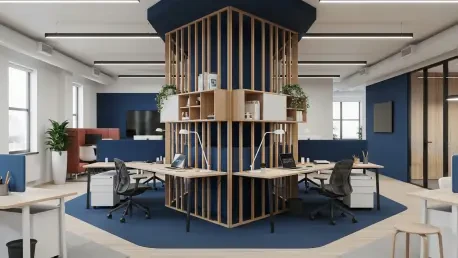
Central to this transformation is the “work wall” concept, which layers essential infrastructure directly into the workstation structure. By embedding task lighting, acoustic buffering, and power management into a vertical framework, designers eliminate the need for bulky add-on cabinets or separate floor lamps. Furthermore, modularity and swappable components ensure that the office remains future-proof. When a workstation is designed as a system rather than a single piece of furniture, components can be easily reconfigured or upgraded as organizational needs evolve. This allows the physical environment to keep pace with technological advancements without requiring a complete teardown of the office interior.
Maximizing Operational Efficiency: Lifecycle Value
Industry experts emphasize that the workstation is no longer just furniture; it is a compact, high-performance environment designed to maximize the lifecycle value of the office. Transitioning to integrated systems offers pragmatic advantages that directly impact the bottom line by reducing the frequency of total office overhauls. Multi-functional systems allow for a phased approach to office upgrades, which minimizes workplace downtime and spreads financial burdens over several budget cycles. This incremental strategy is particularly valuable for growing companies that need to scale their headcount without immediately moving to a larger, more expensive facility.
Operational efficiency also extends to the daily maintenance and management of the workplace. Unified systems reduce clutter and surface area, leading to faster cleaning cycles and more predictable maintenance schedules for janitorial teams. When cables are managed within the furniture and storage is integrated vertically, there are fewer dust-gathering corners and tripping hazards. This streamlined environment protects the original capital investment by allowing facility managers to modify existing setups rather than discarding entire furniture sets when work styles change. The result is a more sustainable approach to office management that prioritizes longevity and adaptability over the disposable trends of the past.
Strategic Framework: Implementing Modern Design
Transitioning to a high-density, high-utility workspace requires a calculated assessment of the existing office ecosystem rather than a simple furniture replacement. The process begins with a deep analysis of occupancy patterns to distinguish between departments that require dedicated stations and those that thrive in shared hot-desking environments. By identifying these nuances, facility managers can allocate resources where they provide the most value, avoiding the “one size fits all” mistake that leads to spatial inefficiency. An audit of storage requirements is equally vital, as reclaiming floor space often starts with eliminating redundant physical files and personal cabinets in favor of centralized or digital solutions.
Technical synergy is the final pillar of a successful implementation strategy. It is imperative to verify that new modular systems are compatible with existing floor power boxes and data ports to avoid expensive electrical renovations. Standardization across the office footprint further simplifies the procurement of replacement parts and eases the burden on maintenance staff. By maintaining consistency in the modular components used throughout the facility, organizations ensure that their workspace remains scalable and easy to manage as the team grows. This strategic framework turns the office into a flexible asset that responds to the needs of the business rather than a static expense that limits growth.
The decision to optimize the office footprint became a defining moment for modern organizations that realized physical size was no longer the primary indicator of corporate success. Leadership teams discovered that by embracing verticality and modularity, they moved away from the inefficiencies of the past and toward a model where every square foot served a distinct purpose. The transition toward high-density workstations provided the necessary infrastructure for a workforce that valued flexibility and high-performance tools over the traditional ownership of a desk. Organizations that took these steps successfully navigated the rising costs of real estate while creating environments that were more responsive to the unpredictable nature of modern work. Moving forward, the focus remained on refining these systems to ensure that as technology evolved, the physical workspace was prepared to adapt without significant capital disruption. This shift in perspective ensured that the office remained a vital, albeit more compact, center for collaboration and professional achievement.