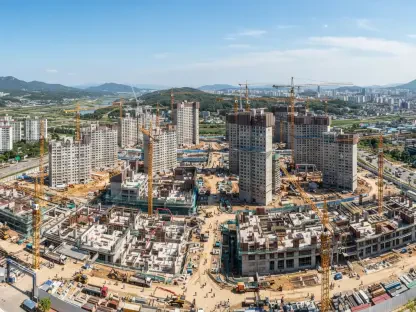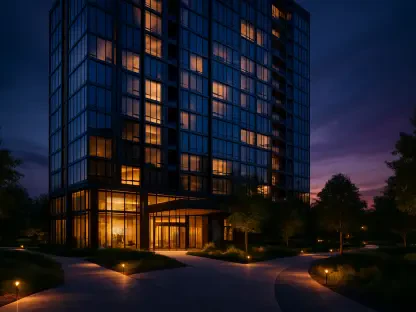

Lenders allege that MG Developer neglected to pay 2025 property taxes and failed to maintain essential financial reserves required under their $105 million loan agreement. This legal challenge, initiated by Scale Lending—the specialized financing arm of a partnership between Slate Property Group and The Carlyle Group—represents a significant escalation in the struggle over Metro Parc South. The 347-unit residential tower was envisioned as a vital addition to Hialeah’s skyline, yet the project now faces a foreclosure action targeting a $31.1 million portion of its total debt. Court records indicate that the developer’s inability to clear construction liens and manage operational capital prompted the lender to move beyond earlier forbearance agreements. While Hialeah remains a focal point for urban redevelopment, the specific financial missteps surrounding this nearly two-acre site highlight the precarious nature of large-scale construction in a tightening fiscal environment where lenders are increasingly unwilling to overlook repeated contractual defaults.
Financial Instability and Strategic Asset Liquidation
Liquidity Pressures: Corporate Debt Struggles
The broader implications of the legal battle extend far beyond a single construction site, as the firm finds itself entangled in multiple litigation tracks involving diverse creditor groups. Beyond the primary foreclosure action, MG Developer is currently defending against eight separate lawsuits stemming from $21.4 million in unpaid promissory notes. These particular legal challenges are especially volatile because they involve individual investors who provided capital without the safety net of a mortgage or physical collateral. In the complex hierarchy of real estate debt recovery, these unsecured creditors are positioned at a significant disadvantage, often left with few options if a project’s primary assets are seized by senior lenders like Scale Lending. This accumulation of secondary debt suggests that the developer’s financial strain is systemic, reflecting a pattern of borrowing that outpaced the firm’s immediate cash flow during a period of rising operational costs that have impacted many mid-market South Florida developers.
Divestment Tactics: a Survival Strategy
In an effort to manage these cascading financial obligations, the leadership at MG Developer, led by Alirio Torrealba, has sought to implement an aggressive asset liquidation strategy to preserve core operations. This pivot is most visible in the firm’s attempts to sell its stake in a North Bay Village property to an affiliate of Prosper for approximately $20 million. While the developer maintains that it is acting in good faith and remains actively engaged in discussions with potential equity partners, the timing of these divestments has consistently lagged behind the demands of its primary lenders. The discrepancy between the developer’s optimistic projections of capital infusion and the hard reality of missed tax payments and lien filings has created a credibility gap. For many in the industry, the reliance on selling off future equity to pay down past-due construction debt is viewed as a high-stakes gamble that requires perfect market timing, which has proven elusive for many builders in this current fiscal year.
Market Headwinds and the Local Housing Crisis
Navigating Realities: a Cooling Rental Market
The timing of the foreclosure coincides with a notable shift in the South Florida real estate landscape, where the frantic growth of previous years has finally met with economic cooling. Throughout Miami-Dade County, developers are grappling with high interest rates that have transformed the math of multi-phase residential projects. In Hialeah specifically, median rents have dipped by roughly 3.52% over the last twelve months, bringing the average down to approximately $2,412. While demand remains statistically high, this slight correction in rental pricing, combined with skyrocketing insurance premiums and labor costs, has squeezed the margins for mid-sized firms that initiated projects during the post-pandemic peak. The transition from a period of endless liquidity to one of rigorous fiscal discipline has caught many developers off guard, leading to the current scenario where refinancing options are limited and lenders are more inclined to seize assets than to extend further grace periods.
Essential Developments: the Need for Affordable Housing
The resolution of the Metro Parc South dispute was seen as a critical bellwether for the future of urban density projects in cities with extreme rent burdens. In Hialeah, where residents typically allocated nearly 68% of their income toward housing, the delay of 347 units represented a significant setback for local housing security. Stakeholders recognized that while adjacent phases like Metro Parc North remained stable and successfully refinanced, the legal fragmentation of multi-phase developments could jeopardize long-term community revitalization. To move forward, the industry analyzed the necessity of more robust risk mitigation strategies for unsecured investors and the importance of early intervention in lien management. Future developers were advised to prioritize transparent tax compliance and diverse capital stacks to withstand the volatility of a cooling market. Ultimately, the focus shifted toward ensuring that project insolvency did not permanently stall the delivery of essential housing units.