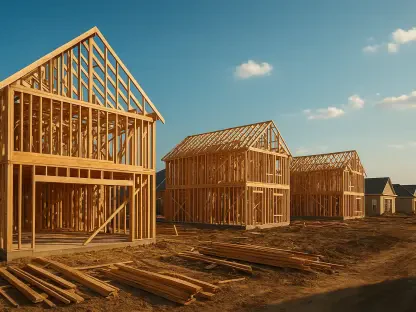

The transformation of the built-to-rent model from a niche market to 7% of the total housing industry highlights a fundamental shift in how Americans consume residential space. This evolution represents a departure from the traditional binary choice of high-density apartment living or individual homeownership, introducing a professionally managed alternative that balances the privacy of a single-family home with the flexibility of a lease. However, as the second quarter of 2026 unfolded, this trajectory encountered its most significant hurdle to date. Despite persistent demand for high-quality housing, the industry witnessed a surprising 16% contraction in construction starts over the preceding twelve months. This sudden cooling was not the result of a natural market saturation but rather the consequence of profound legislative uncertainty emanating from Washington. The emergence of the “21st Century ROAD to Housing Act” introduced a wave of volatility that forced institutional investors and developers to reconsider their long-term commitments. By injecting potential regulatory mandates into a capital-intensive sector, federal policy inadvertently created a bottleneck that threatened to stall the production of thousands of much-needed rental units across the United States.
Market Evolution: The Built-to-Rent Framework
Part 1. Historical Growth and the 2026 Contraction
In the years leading up to the current economic landscape, the built-to-rent (BTR) sector demonstrated a remarkable resilience, expanding its share of the national housing market from a modest 2.7% to a significant 7%. This expansion was fueled by a combination of shifting demographic preferences and a shortage of entry-level homes for sale. Institutional capital poured into the space, transforming what was once a fragmented collection of mom-and-pop rentals into a sophisticated, professionally managed asset class. These developments often feature entire neighborhoods of single-family homes, townhouses, or cottages specifically designed for long-term tenancy rather than immediate sale. By centralizing ownership, developers were able to achieve economies of scale in maintenance and property management, offering a level of service that was previously unavailable in the single-family rental market. This structural shift allowed the industry to weather various economic cycles by providing a steady stream of inventory for those who desired a suburban lifestyle without the immediate financial burden of a down payment.
Despite this robust history of growth, the data from the second quarter of 2026 revealed a stark divergence from previous trends. Construction starts for single-family rental units plummeted to approximately 15,000, down significantly from the 18,000 units recorded during the same period in the prior year. This 16% decline served as a wake-up call for the industry, signaling that even the most promising sectors are not immune to the “chilling effect” of proposed federal interventions. Developers who had previously moved forward with multi-phase projects suddenly paused their operations, citing the high risk of future forced liquidations. The uncertainty was not tied to consumer demand, which remained high, but to the financial viability of projects that might be subject to mid-stream regulatory changes. This period of contraction highlighted the extreme sensitivity of the housing supply chain to legislative signals, illustrating how a single piece of pending legislation can disrupt years of capital planning and construction momentum.
Part 2. The Value Proposition: Why Developers and Tenants Converge
The BTR model functions on a fundamentally different operational logic than standard residential construction, as a single institutional entity retains ownership of the entire community long after the final nail is driven. For developers, this approach streamlines the entire lifecycle of a project, from land acquisition to daily management, by eliminating the need to market individual units to retail buyers with varying credit profiles. This unified ownership structure allows for more efficient capital expenditures, such as bulk purchasing of appliances and synchronized landscaping services, which ultimately lowers the cost of operations. Furthermore, because these communities are designed for rentals from the outset, they often include specialized amenities like community centers, dog parks, and high-speed internet infrastructure that are managed as a cohesive whole. This professional oversight ensures that the neighborhood maintains its aesthetic appeal and functional integrity, protecting the long-term value of the asset for the institutional owner while providing a superior living experience for the residents.
From the perspective of the tenant, these communities offer the highly sought-after “middle path” of housing, bridging the gap between cramped urban apartments and the responsibility of traditional homeownership. This is particularly appealing to a demographic often described as “renters by choice”—families and young professionals who value the space of a suburban backyard but require the mobility that a lease provides. These residents are frequently looking for the stability of a single-family environment without the hidden costs of property taxes, roof repairs, or fluctuating interest rates. In the current market, where the cost of buying a home remains prohibitively high for many, BTR neighborhoods provide a critical safety valve. They allow families to remain in high-quality school districts and desirable suburban corridors while they build their financial reserves. The combination of professional management and residential privacy creates a unique value proposition that has solidified the sector’s place in the modern housing ecosystem, regardless of the temporary shifts in construction volume.
Legislative Impact: Navigating the Policy Landscape
Part 3. The Road to Friction: Understanding the ROAD to Housing Act
The introduction of the “21st Century ROAD to Housing Act” was initially presented as a comprehensive solution to the national housing shortage, yet it contained provisions that sent shockwaves through the single-family rental industry. The primary source of contention was a specific clause designed to prevent what some lawmakers characterized as the “hoarding” of property by institutional investors. This provision would have mandated that any developer of single-family rental homes sell their assets to individual owners within seven years of the project’s completion. While the stated intent was to encourage individual homeownership, the practical reality of such a mandate threatened to undermine the entire financial foundation of the BTR model. Institutional investors typically operate on 10-to-20-year time horizons, relying on the steady yield of rental income and the long-term appreciation of a managed portfolio. A forced liquidation within seven years would not only disrupt these financial models but also create a massive tax liability and administrative burden that many developers were unwilling to accept.
Industry advocates, including the National Association of Home Builders, were quick to point out the potentially catastrophic consequences of this policy. They warned that if the seven-year sale mandate remained in the legislation, the nation could lose up to 72,000 new rental units annually as developers shifted their capital toward other, more stable asset classes. This loss of inventory would have a cascading effect, tightening the rental market and driving up costs for the very families the bill was intended to protect. Moreover, the threat of mass displacement for tenants was a major concern; families who had settled into a BTR community with the expectation of long-term stability would face the possibility of their homes being sold out from under them. This friction between the federal government’s desire to promote homeownership and the industry’s need for stable, long-term capital highlights the complex trade-offs involved in housing policy. The resulting “chilling effect” effectively froze the pipeline of new projects as the industry waited for a resolution from Congress.
Part 4. The Congressional Shift: Restoring Market Equilibrium
The resolution of this legislative battle arrived in May 2026, when the House of Representatives approved a critical amendment to repeal the controversial seven-year sale requirement. This pivot followed months of intense advocacy, where housing experts provided data demonstrating that BTR communities actually supplement, rather than detract from, the broader housing stock. By removing the forced liquidation threat, lawmakers acknowledged that institutional investment is a necessary component of modern housing production. This legislative victory signaled a federal recognition of the built-to-rent sector as a permanent and essential fixture of the national real estate landscape. The amendment was seen as a landmark moment, as it shifted the focus from restrictive mandates to supply-side incentives. With the removal of the liquidation clause, the industry saw an immediate return of confidence, as institutional lenders once again began green-lighting large-scale projects that had been held in purgatory during the height of the legislative debate.
This shift in congressional sentiment suggests that future federal policy is likely to favor collaborative solutions that leverage institutional capital to address the housing deficit. Instead of viewing large-scale rental developers as competitors to individual homeowners, regulators are beginning to see them as partners in expanding the total available inventory. This realization is crucial for the long-term health of the market, as it allows for the integration of rental communities into regional planning strategies. The path to resolution in 2026 demonstrated that when policy aligns with market realities, it can foster an environment where multiple housing models coexist and thrive. The restoration of equilibrium has allowed the BTR sector to resume its role as a high-growth industry, providing the predictability that investors require to commit billions of dollars to new construction. This stability is expected to pave the way for more innovative housing solutions as the relationship between the private sector and federal regulators continues to evolve into a more productive partnership.
Economic Realities: The Future of Residential Investment
Part 5. Affordability Metrics: The Rental vs. Ownership Gap
The enduring demand for built-to-rent housing is largely sustained by a significant affordability gap that has become a defining feature of the American real estate market. As of mid-2026, the financial disparity between renting a starter home and purchasing one reached historic levels, with renters saving an average of $858 per month compared to the costs of a traditional mortgage, insurance, and property taxes. This staggering figure has fundamentally altered the decision-making process for millions of households. For many families, the prospect of saving nearly $10,000 annually by opting for a professionally managed rental community is more than just a matter of convenience; it is a vital economic necessity. This price gap acts as a powerful tailwind for the BTR sector, ensuring a constant influx of qualified tenants even during periods of broader economic uncertainty. As long as home prices remain elevated and inventory for sale remains tight, the single-family rental model will continue to serve as the most viable path to a suburban lifestyle for a large portion of the population.
This financial reality has solidified the BTR sector’s role as a critical safety valve for the national economy, preventing a total housing gridlock by providing high-quality alternatives to ownership. The persistence of high interest rates has further exacerbated this gap, making the cost of borrowing for a retail homebuyer significantly higher than the capital costs for institutional developers. While individual buyers struggle to qualify for mortgages, institutional owners can utilize their balance sheets to secure financing and continue building. This allows the BTR industry to maintain a steady flow of new units, which helps to mitigate the overall housing shortage. The economic resilience of the sector is built on its ability to offer a product that is both desirable and financially accessible compared to the traditional alternative. As the market moves forward, this affordability metric will remain the primary driver of growth, forcing policymakers to consider the BTR model not as a secondary option, but as a central component of a diversified and healthy housing strategy.
Part 6. Final Implications: Long-Term Integration and Strategic Policy
The 2026 downturn served as a definitive case study in how federal policy can shape or stifle industrial growth. This period of contraction proved that even a sector with robust fundamentals and high consumer demand can be derailed by well-intentioned but economically disruptive legislation. The temporary retreat in construction starts was a clear indicator that the housing supply chain is highly sensitive to regulatory signals, particularly regarding the long-term ownership of assets. Developers and investors realized that the traditional “build and hold” strategy was vulnerable to political shifts, leading to a more sophisticated approach to government relations and advocacy within the industry. The successful resolution of the ROAD to Housing Act debate established a precedent for how the industry can communicate its value to lawmakers, emphasizing the role of institutional capital in solving the supply crisis. This experience has left the industry more resilient and better prepared to navigate the complexities of federal oversight in the coming years.
Looking ahead, the relationship between federal regulators and BTR developers is expected to become increasingly collaborative, focusing on how to maximize the production of new units rather than imposing restrictive mandates. The 2026 experience taught the industry that maintaining a stable regulatory environment is just as important as managing construction costs or interest rate exposure. As the American housing landscape continues to evolve, the built-to-rent model stands as an essential bridge, providing the lifestyle of a traditional home with the flexibility that modern economic conditions demand. Policymakers have increasingly recognized that a healthy housing market requires a mix of ownership and rental options to meet the needs of a diverse population. By integrating large-scale rental communities into the national housing strategy, the government can leverage private investment to achieve public goals. The future of the sector now depends on a sustained commitment to supply-side solutions, ensuring that the BTR model can continue to expand and innovate within a supportive and predictable legislative framework.