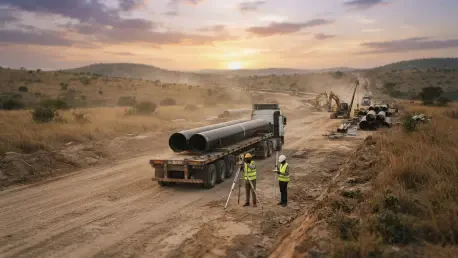

A coalition of over one hundred forty-nine civil society organizations focused on the project’s carbon footprint, yet failed to prevent the pipeline from securing nearly five billion dollars in total commitments. As of late 2026, the East African Crude Oil Pipeline (EACOP) has achieved a remarkable 93.9% implementation progress, effectively neutralizing one of the most coordinated divestment campaigns in history. Stretching approximately 1,443 kilometers from the Tilenga and Kingfisher fields in Uganda to the Tanga port in Tanzania, this heated infrastructure project serves as a vital midstream link for a broader energy development strategy. The project was designed to transport waxy crude through some of the most ecologically diverse and sociopolitically complex landscapes in East Africa. Despite the “StopEACOP” movement successfully lobbying more than forty major international commercial banks and thirty insurance providers to withdraw their support, the project found a way to bridge the financial gap. This resilience offers a masterclass in how massive infrastructure projects in emerging markets can circumvent Western financial exclusion by leveraging regional solidarity, alternative capital sources, and substantial shareholder equity.
The Structural Shift: Internalizing Financial Risk
The evolution of the financial architecture for this pipeline reflects a significant departure from the traditional project finance models typically seen in large-scale energy developments. Originally, the sponsors anticipated a standard seventy-thirty debt-to-equity ratio, which would have leaned heavily on international commercial lenders to provide the bulk of the capital. However, the systematic withdrawal of Western banking institutions necessitated a radical recalibration of the capital structure. By late 2026, the financing had shifted to a much more equity-intensive model, now estimated at approximately 52% equity and 48% debt. This pivot forced the primary shareholders, led by TotalEnergies and the China National Offshore Oil Corporation (CNOOC), to dig much deeper into their own coffers. This change effectively internalized the financial risk that would have otherwise been distributed among a wider array of global commercial banks. By increasing their “skin in the game,” these multinational entities signaled to the remaining regional lenders that they were fully committed to the project’s long-term viability regardless of international pressure.
This transition toward a sponsor-heavy model was not without significant financial consequences, as the total project cost surged from an initial estimate of $3.6 billion to roughly $5.6 billion. This two-billion-dollar escalation, often referred to by industry analysts as the “cost of opposition,” was driven by a combination of global inflation, logistical delays, and the necessity of seeking more expensive alternative financing. While the divestment movement intended to render the project unbankable, it instead created a situation in which capital became more concentrated and the financial burden more localized. The determination of the Ugandan and Tanzanian governments to see the project through led to a mobilization of resources that prioritized national strategic interests over the fluctuating Environmental, Social, and Governance (ESG) standards of the West. This resilience underscores a growing trend in which sovereign states in the Global South are finding ways to assert their developmental autonomy by forging new financial paths that do not rely exclusively on traditional European or American banking centers.
Indirect Liquidity: The Corporate Bond Loophole
One of the most sophisticated aspects of the project’s survival was the strategic use of general corporate bond financing as an indirect channel for liquidity. While many Western financial institutions publicly committed to refusing direct, project-specific loans for the pipeline, they continued to facilitate massive capital raises for the primary corporate sponsors. For instance, TotalEnergies was able to issue billions of euros in corporate bonds throughout the mid-2020s, with many of the same banks that distanced themselves from the pipeline acting as underwriters for these general-purpose funds. Once these funds entered the corporate pool, they could be legally used to meet the equity obligations of the pipeline project without triggering the restrictive covenants associated with project-specific lending. This dynamic revealed a critical vulnerability in global divestment strategies, as it demonstrated that as long as a project sponsor maintains a strong balance sheet and access to global capital markets, it can effectively bypass project-level financial blockades to fund its strategic priorities.
The distinction between project finance and corporate finance allowed the pipeline’s developers to maintain a steady flow of capital, even during the height of the international pressure campaign. Activists found it significantly more difficult to target general corporate bondholders than specific project lenders, as the former are often institutional investors with broader mandates and less direct exposure to the site-specific controversies of the pipeline. By utilizing these indirect channels, the developers were able to fund the procurement of long-lead items, such as the specialized thermal insulation required for the waxy crude, and maintain construction schedules across the Tanzanian and Ugandan borders. This strategy not only provided the necessary cash flow but also served as a buffer against the reputational risks that initially deterred commercial lenders. The success of this approach has since become a focal point of debate within the financial sector, as it highlights the limitations of divestment when applied to diversified multinational corporations with robust internal financing capabilities.
Regional Integration: The Rise of Pan-African Capital
The successful closure of the first major external debt tranche in March 2025 marked a definitive turning point in the project’s financial narrative, proving that African institutions were ready to fill the vacuum. This initial package, valued at approximately $755 million, was anchored by a syndicate of regional players who viewed the pipeline as a cornerstone for East African economic integration. Afreximbank played a central role in this process, providing not just capital but also a layer of political and institutional legitimacy that Western banks were no longer willing to offer. By positioning the pipeline as a vital piece of regional infrastructure, these African lenders were able to frame their involvement as a commitment to continental growth and energy security. This move signaled a significant shift in the landscape of African infrastructure finance, where “homegrown” capital is increasingly being utilized to protect strategic projects from the shifting tides of international climate policy and Western ethical standards.
The participation of commercial giants such as Standard Bank of South Africa, Stanbic Bank Uganda, and KCB Bank further solidified the regional nature of the lending group. These banks used their deep local market expertise and their vested interest in the economic success of the East African Community to justify their exposure to the project. Their involvement provided a form of “social proof” that helped stabilize the project’s reputation within the African business community, even as it faced condemnation in Europe and North America. This localized support was crucial for managing day-to-day financial operations across the 1,443-kilometer corridor, as these banks provided the necessary clearing and liquidity services for thousands of local contractors and suppliers. The resilience of this regional syndicate demonstrated that African financial markets have matured to a point where they can, under the right conditions, sustain massive industrial developments that previously would have been entirely dependent on the whims of the London or New York financial centers.
Strategic Diversification: The Impact of Islamic Finance
The introduction of Sharia-compliant capital into the project’s financing mix represented a strategic move to diversify the pool of available liquidity beyond traditional commercial banking. The Islamic Corporation for the Development of the Private Sector (ICD), the private sector arm of the Islamic Development Bank Group, provided a critical source of funding that operated under a different risk assessment framework than those of Western institutions. Because Islamic finance focuses on asset-backed transactions and risk-sharing, it was naturally suited to the physical realities of a massive infrastructure project like a pipeline. This involvement allowed the developers to tap into Middle Eastern capital markets, which have historically been less susceptible to the specific pressures of Western-led divestment campaigns. The ICD’s participation not only added hundreds of millions of dollars to the debt facility but also provided a unique layer of financial protection against the volatility of conventional interest rates.
By late 2025, the commercial debt facility had grown significantly through these diverse channels, reaching an estimated $1.2 billion. The integration of Islamic finance served as a hedge against the shrinking pool of traditional lenders and provided a model for how other African nations might fund fossil fuel projects in the future. This approach highlighted a broader trend of South-South cooperation, where emerging economies and their financial institutions are increasingly working together to bypass the restrictions of the Global North. The resilience of Sharia-compliant models in this context was particularly notable, as they provided the stability needed to ensure that the project’s complex debt service requirements could be met without relying on the very banks that had turned their backs on the region. This diversification strategy effectively neutralized the leverage that Western activists held over the project’s financing, ensuring that construction could continue toward its late-2026 completion goals.
State Support: Legislative Floors and Fiscal Certainty
To make the project bankable for regional and international lenders, the governments of Uganda and Tanzania established a rigid and highly predictable revenue framework that minimized commercial risk. The cornerstone of this framework is a $12.77 per barrel transportation tariff, which is applied to the first billion barrels of oil flowing through the system. To ensure that this revenue stream remains robust even in a fluctuating economic environment, the tariff includes an annual adjustment mechanism tied to either a flat 2% increase or the U.S. inflation rate. This provides a guaranteed cash flow projection that lenders can use to model debt service coverage ratios with a high degree of confidence. By codifying these terms into national law through instruments like Uganda’s Special Provisions Act, the host nations created a legislative “floor” that protected the project from future political or economic shifts, making it a far more attractive proposition for risk-averse regional banks.
Furthermore, both nations provided significant fiscal concessions that lowered the project’s overall break-even point and enhanced its attractiveness to investors. Tanzania’s decision to waive transit levies and Uganda’s provision of corporate tax relief were strategic moves designed to prioritize the pipeline’s long-term operational viability over immediate state revenue. These concessions were essential for ensuring that the upstream production in the Lake Albert basin remained profitable, which in turn guaranteed the volume of crude oil necessary to keep the pipeline running at capacity. By effectively subsidizing the midstream infrastructure through tax breaks, the governments ensured that the pipeline would be a steady, low-risk earner for its creditors. This level of state intervention was a clear response to the divestment movement, demonstrating that when a project is deemed a national priority, the state can and will use its fiscal powers to compensate for the withdrawal of private international capital.
The Geopolitics of Chinese Technical and Financial Support
The involvement of Chinese financial institutions and industrial contractors was a fundamental pillar of the project’s survival, particularly as Western technical expertise became harder to secure. While the China National Offshore Oil Corporation (CNOOC) acted as a primary equity partner, Chinese firms were also responsible for providing the physical infrastructure, including high-grade steel pipes and the complex heating systems required for the waxy crude. Throughout 2025 and into 2026, negotiations for major debt tranches from Chinese export credit agencies continued to provide a backdrop of financial security for the project. These agencies often link their financing directly to the use of Chinese goods and services, creating a self-sustaining ecosystem of development that is largely insulated from Western ESG pressures. This “South-South” financial cooperation has become a hallmark of the pipeline’s narrative, representing a shift toward a more multipolar world in energy infrastructure.
The technical implementation of the project also benefited from this alignment with China, as contractors brought a level of speed and experience in large-scale energy projects essential for maintaining the 93.9% completion rate. The presence of Chinese capital and labor on the ground in both Uganda and Tanzania provided a counterweight to the withdrawal of European engineering firms and financial advisors. This partnership was not merely about funding; it was about ensuring that the physical reality of the pipeline could be achieved despite logistical and political hurdles. By late 2026, the collaboration between East African governments and their Chinese partners had created a blueprint for how other resource-rich nations in Africa might navigate the complexities of global energy transitions. The pipeline stands as a physical manifestation of this geopolitical shift, where the dominance of Western capital is no longer an absolute requirement for achieving massive industrial goals on the continent.
Sociopolitical Resistance and the Developmental Debate
The progress of the pipeline has been inextricably linked to a fierce debate over the balance between national development and global environmental accountability. A coalition of more than 149 civil society organizations argued that the project posed an existential threat to the Lake Victoria basin and would result in the displacement of thousands of people. These groups documented significant concerns regarding the land acquisition process, claiming that compensation was often inadequate and that the power imbalance between state-backed oil companies and rural farmers was insurmountable. This resistance created a complex sociopolitical environment that developers had to navigate alongside financial challenges. While the companies involved insisted they were adhering to the highest international standards, such as the IFC Performance Standards, the ongoing friction between developers and local communities remained a primary focus for international observers and critics.
This conflict highlighted the diverging worldviews of the Global North and the Global South regarding the “right to develop” through fossil fuel resources. Ugandan and Tanzanian officials consistently framed the project as a matter of developmental sovereignty, arguing that their nations should not be denied the economic benefits of their natural resources by the very countries that built their wealth on fossil fuels. This narrative proved a powerful tool for maintaining domestic support for the project even as international pressure mounted. By late 2026, the pipeline had become a symbol of this ideological tug-of-war, with the 93.9% completion rate viewed by proponents as a victory for sovereign development. However, the lack of complete financial transparency regarding the exact terms of the regional loans continued to fuel skepticism among activists, who argued that the true social and environmental costs of the project were being obscured by the opaque nature of the alternative financing arrangements.
Navigating the Legacy of Risk and Financial Decoupling
The financial journey of the East African Crude Oil Pipeline culminated in a significant redistribution of risk that will have lasting effects on the host nations’ economies. By late 2026, it was clear that while the withdrawal of Western banks did not stop the project, it shifted a much larger portion of the potential downside onto the state oil companies of Uganda and Tanzania. UNOC and TPDC, the national oil entities, now carry a heavier financial burden than they would have in a more diversified international project finance structure. This exposure means that the economic health of these nations is now more closely tied to the global price of oil and the operational efficiency of the pipeline than ever before. If production targets are missed or if there are significant disruptions in the global energy market, the fiscal impact will be felt directly by the taxpayers of Uganda and Tanzania, rather than being absorbed by a syndicate of global commercial banks.
The project demonstrated that financial decoupling from Western markets is a viable, if costly, path for strategic infrastructure in the Global South. It proved that when sovereign interests align with the goals of major non-Western corporations and regional banks, it is possible to build massive industrial assets despite a global divestment movement. However, the lessons learned from this process suggest that future projects must adopt even more robust transparency and community engagement strategies from the outset to mitigate the “cost of opposition.” Investors and policymakers should look to the EACOP model as a precursor for how the geopolitics of energy finance will continue to evolve, with regional institutions taking on a more assertive role. To ensure long-term stability, it is recommended that subsequent developments prioritize the creation of local sovereign wealth funds and more inclusive compensation frameworks to guarantee that the economic benefits of such projects are felt broadly across society. The successful implementation of the pipeline by late 2026 marks the end of one chapter and the beginning of a new era in which African states are increasingly setting the terms for their own industrial future.