
The escalating cost of living in Australian metropolitan areas has transformed from a persistent concern into a full-blown national emergency. The Australian government’s Intergenerational Report identifies the current housing shortage as a primary driver of rising inequality between younger and older citizens. This disparity is particularly evident in the rental market, where low vacancy rates and surging prices have forced many into precarious living situations. A new study by University of Melbourne researchers, commissioned by the developer Freecity, highlights a critical stagnation in the domestic property sector compared to international counterparts. While countries like Singapore and the United Kingdom have embraced industrialized building methods, Australia continues to rely on traditional, fragmented construction processes. The report suggests that without a rapid pivot toward modern housing models, the gap between supply and demand will only widen, further entrenching economic divides across the nation.
Economic Bottlenecks: The High Cost of Traditional Development
The financial reality of the Australian property market has become increasingly grim as apartment construction costs surged by approximately 80 percent over the last decade. Current data indicates that building expenses have climbed from $2,500 to $4,500 per square meter, making many planned projects financially unviable. This inflation, paired with high interest rates and labor shortages, has created a critical bottleneck that prevents new supply from entering the market. Consequently, the traditional model of residential development is struggling to keep pace with the needs of a growing population. Developers are finding it difficult to secure financing for projects that face such high upfront costs and unpredictable timelines. This economic pressure has forced the industry to look for alternative solutions that can provide greater cost certainty and faster delivery times, yet systemic inertia remains a significant obstacle to the broad adoption of more efficient industrial methods.
Furthermore, the Australian Build-to-Rent sector currently accounts for a negligible 0.2 percent of the country’s residential market value. This is a stark contrast to the United States, where the sector represents a substantial 12 percent of the residential value, or the United Kingdom, where it stands at 5.4 percent. The disparity suggests that Australia is missing a massive opportunity to leverage institutional investment to solve its housing woes. Since 2023, over 26,500 approved rental apartments—representing roughly 64 percent of the total approved pipeline—have failed to break ground due to these economic headwinds. This failure to move from approval to construction highlights a deep-seated inefficiency in the current market structure. Without significant intervention to lower development risks, institutional investors, such as superannuation funds, are likely to remain on the sidelines, leaving the rental market underserved and prices high for the average citizen.
Industrialized Solutions: The Synergy of Modular Construction
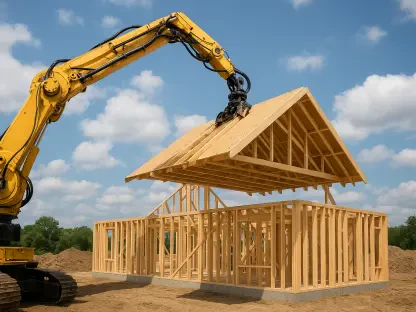
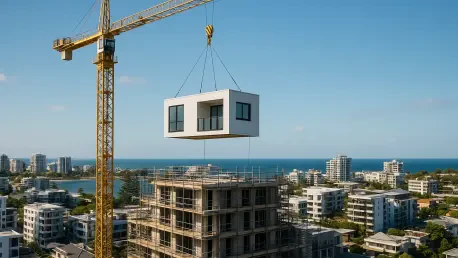
A unique techno-economic synergy exists between the Build-to-Rent model and Volumetric Modular Construction because rental projects rely on standardized designs. This construction method involves manufacturing entire apartment units in a controlled factory setting, complete with interior finishes, plumbing, and electrical systems. Once completed, these modules are transported to the construction site and stacked to form a high-density building. The primary advantage of this approach is the dramatic reduction in construction timelines, with evidence suggesting that modular methods can slash schedules by 25 to 50 percent compared to traditional on-site building. By moving the majority of the work into a factory, developers can avoid weather-related delays and coordinate trades more efficiently. This speed is essential for addressing a housing crisis where the speed of delivery is just as important as the volume of units produced to meet the immediate demand.
Beyond speed, modular construction offers much greater predictability regarding labor costs and material waste, which is vital in a climate of high construction inflation. Because the environment is industrialized and repeatable, builders can implement rigorous quality control measures that are difficult to achieve on a standard construction site. This level of standardization is particularly well-suited for professionalized rental housing, where owners prioritize long-term durability and lower maintenance costs. The integration of manufacturing and real estate development represents a fundamental shift from a bespoke craft to a high-volume industry. For a market like Australia, transitioning to this industrialized model could provide the scalability required to stabilize housing costs. However, achieving this scale requires a consistent pipeline of projects to justify the initial investment in factory infrastructure, a challenge that requires both private sector innovation and supportive government policy.
Strategic Reform: Navigating Regulatory and Tax Barriers
Despite the clear benefits of modular building, primary barriers continue to stifle its adoption across the Australian landscape. The most significant hurdle is a taxation disadvantage where developers cannot recover the Goods and Services Tax on construction costs for rental properties. Because residential rent is classified as input-taxed, owners face a 10 percent unrecoverable expense that undermines the overall viability of projects. This stands in contrast to the tax treatment of hotels or for-sale apartments, creating an uneven playing field that discourages the development of long-term rental housing. Additionally, the industry faces fragmented planning systems and a lack of standardized national certification for modular quality. These regulatory hurdles make it difficult for lenders to assess risk and for insurers to provide coverage for innovative building methods. Without a unified framework, the transition to modular housing remains a high-risk endeavor for most developers.
The research concluded that Australia possessed the necessary technological capabilities to address the shortage, yet was held back by regulatory inertia. It was determined that by adopting a national certification framework and harmonizing tax treatments, the government could have stimulated a pipeline of 10,000 high-quality rental homes annually. The study emphasized that providing such certainty was the only way to attract the institutional investment required to stabilize the market. Researchers observed that while developers like Freecity were already implementing these models in areas like Rouse Hill and Parramatta, systemic support was the missing link for broad adoption. Ultimately, the transition to an industrialized housing sector was identified as the most effective path to restoring affordability and ensuring that the residential market met the needs of a growing population. By removing financial hurdles, the nation moved closer to a future where high-quality, professionalized rental options became the standard.