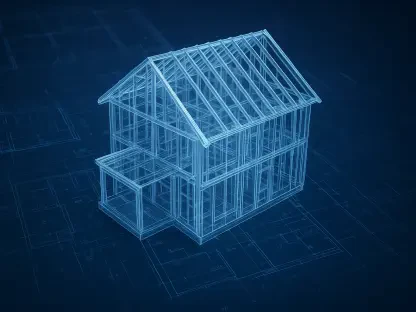

Engineering teams are no longer tethered to the rigid constraints of traditional parametric modeling because Neural CAD has introduced a paradigm shift in how digital geometry is synthesized and manipulated within the digital space. This breakthrough marks a departure from the manual drafting era, establishing a class of artificial intelligence that possesses the intrinsic ability to reason directly with complex geometric data sets. For decades, designers relied on clicking and dragging points in a three-dimensional environment, essentially acting as operators for sophisticated but ultimately static tools. Now, the software functions as an active participant that understands the creative intent behind a command, translating high-level concepts into mathematically sound blueprints. This shift signifies a major leap in capability that has not been witnessed since the initial adoption of computer-aided design over forty years ago. By integrating cognitive understanding, the industry moves toward a world where technical limits no longer stifle imagination.
Defining the Intelligence: Behind the Model
Specialized Geometry: Structural Logic
Professional engineering environments require a level of precision that general-purpose artificial intelligence models, such as those used for text or image generation, simply cannot provide in a reliable manner. Neural CAD fills this void by focusing on the underlying structural logic of a design rather than just its visual appearance or surface-level aesthetic qualities. These specialized systems are trained to understand how individual components fit together within a larger assembly and what specific constraints govern their movement and functionality in the physical world. This enables the AI to move beyond mere visualization to perform actual design work, generating high-precision geometry that integrates into existing industrial workflows without requiring manual corrections. By prioritizing the internal logic of the object, these models ensure that the resulting designs are not only beautiful but are also technically feasible and ready for immediate testing or manufacturing cycles.
A recurring theme in this recent development is the deliberate focus on geometric reasoning over simple visual representation which has been a major hurdle in previous iterations of design software. While standard generative AI can create realistic renderings that look impressive in a portfolio, it often lacks the spatial logic and mathematical precision required for physical manufacturing and assembly line integration. Neural CAD addresses this fundamental flaw by operating on the actual vectors and underlying mathematics that define an object’s physical reality in a virtual space. This ensures that any modifications made by the designer or suggested by the AI preserve the functional intent of the entire assembly without breaking its structural integrity or violating critical tolerances. As engineers transition into this new method, the emphasis shifts from managing pixels to managing the fundamental properties of materials and mechanical relationships, creating a robust foundation for product development.
Bridging the Gap: Geometric Reasoning and Reality
The integration of physical laws into the digital modeling process allows Neural CAD to predict how a component will react to stress, heat, and other environmental factors during the design phase. By embedding these physical constraints into the core of the geometric model, the software prevents the creation of impossible shapes that cannot be fabricated using current industrial methods. This bridge between abstract digital design and concrete physical reality is what sets this technology apart from previous generations of software that treated geometry as a purely visual exercise. Designers can now receive real-time feedback on the viability of their concepts, allowing for rapid iteration and refinement that was previously impossible without lengthy simulation cycles. This capability is particularly valuable in aerospace, where every millimeter of material must be justified by its performance and structural contribution to the overall vehicle, ensuring that safety and efficiency are baked into the design from the very first sketch.
Furthermore, the ability to maintain the integrity of a design across different scales and levels of complexity represents a significant advancement in the reliability of automated systems. As the AI reasons through the geometric requirements of a project, it maintains a holistic view of the entire system, ensuring that a change in one small part does not lead to a failure in another distant component. This systems-thinking approach is mirrored in the way Neural CAD handles the relationship between different parts of a complex assembly, such as a bridge or a jet engine. By maintaining these logical connections, the software reduces the risk of human error during the tedious process of updating hundreds of related drawings or models. This leads to a more synchronized and accurate design environment where the digital twin of a product is a perfect reflection of its intended physical form. Consequently, the gap between what is envisioned and what is produced on a factory floor continues to shrink, fostering a new era of manufacturing.
Industrial Impact: The New Design Era
Transforming Sectors: Enhancing Creative Output
The practical implications of Neural CAD are far-reaching and offer significant advantages across various sectors including architecture, manufacturing, and digital media production. In the construction sector, the software can automatically navigate complex building codes and zoning regulations, ensuring that designs are compliant from the very beginning of the planning process. This reduces the need for costly revisions and speeds up the approval timeline for new projects, which is critical in an era of rapid urbanization and housing demand. In the manufacturing world, the technology accelerates the design-to-prototype cycle by generating parts that are already optimized for specific production methods like 3D printing or CNC machining. By taking manufacturing constraints into account during the initial design phase, companies can reduce material waste and energy consumption, leading to a more sustainable and cost-effective production process that benefits both the manufacturer and the end consumer in the long run.
Even in the digital media and entertainment industry, the impact of Neural CAD is being felt as it simplifies the creation of incredibly complex 3D assets for film and gaming. High-fidelity digital modeling, which once required a team of specialized artists and thousands of hours of work, is becoming more accessible to a much wider range of independent creators and smaller studios. The software can automatically generate detailed background environments, mechanical props, and architectural structures that maintain a high level of physical realism and consistency. This allows creators to focus more on the narrative and artistic aspects of their work, while the AI handles the technical complexities of 3D geometry and spatial arrangement. As these tools become more prevalent, we are seeing an explosion of creativity in digital storytelling, as the barriers to high-quality visual production continue to drop and the speed of content creation increases to meet the growing global demand for immersive and realistic digital experiences.
Future Considerations: Navigating Intent-Based Design
The industry transitioned from explicit manual modeling to an intent-based design philosophy that fundamentally altered the relationship between engineers and their digital instruments. Professionals recognized that the era of manually specifying every single coordinate or line segment had ended, replaced by a system where defining high-level goals became the primary objective. This evolution bridged the gap between raw human creativity and the rigorous, uncompromising demands of the physical world, ensuring that professional tools finally kept pace with increasingly complex global challenges. To stay competitive in this new environment, organizations adopted comprehensive training programs that prioritized creative problem-solving and algorithmic thinking over traditional software proficiency. Designers and architects began focusing on setting constraints and defining performance parameters, allowing the neural networks to handle the geometric synthesis. This proactive shift enabled teams to iterate faster and reduce engineering errors.
Forward-thinking firms implemented strategies to leverage these automated capabilities by integrating Neural CAD directly into their proprietary manufacturing pipelines and supply chains. They invested heavily in data-driven workflows that allowed the AI to learn from past projects, creating a continuous feedback loop that improved design quality over time. This approach necessitated a rethink of traditional project management, moving toward more agile and iterative methodologies that embraced the speed of AI-driven generation. By focusing on the intent rather than the technical execution, designers were able to explore vast design spaces that were previously too complex to navigate. This new landscape encouraged a more collaborative environment where multidisciplinary teams worked alongside intelligent systems to solve multifaceted problems in urban planning and sustainable manufacturing. Ultimately, the transition empowered a new generation of creators to build a more resilient and efficient world by aligning digital precision with vision.