
The financial incentive to innovate is driven by a liability framework where the general contractor bears primary responsibility for every incident on a project. This reality has fundamentally altered how heavy industrial projects are managed, pushing the sector toward a future where technological oversight is a necessity rather than an optional luxury. While the construction industry has historically been slow to adopt digital transformations, the mounting costs of workplace accidents and the increasing complexity of modern infrastructure have forced a pivot toward high-tech safety solutions. From massive skyscraper developments to subterranean transit tunnels, the physical environment remains unpredictable and dangerous, yet Artificial Intelligence now offers a way to predict the unpredictable. By analyzing vast streams of data in real-time, these systems serve as a tireless eye that never blinks, providing a level of vigilance that human supervisors simply cannot maintain throughout a grueling twelve-hour shift on a bustling site.
The Evolution of Regulatory Responsibility and Risk Management
Industrial safety protocols have traveled a long road from the informal trade customs of the 19th century to the rigid, data-heavy frameworks defining current standards. In the early days of vertical expansion, worker safety was often treated as an individual responsibility, but as projects grew in scale and technical difficulty, the legal and moral burden shifted decisively toward the managing entities. This historical progression led to the implementation of “prevention-through-design” philosophies, where potential hazards are identified and mitigated during the pre-construction phase rather than on the fly. Today, this mindset is being supercharged by algorithmic analysis, allowing firms to simulate construction sequences in virtual environments to detect safety clashes before a single shovel hits the dirt. The transition from reactive measures to proactive, intelligence-led strategies marks a significant turning point in how the industry handles its most vulnerable assets: the workers on the ground.
The integration of AI is not merely a philanthropic effort to protect personnel but a strategic response to the rising costs of insurance premiums and legal litigation. Modern general contractors are finding that traditional safety audits, while helpful, often fail to capture the transient risks that emerge and vanish within minutes on a fluid job site. To address this, many are now employing specialized software that correlates historical incident data with current weather patterns, crew experience levels, and specific equipment usage. This allows management to issue preemptive safety alerts or “targeted stand-downs” when the probability of an incident crosses a certain threshold. By documenting these proactive measures through automated reporting, companies can demonstrate a higher standard of care, which is increasingly becoming a requirement for securing favorable insurance rates in a market that remains skeptical of human-only supervision and traditional observation methods.
Modern Applications of Site-Specific Assistive Technologies
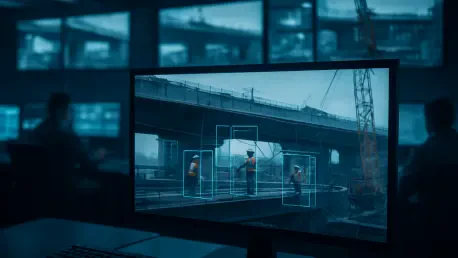
Autonomous aerial drones and high-definition camera arrays have become the primary conduits for AI-driven safety oversight in the current landscape. These devices are equipped with computer vision algorithms that can distinguish between a properly secured harness and a loose strap from hundreds of feet away. By continuously scanning the site, the software can identify structural anomalies, such as an unsecured trench wall or an overloaded scaffolding platform, and immediately notify the relevant foreman via a mobile alert. Unlike static sensors, these mobile units provide a holistic view of the workspace, ensuring that the periphery of a project is just as scrutinized as the central work zone. This capability is particularly vital for expansive horizontal projects like highways or bridges, where human supervisors may be miles apart. The result is a more comprehensive safety net that operates in the background, allowing the field team to focus on production without sacrificing oversight.
Wearable technology has expanded beyond simple GPS tracking to include sophisticated biometric and environmental sensors that protect workers from physiological stress. Modern smart vests and helmets are now capable of monitoring heart rates, body temperatures, and even the “man-down” detection of a sudden fall or impact. When a sensor detects that a worker is approaching the limit of heat exhaustion, the AI system can automatically trigger a rest break or redirect the individual to a shaded area, preventing a medical emergency before it starts. Furthermore, these devices integrate with site-wide communication networks to provide real-time proximity alerts, warning laborers when they are approaching heavy machinery blind spots or high-voltage zones. This democratization of safety data ensures that every individual on the site is an active participant in the digital safety ecosystem, reducing the reliance on top-down communication which can often be delayed or misinterpreted in a noisy and dangerous environment.
Strategizing for a Safer Construction Environment
Implementing a robust AI safety framework required a deliberate focus on data quality and the gradual integration of specialized hardware. Progressive firms successfully moved beyond the initial trial phase by selecting specific high-risk areas, such as fall protection or heavy equipment interaction, where automated monitoring provided the most immediate impact. They prioritized the development of clear protocols for alert management, ensuring that every digital notification was followed by a documented human response. This approach effectively bridged the gap between raw data collection and actionable site safety, proving that the value of AI lay in its ability to support, not replace, the expertise of the safety professional. By establishing these foundational systems, companies created a more predictable work environment that significantly lowered the frequency of recordable incidents and established a new benchmark for operational excellence in the field.
Furthermore, the success of technological safety measures depended on the industry’s ability to standardize data sharing and embrace open-source safety algorithms. Decision-makers focused on investing in platforms that offered high interoperability, allowing various sensors and drone systems to communicate within a single dashboard. Creating a feedback loop where frontline workers reported “near-misses” and correlated them with AI data became essential for refining predictive models. Organizations also remained vigilant about the privacy of their workforce, ensuring that biometric data was used exclusively for safety improvements rather than performance monitoring. By fostering an environment of trust and technological competence, the construction industry finally shed its reputation for high risk and embraced a future where zero-accident projects were no longer an aspirational goal but a consistent reality achieved through the fusion of human ingenuity and machine intelligence.