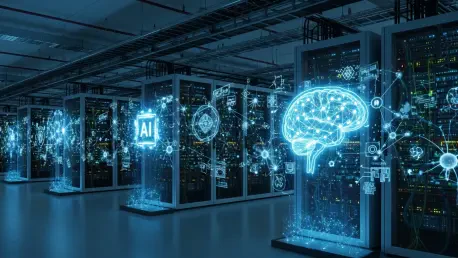

The relentless expansion of artificial intelligence has pushed the boundaries of modern infrastructure to the point where a single server rack now consumes more electricity than a suburban neighborhood. As generative models and complex neural networks become deeply embedded in global commerce, the hardware sustaining these digital minds is hitting a thermal and electrical ceiling. Traditional enterprise environments, once accustomed to modest power draws, now face a reality where high-density compute clusters generate heat at an unprecedented scale.
This evolution creates a fundamental tension between the pursuit of technological progress and the non-negotiable demands of environmental sustainability. Balancing these opposing forces requires a total reimagining of data center architecture, moving away from legacy cooling methods and toward integrated, energy-efficient ecosystems. The path forward lies in harmonizing extreme processing power with resource conservation to ensure that digital growth does not come at the cost of the planet.
Can the Cloud Keep Its Cool: The Reality of 80kW Racks and Global Energy Limits
While artificial intelligence is rapidly reshaping the global economy, the hardware required to run these models is pushing power grids to their breaking point. A single rack housing high-performance AI processors now demands between 30 and 80 kW—a massive leap from the power requirements of standard enterprise servers. This surge in compute density forces a difficult question: how can the industry fulfill the insatiable demand for processing power without compromising urgent environmental goals?
The sheer intensity of these workloads means that heat dissipation is no longer a matter of simple ventilation. Facilities designed only a few years ago are struggling to provide the necessary thermal management, leading to localized hotspots and potential system failures. Consequently, the industry must move beyond incremental upgrades and adopt a radical perspective on power delivery and heat extraction to prevent a total stagnation of digital growth.
Understanding the Pivot Toward a 1.2 Power Usage Effectiveness Standard
Data centers currently account for approximately 1% to 1.5% of global electricity consumption, a figure that is under intense scrutiny as carbon neutrality becomes a corporate mandate. To mitigate this impact, industry leaders are moving away from relaxed energy standards and toward a Power Usage Effectiveness (PUE) target of 1.2 or lower. This shift represents a fundamental change in how facilities are benchmarked, prioritizing energy efficiency as a core metric of operational success rather than just an afterthought.
Achieving such a lean PUE requires more than just efficient hardware; it demands a holistic look at every kilowatt that enters the building. Standard mechanical cooling systems often consume as much energy as the servers themselves, making them the primary target for optimization. By focusing on the ratio between total facility power and actual IT power, organizations are finally treating energy waste as a critical flaw in architectural design.
Prioritizing Low-Energy Strategies Through Tiered Cooling Profiles
The most significant barrier to sustainable AI is the energy intensity of traditional mechanical cooling. To solve this, a tiered cooling approach is emerging as the most viable path forward, designed to meet roughly 70% of annual cooling demand through low-energy methods like economization and adiabatic processes. By reserving energy-heavy mechanical systems only for peak conditions, operators can dramatically reduce their carbon footprint while still protecting the sensitive, high-density hardware required for complex AI workloads.
This strategy leverages ambient air and evaporation to carry away heat, significantly reducing the workload on power-hungry compressors. However, the transition requires a sophisticated understanding of local climates and seasonal variations to maximize free-cooling hours. When implemented correctly, these systems provide a resilient buffer that keeps temperatures stable even as AI processing loads fluctuate wildly throughout the day.
The Critical Role of Early-Stage Performance-Led Design Decisions
The future of sustainable digital infrastructure depends on moving beyond one-size-fits-all cooling paradigms. Experts argue that the most impactful decisions regarding resource efficiency are made at the project’s inception. By adopting a performance-led design approach, engineers can ensure that the physical form of a building is perfectly synchronized with its mechanical systems. This proactive strategy prevents the inefficiencies that typically arise when high-density AI loads are forced into infrastructure designed for a previous generation of computing.
Integrating heat management into the very skeleton of the data center allows for more natural airflow and more efficient liquid cooling pathways. Rather than retrofitting old shells with high-powered fans, designers now treat the building as a living machine where every corridor and plenum serves a specific thermodynamic purpose. This early-stage alignment ensured that long-term operational costs were minimized while scalability remained a core feature of the build.
Strategies for Aligning Physical Infrastructure with AI Operational Systems
To successfully balance performance with ecological responsibility, operators utilized advanced simulation tools early in the development lifecycle. This allowed for the validation of low-energy cooling strategies against real-world AI processing scenarios before any ground was broken. Practical implementation involved focusing on resource efficiency from the start, utilizing rigorous simulation to refine airflow and thermal management, and ensuring that cooling profiles were adaptable to the fluctuating demands of high-performance computing environments.
The industry recognized that the most effective way to maintain stability was through the constant monitoring of fluid dynamics and real-time power distribution. By adopting these performance-driven standards, data center architects transitioned from reactive cooling models to predictive infrastructure that anticipated heat spikes. This shift not only preserved the longevity of expensive AI hardware but also set a definitive precedent for the tech sector, proving that high-speed innovation and environmental stewardship were finally compatible.