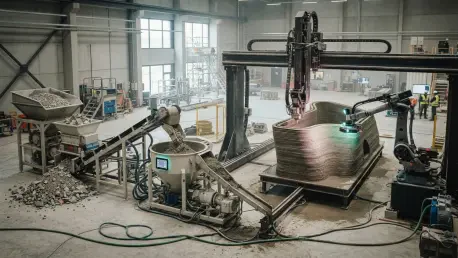

Computer vision systems using semantic segmentation now monitor interlayer lines in real-time to prevent the catastrophic structural failures often caused by minor filament tearing. This technological leap signifies the end of the experimental era for three-dimensional printed concrete (3DPC), which has long been viewed as a transformative force in the construction sector. By enabling the creation of complex architectural geometries that were once impossible to cast using traditional formwork, 3DPC offers a more efficient future for civil engineering. However, the industry has historically faced significant technical obstacles, such as unpredictable material behavior and a lack of standardized quality control. The transition from an “open-loop” system, where material design and printing are isolated steps, to a “closed-loop” framework is the primary driver of current progress. In this modern setup, artificial intelligence creates a bidirectional flow of data, allowing for immediate feedback and error correction during the fabrication process. This evolution transforms 3D printing from a laboratory novelty into a robust, self-adaptive construction ecosystem capable of correcting its own mistakes while the building rises, ensuring that structural integrity is maintained from the first layer to the final capstone.
Strategic Research Trends and Data Integration
The rapid growth of this field is evidenced by a dramatic increase in academic publications and industrial implementation projects over the last several years. Bibliometric analyses indicate that while interest remained steady for some time, a major surge occurred after 2020, reflecting a global push toward digitizing the heavy construction industry. As of 2026, the focus has shifted toward refining these digital tools to handle the complexities of large-scale infrastructure. Despite this momentum, the research landscape has remained somewhat fragmented, with experts often working in silos focused on either material science, computer vision, or structural design. This division has historically slowed the adoption of 3DPC because the data generated in one phase rarely informed the operations of the next. To address this, the current industry goal is to bridge these gaps by creating a unified cyber-physical system where every data point is interconnected across the lifecycle of a project.
Developing a truly integrated construction environment requires a move away from static datasets toward dynamic, real-time information exchange. When material scientists develop a new concrete mix, that data must be instantly accessible to the robotic control systems to adjust extrusion speeds. Conversely, the sensor data collected by robots on the construction site should feed back into material models to improve future formulations. This interconnectedness is essential for achieving the level of reliability required for high-rise buildings and critical infrastructure. Current initiatives are focusing on standardizing these data protocols so that different AI models can communicate seamlessly. By fostering this collaborative digital environment, the industry is moving closer to a reality where the design, material, and fabrication phases act as a single, cohesive unit, significantly reducing the likelihood of project delays and material waste while increasing overall structural safety.
Predictive Material Formulation and Optimization
Creating the perfect concrete mix for 3D printing is a delicate balancing act that requires the material to flow easily through a pump while remaining stiff enough to hold its shape once extruded. In the past, achieving this balance required endless trial-and-error in the lab, a process that was both time-consuming and expensive. Today, machine learning algorithms are replacing these empirical methods by predicting how different ingredients like cement, water, and various fibers will interact under specific environmental conditions. Advanced models, such as Gaussian Process Regression, now provide probabilistic outputs that help engineers understand the certainty of a prediction. This allow teams to better manage the risks associated with structural integrity by providing a range of outcomes rather than a single, potentially misleading number. These predictive tools are now standard in the development of high-performance concrete mixes.
Beyond simple predictions, researchers are using “Explainable AI” to look inside the “black box” of complex algorithms. This transparency allows scientists to quantify exactly how much a specific additive, such as a chemical retarder or a specific fiber type, influences the behavior of the concrete. For example, recent studies have shown that polypropylene fiber content can account for over a third of the influence on the material’s rheological behavior. Such insights allow for surgical precision in mix design, enabling the creation of materials tailored for specific climates or mechanical requirements. Furthermore, multi-objective optimization algorithms are being deployed to balance competing goals, such as increasing the strength of the material while simultaneously reducing its carbon footprint. Some current projects have already demonstrated that this approach can cut carbon emissions by nearly thirty percent without sacrificing the structural performance or the buildability of the printed elements.
Real-Time Process Control and Vision Systems
The printing phase remains the most volatile stage of the construction process, as environmental factors like humidity and temperature can cause layer misalignment or surface defects. To combat this volatility, AI-driven computer vision is being used to create a “perception-decision-execution” loop that functions much like a human operator but with far greater precision. Deep learning systems monitor the printing process in real-time, identifying cracks, tears, or buckling as they occur. By comparing the physical print against the original digital design using high-speed cameras and LiDAR, these systems can instantly detect deviations that are invisible to the naked eye. This real-time monitoring is critical because it allows the system to pause or adjust the print before a minor defect becomes a structural failure, saving both time and resources on the job site.
Once a deviation is detected, the AI system can trigger autonomous repairs on the fly. This might involve adjusting the extrusion rate, changing the travel speed of the robotic arm, or injecting chemical accelerators at the nozzle to stiffen the material instantly. These systems often utilize lightweight neural networks that can run on local hardware, ensuring low-latency responses that are necessary for high-speed printing. While these vision systems are becoming increasingly sophisticated, they must still contend with the harsh conditions of an active construction site, including dust, debris, and changing light conditions. Engineers are currently working on improving the robustness of these sensors to ensure they remain accurate in all weather conditions. Despite these challenges, the implementation of real-time vision systems has already led to a significant reduction in the failure rate of complex printed structures, paving the way for more ambitious architectural designs.
Advancements in Robotic Autonomy and Hardware
The hardware used in 3D concrete printing is evolving from static, factory-based gantry systems to intelligent, mobile robots capable of navigating uneven and unpredictable construction sites. Some of the latest platforms feature autonomous terrain compensation, which uses sensors to adjust the robot’s base in real-time, ensuring the print head remains perfectly level even on sloped ground. This mobility is a significant departure from early 3DPC setups that required a perfectly flat concrete pad to operate. These mobile units can move around a site, printing different sections of a building and then returning to join them together. This flexibility allows for the construction of much larger and more complex structures than was previously possible with fixed-frame systems, effectively removing the size constraints that once limited the technology.
There is also an increasing focus on multi-agent systems, where groups of robots or drones work together to print large-scale structures. These collaborative “swarms” can coordinate their movements to print long-span beams or complex vaults that would be impossible for a single robot to manage. Some of the most experimental work involves aerial additive manufacturing, where drones equipped with extrusion nozzles print structures while in flight. While still in the development phase, these flying printers utilize real-time predictive control to synchronize their flight paths with material extrusion. This suggests a future where buildings could be printed in remote or inaccessible areas, such as disaster zones or mountainous terrain, without the need for traditional scaffolding or heavy machinery. This shift toward robotic autonomy is not just about speed; it is about expanding the boundaries of where and how we can build.
Generative Design and Digital Twin Monitoring
Artificial intelligence is also redefining how structures are designed and evaluated from the ground up. Using topology optimization and generative design, AI can place material only where it is strictly needed to support a load, resulting in lightweight, bio-inspired structures. These designs often resemble organic forms, such as bone structures or tree branches, which provide maximum strength with minimum material usage. Recent applications have shown that these AI-optimized components can use over twenty percent less concrete than traditional rectangular beams while maintaining the same load-bearing capacity. This material efficiency is crucial for the industry’s sustainability goals, as it directly reduces the volume of cement required for a project. These complex designs are only buildable because of the precision offered by 3D printing, creating a perfect synergy between design and fabrication.
Once a structure is completed, AI continues to play a vital role through the management of “Digital Twins”—virtual replicas that are linked to the physical building via embedded sensors. These systems monitor the health of the structure in real-time, collecting data on strain, temperature, and moisture levels. By analyzing this data, the AI can predict maintenance needs and identify potential structural issues before they become visible to the human eye. For instance, on the A30 highway in the United Kingdom, a 3D-printed retaining wall already uses this technology to feed data into a digital twin, allowing engineers to monitor its performance remotely. This continuous feedback loop ensures that the building remains safe throughout its entire lifespan. This move toward “living” infrastructure represents a fundamental shift in how we maintain the built environment, shifting from reactive repairs to proactive, data-driven management.
Overcoming Technical Bottlenecks and Future Implementation
While the progress in AI-powered printing has been impressive, several hurdles remain before the technology can be adopted on a global scale. One primary challenge is the lack of standardized data across the industry. Information from sensors, 3D scans, and material logs often comes in incompatible formats, making it difficult for different software platforms to work together. Additionally, many current AI models are “physics-agnostic,” meaning they recognize patterns in data but do not always account for the fundamental laws of gravity or fluid dynamics. To solve this, researchers are developing physics-informed neural networks that incorporate mathematical equations directly into the learning process. This ensures that AI-driven designs and process adjustments remain grounded in physical reality, meeting the rigorous safety standards required for public infrastructure and housing.
The transition toward a fully closed-loop system was historically hindered by the scarcity of large datasets in the construction industry. Unlike other tech sectors, construction data is often fragmented and project-specific. Moving forward, the industry must focus on creating shared data repositories and more robust algorithms that can learn effectively from smaller, high-quality datasets. As these systems become more reliable, the focus will shift toward integrating them into existing building codes and regulatory frameworks. The successful implementation of these self-adaptive systems has already proven that 3D printed concrete is no longer just a theoretical concept. By focusing on data standardization and physical accuracy, the construction industry is now positioned to deploy these intelligent systems at scale, leading to a more sustainable and architecturally daring era of global development.