
The integration of robotic deposition with biological stabilization allows for the creation of two-square-meter building panels that do not require synthetic resins or chemical binders. This breakthrough addresses the urgent need for carbon-neutral construction materials that eliminate the toxic off-gassing typically associated with industrial glues and formaldehyde-based resins. By merging the precision of industrial automation with the self-assembling properties of fungi, architects and researchers have found a way to bypass the limitations of traditional manufacturing. Standard construction often relies on rigid molds and batch production, which significantly restricts the geometric complexity and customization of sustainable components. However, this new method utilizes a coreless winding approach where a robotic arm braids hemp rope into a complex scaffold that serves as a living substrate. This transition from passive filler to active structural reinforcement marks a significant shift in how bio-based materials are perceived in the industry, moving beyond simple insulation toward load-bearing architectural elements. The resulting panels are not only environmentally friendly but also inherently resistant to common indoor pollutants because the biological process is tightly controlled to prevent the emergence of harmful mold species during the growth phase.
This innovative approach to material science leverages the unique properties of mycelium, the vegetative network of filamentous fungi, to act as a natural adhesive. In traditional bio-composites, mycelium is often grown in a mold filled with loose substrate like wood chips or straw, resulting in a material that is good for compression but weak in tension. By introducing a robotically braided hemp rope scaffold, the researchers have created a hybrid system where the continuous fibers carry the primary structural loads while the mycelium locks the intersections and stabilizes the overall form. This collaboration between a high-tech robotic “weaver” and a biological “binder” suggests a future where buildings could be grown to specific structural requirements, reducing the environmental footprint of the construction sector. The process ensures that every fiber is placed exactly where it is needed, minimizing waste and maximizing the efficiency of the natural resources involved in the production of these large-scale architectural panels.
1. Digital Design and Toolpath Generation
The development of these complex panels begins with a sophisticated grid-based computational model that bridges the gap between architectural intent and biological growth requirements. This system employs a raster-based design tool to convert a target boundary into a series of deposition-relevant fields, effectively encoding the local fiber density and orientation within a control grid. By assigning grayscale values to specific coordinates, the software dictates where the robot should place more layers of hemp rope and where the structure should remain more porous to allow for better fungal colonization. High-density regions are characterized by frequent rope intersections and multiple layers, which provide the necessary stiffness for structural support, while lower-density areas allow for better airflow and fungal penetration during the incubation period. This digital environment allows designers to simulate the structural hierarchy of the panel before any physical material is consumed, ensuring that the distribution of mass is optimized for the specific mechanical demands of the building component while maintaining the health of the living organism.
Translating these digital patterns into physical reality requires a rigorous calibration process that accounts for the material properties of the hemp rope and the mechanical limits of the robotic arm. The computational system must calculate minimum possible bending radii for rope diameters ranging from 15 to 60 millimeters to ensure that the robot does not attempt turns that would cause the fiber to snap or slip from its anchors. Once the geometry is validated against these physical constraints, the software generates detailed instructions for a six-axis industrial robot. This includes complex toolpath planning that incorporates simulations to prevent collisions between the robot and the modular pin-loom system. Furthermore, the system manages rope tension in real time, adjusting the robot’s speed to accommodate the friction and elasticity of the natural fibers. This proactive approach to toolpath generation ensures that the final braided scaffold is a faithful representation of the digital model, providing a stable and predictable base for the subsequent biological growth phase, which is essential for achieving architectural-scale consistency.
2. Robotic Fabrication and Braiding
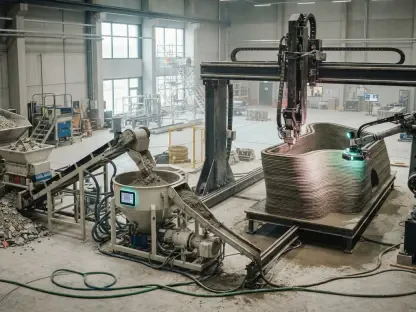
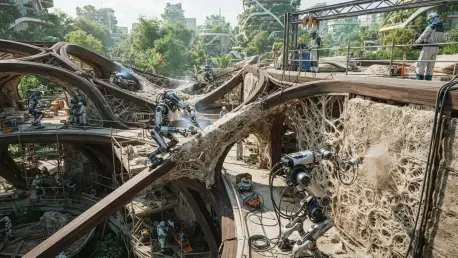
The fabrication phase utilizes a high-precision robotic arm to execute the automated winding of hemp rope around a specialized modular pin-loom system. This arrangement allows for the creation of large-scale scaffolds without the need for traditional solid molds, which typically consume vast amounts of material and limit design flexibility. As the robot moves along its pre-programmed path, it anchors the rope at specific points, creating a multi-layered network of fibers that forms the skeleton of the building panel. This coreless winding technique is particularly effective for producing components that require high tensile strength, as the continuous nature of the braided rope ensures a consistent load path throughout the structure. By operating within a 2000 by 1000 millimeter workspace, the robot can produce panels that are large enough for practical architectural applications, proving that automated bio-fabrication is a scalable solution for modern construction challenges where traditional methods often fall short in terms of efficiency and customization. The precision of the robot ensures that the rope density is perfectly matched to the digital model, creating a repeatable manufacturing process.
Success in robotic braiding depends on the seamless coordination between the movement of the robotic arm and the feed rates of the rope dispenser. If the robot moves too quickly relative to the fiber output, the rope may snap under tension; if it moves too slowly, the material will sag, leading to a loss of geometric fidelity and structural integrity. To maintain this balance, the control system synchronizes the tool-center-point speed with the mechanical extrusion of the hemp yarn. Despite the high level of automation, the unpredictable behavior of natural hemp necessitates a hybrid approach involving a human operator. During complex diagonal transitions or tight turns where the rope might slip, an operator provides real-time assistance by guiding and pressing the loops into place along the vertical axis. This collaborative effort ensures that the scaffold remains perfectly aligned with the digital toolpath, achieving a high autonomous turn-closure rate while maintaining the structural integrity needed for the biological phase. This synergy between human intuition and robotic precision allows for the handling of variable natural materials that standard industrial systems often struggle to process alone.
3. Biological Stabilization Protocol
Once the mechanical scaffold is complete, it enters a rigorous biological stabilization protocol designed to transform the loose rope into a solid, mold-free composite. The process starts with the sanitation of the hemp structure, which involves a combination of thermal-chemical treatments and short-wave UV-C light exposure. This step is critical to suppress any competing molds or bacteria that might inhabit the natural fibers and interfere with the desired fungal growth. Following this pasteurization, the scaffold is inoculated with a liquid culture of specific fungal strains, such as Trametes pubescens or Ganoderma lucidum. These species are selected for their ability to thrive on lignocellulosic substrates like hemp and their capacity to produce a dense, protective rind. The liquid inoculum is distributed evenly across the braided network, ensuring that the fungal mycelium has access to all the rope-to-rope contact points where it will eventually act as a natural binding agent, replacing the need for toxic synthetic resins or glues commonly used in standard construction.
The inoculated panels are then moved to a climatically controlled clean room for a period of two to four weeks. During this incubation phase, the environment is strictly maintained at temperatures between 25 and 26 degrees Celsius with high humidity levels to encourage the mycelium to weave through the hemp fibers. As the fungus grows, it consumes a small portion of the substrate and creates a dense network of filamentous hyphae that locks the rope junctions in place. Once the desired density is reached, the biological activity is halted through a controlled dehydration process. The panels are moved to a lower-humidity area where they air-dry until they reach a constant mass. This dehydration triggers a stiffening effect that effectively freezes the braided geometry into its final form. The resulting material is a rigid, bio-based composite that achieves structural stability through purely biological means. This final step not only ensures the panel is safe for indoor use by stopping the growth but also significantly reduces the weight of the component, making it easier to handle and install in building projects.
4. Future Insights: Advancing Bio-Based Fabrication Standards
The development of braided mycelium composites proved that the intersection of robotics and biology could yield viable alternatives to conventional building materials. Researchers found that while the biological stabilization process introduced some geometric deviations, the resulting panels possessed a unique combination of lightweight properties and structural resilience. The mechanical tests indicated that the mycelium successfully localized loads at the rope junctions, preventing brittle fracture and allowing for progressive damage accumulation. This suggested that the panels could serve as effective cladding or semi-structural elements in interior environments. However, the study also revealed that acoustic absorption remained a challenge, as the dense configuration of the braided hemp did not naturally facilitate the high levels of sound attenuation typically expected from porous bio-composites. The data showed that reaching the industry standard for speech intelligibility would require further modifications to the fiber spacing and the open porosity of the panels to better trap sound waves.
To move this technology from the laboratory to the construction site, future efforts focused on optimizing the braid topology to enhance acoustic performance and reducing the multi-week incubation time through the use of faster-growing fungal strains. The researchers recognized that the mass fluctuations during the wetting and drying phases presented a logistical hurdle that needed to be addressed through better fixturing systems. Furthermore, the development of integrated moisture sensors and automated humidity control within the bioreactors helped to minimize the warping observed during the final dehydration phase. As these fabrication frameworks continued to evolve, they began to incorporate more advanced feedback loops where the robot adjusted its tension based on real-time sensing of the hemp’s variable thickness. This led to a more robust and predictable manufacturing pipeline for sustainable architecture, eventually allowing for the production of custom, mold-resistant building components that could be seamlessly integrated into carbon-neutral building designs without sacrificing geometric freedom or structural safety.