
By utilizing inexpensive fertilizer chemistry, researchers have successfully doubled the strength of a carbon-negative building material without increasing its weight or density. This development arrives at a pivotal moment as the global construction sector faces intensified pressure to transition away from high-emission materials like traditional Portland cement. Hempcrete, a mixture of hemp shives, lime, and water, has long been a favorite for its thermal efficiency and carbon sequestration, yet its inherent fragility relegated it to non-structural roles. The recent breakthrough focuses on a specific chemical activator—potassium sulphate—to transform this lightweight bio-composite into a more robust building tool. By addressing the structural limitations that have historically hindered hempcrete’s adoption, scientists are paving the way for a new generation of architecture that actively removes carbon from the atmosphere. This shift represents a move toward high-performance sustainability, where environmental benefits do not require a compromise in durability or structural reliability in the face of modern building demands.
Material Innovation: Bridging the Gap Between Porosity and Power
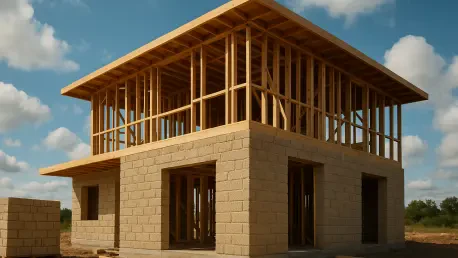
The fundamental challenge of bio-based materials like hempcrete lies in the inverse relationship between thermal performance and physical resilience. To maintain the low thermal conductivity necessary for energy-efficient housing, the material must remain highly porous, which inevitably results in a lower density that cannot withstand significant structural loads. In the current 2026 landscape, most hemp-based constructions are limited to timber-frame infill where the wood provides the skeleton and the hempcrete serves as the skin. Previous attempts to increase the strength of these mixtures usually involved the heavy-handed addition of Portland cement or an increase in the lime-to-hemp ratio. These adjustments often backfired, as they significantly increased the embodied carbon of the project and reduced the material’s ability to regulate moisture. Consequently, the search for a catalyst that could strengthen the binder without densifying the core became a priority for material science labs.
The solution identified by researchers involves the deliberate introduction of potassium sulphate as a chemical catalyst within a ternary binder system. This binder typically consists of dolomitic pressure-hydrated lime, calcium hydrated lime, and highly reactive metakaolin, which is rich in alumina. When potassium sulphate is added, it triggers a rapid chemical reaction that produces ettringite, a needle-like crystal that forms early during the curing process. These crystals grow within the microscopic voids of the lime-metakaolin matrix, creating a dense network of interlocking bridges between the binder and the woody hemp shives. This internal reinforcement provides a significant boost to the mechanical integrity of the composite without requiring more material or higher compaction levels. By manipulating the chemistry at a molecular level, the research team found a way to enhance the structural network of the material while preserving the air pockets that give hempcrete its celebrated insulation properties.
Empirical Results: Quantifying the Strength of Chemical Activation
Empirical data from the latest testing cycles shows that the addition of only three percent potassium sulphate yields transformative results for the material’s compressive capacity. When compared to a standard high-performance hempcrete reference mix, the chemically activated version demonstrated strength gains of over 50 percent within the first week of curing. By the fourteen-day mark, the strength had increased by nearly 100 percent, eventually reaching a terminal 28-day strength of 0.681 megapascals. While this figure is still lower than that of heavy-duty structural concrete used in high-rise foundations, it represents a massive leap for a material with a density of only 548 kilograms per cubic meter. This level of performance makes the material significantly easier to handle during the construction phase, as it can support its own weight and withstand the rigors of on-site assembly much earlier than traditional hemp-lime formulations, thus speeding up project timelines and reducing labor costs.
Beyond the raw increases in compressive strength, the chemical activation provides a crucial solution to the problem of dimensional instability and moisture sensitivity. Standard hempcrete is known to lose nearly 44 percent of its strength when it transitions from a wet state to an oven-dry state, a vulnerability that has long worried structural engineers. However, the activated mix in the current study showed remarkable resilience, losing only six percent of its strength under the same drying conditions. Using advanced digital image correlation techniques to track microscopic movements, the team also observed a 28 percent reduction in drying shrinkage. This improvement is vital for maintaining the integrity of the building envelope over several years, as it prevents the formation of cracks and gaps that could lead to air leakage or water infiltration. This enhanced stability ensures that the material remains a reliable barrier against the elements, providing a consistent level of thermal protection.
Lifecycle Assessment: The Environmental Math of Carbon-Negative Building
Maintaining the carbon-negative status of hempcrete was a non-negotiable requirement for the research team, as the primary draw of bio-composites is their ability to mitigate climate change. A comprehensive life-cycle assessment was conducted to determine if the production and transport of potassium sulphate would offset the carbon captured by the hemp. The findings were overwhelmingly positive, confirming that the biogenic carbon stored within the hemp plant remains the dominant factor in the material’s environmental profile. During its growth phase, the hemp sequestered more carbon dioxide than was emitted during the mining and processing of the lime and the chemical additives. When the carbonation process of the lime binder—which continues to absorb carbon dioxide from the air long after the building is completed—was factored into the equation, the resulting material remained a powerful carbon sink. The activated mix was found to have a net-negative carbon footprint of nearly half a kilogram per test specimen.
The precise chemistry of the activator also contributes to the material’s longevity, which is a secondary but vital component of sustainability. By creating a more stable internal structure that resists shrinkage and cracking, the potassium sulphate ensures that the sequestered carbon remains trapped within the wall for a longer period. The study noted that the three-percent dose of the chemical activator only increased the overall carbon footprint of the production phase by a negligible four percent, a small price to pay for a material that is twice as strong. This balance demonstrates that high-performance building tools can be developed using affordable fertilizer-grade chemistry without abandoning the principles of circular economy or environmental stewardship. As national building codes in 2026 begin to mandate stricter carbon limits for new developments, this evidence provides the necessary scientific backing for architects to specify hemp-based materials in a wider variety of commercial and residential projects.
Industrial Implementation: Long-Term Outlook for Industrial Adoption
Despite the significant progress made in the laboratory, the journey toward widespread industrial adoption requires addressing several practical challenges related to long-term durability. Moving forward, the research focus is shifting toward how these sulphate-activated systems perform over a multi-decade lifespan, particularly when exposed to extreme environmental stressors. Researchers are currently planning extensive testing to evaluate the material’s resistance to freeze-thaw cycles, which can be particularly damaging to porous bio-composites in northern climates. Furthermore, the industry must verify that the chemical activator does not inadvertently encourage biological growth or attract pests that could compromise the organic hemp core. Mapping the full response curve for different dosages of potassium sulphate will also be necessary to ensure that builders can tailor the mix to specific regional climates and structural requirements, ensuring that the material is as versatile as the traditional concrete it aims to replace.
The study concluded that the strategic use of chemical activators successfully bridged the gap between sustainable intent and structural reality. Builders were encouraged to adopt these refined binder formulations to move beyond the limitations of traditional bio-composites. Future projects should prioritize the implementation of sulphate-activated hempcrete in low-rise residential structures to gather real-world performance data. It was also determined that establishing localized supply chains for hemp and lime would further reduce the embodied energy of the final product. By focusing on the end-of-life recyclability of these materials, the industry ensured that the carbon sequestered during the building’s life would not be released back into the atmosphere upon demolition. These findings provided a robust foundation for updating regional building standards, offering a clear path for developers to meet carbon neutrality targets. Ultimately, the integration of simple chemical catalysts transformed a niche eco-material into a viable tool for resilient and sustainable modern construction.