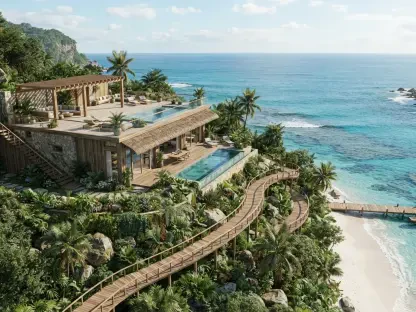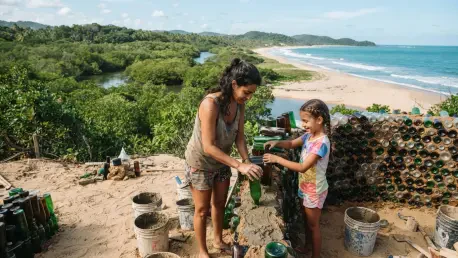

What started as a response to an eviction notice evolved into a multifunctional space that integrates hospitality, environmental pedagogy, and social justice advocacy for the local community. Located on the scenic yet ecologically fragile Itamaracá Island in Brazil, Casa de Sal is a 750-square-foot sanctuary constructed by Edna Dantas and her daughter, Maria Gabrielly. The project emerged from a housing crisis during the 2020 pandemic when the family, despite owning land, lacked the financial capital for conventional building materials. By identifying the glass bottles littering local mangroves and beaches as a viable structural resource, they embarked on a two-year journey that redefined the concept of “waste.” This residence is more than just a home; it is a physical manifestation of environmental activism. By salvaging 8,000 bottles, the duo addressed both their personal need for shelter and the island’s lack of selective recycling systems, creating a pioneering model for circular living and sustainable construction.
Architectural Innovation: Technical Mastery
Engineering With Discarded Resources
The physical assembly of Casa de Sal required a methodical approach to waste management that turned environmental cleanup into a sophisticated engineering endeavor. Over twenty-four months, the builders scoured the island’s ecosystems to salvage thousands of glass containers. To ensure maximum structural integrity, the bottles were set vertically into mortar with their openings facing downward. This specific orientation allowed for the creation of an interlocking matrix that mimics the strength of traditional masonry while significantly decreasing the overall volume of sand and cement required for the project.
This masonry technique provided a distinct advantage in a coastal environment where humidity and salt air often degrade traditional materials over time. By embedding the glass within a sturdy mortar shell, the creators built a residence that is remarkably resilient against the elements while maintaining a low thermal mass to regulate interior temperatures. This strategic repurposing of glass demonstrate that low-cost housing does not have to sacrifice durability, provided that builders are willing to experiment with unconventional geometries and locally available resources that others might perceive as useless debris.
Maximizing Natural Light and Recycled Elements
The aesthetic and functional brilliance of the residence is most evident in the way the glass bottles interact with natural light to create a vibrant interior environment. Because the walls are composed of thousands of glass units, they act as translucent bricks that permit daylight to filter through the structure without compromising privacy. Throughout the day, the shifting position of the sun creates intricate, colorful light patterns across the interior floors, effectively turning the house into a large-scale optical installation. This design choice significantly reduces the dependence on artificial lighting.
Beyond the glass walls, the home incorporates diverse waste streams to achieve a holistic vision of resource diversion. The roofing system utilizes specialized tiles manufactured from recycled toothpaste tubes, which offer superior thermal insulation and waterproofing. Interior partitions were crafted from reclaimed wood and discarded shipping pallets, which were sanded and treated to provide a warm, rustic contrast to the glass and mortar. This multi-material approach underscores the commitment to a circular economy, proving that consumer waste can be utilized to create high-performance components.
Social Resilience: Community Impact
Overcoming Prejudice in the Building Process
Navigating the social complexities of a self-build project presented as many challenges as the technical construction itself, particularly regarding local perceptions of expertise. As the project progressed, Edna and Maria Gabrielly faced skepticism from neighbors and hired contractors who doubted their technical competency. As women leading a radical departure from conventional methods, they had to constantly assert their researched methodologies and organizational leadership to maintain control over the build. Overcoming these deep-seated gender prejudices was a central part of the building process.
Their professional backgrounds were instrumental in navigating these hurdles, blending environmental education with creative design thinking. Edna’s thirty years as an ecological educator provided the ethical foundation, while Maria Gabrielly’s training in fashion design informed the aesthetic cohesion and spatial logic of the residence. By merging these disciplines, they approached construction problems from a design-thinking perspective, viewing the house as a piece of functional art. This success has since encouraged other local women to take an active role in sustainable development initiatives.
A Sustainable Hub: Environmental Education and Justice
Today, the residence serves as a vibrant center for environmental advocacy and community-led pedagogy, extending its influence far beyond its own footprint. The Dantas family utilizes the space as a primary residence while also offering hospitality services, allowing visitors to experience the practicalities of sustainable living first-hand. This dual-purpose model generates income while serving as an immersive educational tool. The house also hosts frequent workshops focused on the circular economy, providing actionable advice for local residents on how to mitigate environmental impact through reuse.
The project ultimately established a powerful critique of the environmental racism and infrastructure neglect that often plagues marginalized coastal communities. By successfully transforming 8,000 bottles into a high-quality home, the builders provided a tangible solution to the intersection of housing scarcity and environmental degradation. They proved that grassroots innovation could effectively bypass systemic failures, offering a blueprint for a more equitable future. This initiative motivated regional authorities to consider more robust recycling strategies, demonstrating how one project can spark change.