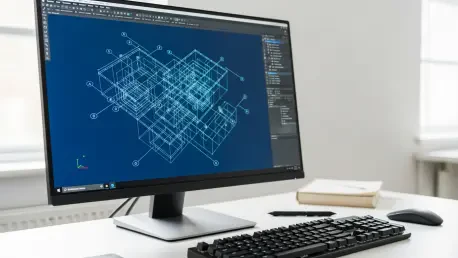

The architectural and engineering industries have long dreamed of a “magic button” that could transform conceptual sketches into fully dimensioned, production-ready blueprints with a single click. While the rapid advancement of large language models has revolutionized content creation and software development, the specific domain of 2D Computer-Aided Design (CAD) remains a bastion of manual precision that resists simple automation. Today, the conversation surrounding AI in drafting is saturated with grandiose promises from marketing departments that often exceed the functional capabilities of the tools currently available on the market. Professionals frequently encounter software advertisements claiming full generative capabilities, yet the reality involves a high degree of manual oversight and technical troubleshooting. This gap between expectation and reality necessitates a closer examination of what contemporary systems can actually achieve in a high-stakes production environment where errors are costly. This exploration uncovers the nuanced truth behind the marketing.
The Disconnect: Market Claims Versus Technical Reality
One of the most significant barriers to understanding the current state of CAD technology is the absence of a universally accepted definition for what constitutes “Artificial Intelligence” within a drafting environment. Marketing teams frequently exploit this ambiguity by labeling basic features—such as command prediction algorithms or rudimentary help-desk chatbots—under the expansive and often misleading umbrella of AI-driven design. Consequently, a professional drafter might invest in a suite expecting a revolutionary generative engine, only to find that the “intelligence” is merely a smarter search function for software documentation. This semantic inflation creates a sense of technological maturity that the actual software core has yet to reach, leaving users to navigate a landscape where every minor update is rebranded as a major cognitive breakthrough. Without clear industry standards, the distinction between a useful productivity tool and a buzzword remains opaque for decision-makers and engineers.
A detailed analysis of the current market leaders reveals that the promise of a native, prompt-to-geometry generation system remains unfulfilled in professional 2D CAD environments. While there are countless startups claiming to offer “text-to-CAD” solutions, these platforms almost never operate within the primary software used by large-scale engineering firms. Instead, they exist as siloed web applications that struggle to output the complex, layered, and standards-compliant files required for municipal permitting or structural fabrication. The technical reality is that no major vendor has successfully integrated a natural language interface capable of interpreting a sentence like “draw a three-bedroom ranch layout with seismic bracing” into a mathematically perfect DWG or DXF file. Instead, the industry has focused on optimizing existing manual workflows, improving object recognition, and automating repetitive metadata entry, while the core task of original creation remains firmly with human operators.
Categorizing the Landscape: Current Functional Tiers
The current spectrum of design tools can be segmented into distinct functional categories, primarily beginning with integrated assistants that act as workflow accelerators. For example, contemporary versions of the Autodesk Assistant function as sophisticated documentation overlays, enabling users to query technical manuals via a chat interface rather than generating actual geometry. Similarly, BricsCAD’s AI-Predict feature uses historical data to suggest the most likely next command based on a user’s current actions, which functions more like a dynamic toolbar than an independent creator. These tools are meticulously designed to “bolt onto” existing methodologies, aiming to shave seconds off common tasks rather than fundamentally rethinking the design process. They are essentially digital lubricants for the human-led drafting machine, providing incremental efficiency gains that, while valuable, do not constitute a transition toward autonomous design generation or true geometric synthesis in 2026.
Beyond the established software ecosystems, there is a secondary tier of external utilities and academic prototypes that offer a more experimental glimpse into the possibilities of automated drafting. Some developers have introduced third-party plugins that utilize generative models to write custom scripts in languages such as AutoLISP or Python, which then execute repetitive drawing tasks within a host application. While these can be highly effective for generating simple shapes or managing bulk edits across thousands of files, they typically require significant professional intervention and rigorous manual cleanup to be usable in a real-world project. These systems are better described as “script-writing assistants” rather than autonomous drafters, as the user must still possess the expertise to verify every line and constraint. This layer of the market represents the bleeding edge of research, yet it remains separated from the daily production pipelines that demand absolute reliability and precision.
Assessing the Future: Precision and Integration
The most formidable challenge facing the development of true generative CAD is the inherent requirement for absolute mathematical precision, a standard that conflicts with the probabilistic nature of modern AI. Unlike text generators or image synthesis tools, which can afford a degree of creative “fuzziness” or stylistic flair, engineering blueprints must adhere to rigid geometric constraints and structural codes. An AI that generates a floor plan where walls are off by a millimeter or lines fail to snap correctly creates a cascading series of errors that can render an entire project unbuildable. Current models are excellent at recognizing patterns and predicting the next likely word or pixel, but they struggle with the deterministic logic required to maintain complex relationships between objects in a parametric model. This gap is why many “AI CAD” tools remain focused on secondary support roles, as the high-stakes task of creating the primary geometric truth of a building still requires the discerning eye of a human engineer.
Organizations that successfully navigated this transition focused on a tiered adoption strategy that prioritized mathematical accuracy over creative generation. The most effective approach involved implementing a “human-in-the-loop” verification system where AI-generated drafts underwent rigorous structural audits before being finalized. This strategy mitigated the risks associated with the probabilistic nature of current models while capturing significant time savings in the documentation phase. Moving forward, the industry prioritized the development of standardized protocols for AI-to-CAD translation to ensure cross-platform compatibility and structural safety. By focusing on these concrete integration steps, firms established a foundation that allowed for the seamless adoption of more advanced generative features as they emerged. This shift transformed the role of the drafter from a manual laborer into a high-level systems auditor. Consequently, the focus remained on refining the interaction between natural language inputs and deterministic geometric outputs to maintain engineering integrity.