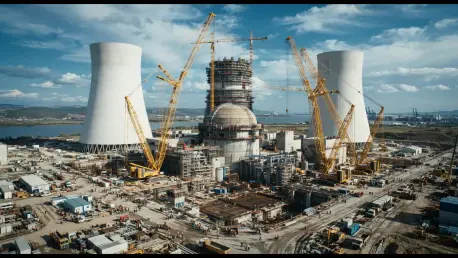

Economic stability in the nuclear sector now hinges on whether the government will allow a fair distribution of risk between state entities and private construction firms. The South Korean government, led by the Ministry of Economy and Finance, has initiated an exhaustive review of the special contract exemptions historically granted to Korea Hydro & Nuclear Power. This policy shift emerged as a direct response to intensifying grievances from the domestic construction industry, where major players argued that current contractual frameworks are not only antiquated but financially ruinous in the current market. At the heart of this analysis lies the tension between the state’s desire for rigid project cost controls in the nuclear energy sector and the private sector’s desperate need for a balanced mechanism to adjust for inflation and unforeseen design modifications. The investigation encompasses the legal structures of the Government Contracts Act and the broader implications for South Korea’s export strategy as the nation seeks to maintain its status as a global leader in atomic energy technology.
Structural Disparities: Public Procurement Rules versus Nuclear Projects
A fundamental theme emerging from the current review is the disparity between standard government contracts and those managed by KHNP. Under the general Government Contracts Act, public infrastructure projects typically include provisions for contract amount adjustments. These allow for the renegotiation of fees when material costs rise significantly or when design changes increase the total workload. However, KHNP has long operated under a set of special exemptions justified by the unique and long-term nature of nuclear power plant construction. These exemptions essentially create a closed financial loop where the state entity holds the leverage. While KHNP is a public organization, its special status allows it to bypass standard rules of price adjustment. For instance, current exemptions restrict adjustments solely to direct material and labor costs. Crucially, they exclude indirect costs like overhead and profit margins, which are essential for the survival of any major private contractor in this economy.
The construction industry’s urgent call for reform is fueled by astronomical reported losses that threaten the viability of the entire supply chain. The most prominent example cited in recent discussions involves the construction of Saewul Nuclear Power Plant Units 3 and 4. This specific project faced significant delays of over three years, during which time the global economic landscape shifted dramatically. Industry representatives claim that contractors on this project alone have suffered losses exceeding 600 billion won. These failures are often attributed to premature bidding, where contractors are forced to commit to a fixed price based on conceptual basic design documents. These documents provide no granular detail on the actual volume of work required for safety-critical nuclear infrastructure. When the reality of the construction site diverges from the initial conceptual plan, the current exemptions leave no room for builders to recoup their expenses, forcing them to absorb the financial shock.
Global Export Ambitions: Aligning Domestic Standards with International Markets
There is a growing consensus among policy experts that the current regulatory environment has failed to keep pace with modern construction realities. In the past, these exemptions were viewed as a necessary tool to maintain momentum in the nuclear sector and foster rapid industry expansion. However, the modern trend toward parallel design and construction—often referred to as fast-tracking—has turned these exemptions into a systemic risk. Building begins before the final blueprints are even finished, yet the financial burden remains fixed on the contractor. This approach effectively shifts all financial risks away from the state and onto the private sector, creating an environment where even the most efficient firms can face insolvency due to factors beyond their control. This dynamic has stifled innovation within the domestic market, as companies are more focused on mitigating financial ruin than on advancing the technical boundaries of nuclear engineering and project management.
Furthermore, the industry is increasingly concerned about the exportability of these restrictive domestic practices to the international stage. As South Korea seeks to solidify its position as a premier global provider, evidenced by recent developments regarding the Dukovany nuclear plant in the Czech Republic, contractors are wary of the precedent being set. They fear that KHNP might attempt to apply these same restrictive domestic exemptions to international projects to keep bid prices artificially low. The industry argues that if these domestic rules are not reformed, South Korean firms will eventually lose their competitive edge and technical viability. They cannot indefinitely sustain hundreds of billions of won in losses simply to maintain their standing in the global market. Aligning domestic regulations with international standards for risk-sharing is now seen as a prerequisite for the successful expansion of South Korea’s nuclear influence throughout Europe and the Middle East.
A Strategic Path: Implementing Structural Reform for Contractual Equity
During recent high-level meetings with the Ministry of Economy and Finance, construction firms outlined a clear roadmap for structural reform. They are not merely seeking government subsidies but are advocating for a structured and transparent method of risk-sharing that reflects 21st-century economic realities. One primary recommendation involves expanding the scope of price adjustments to include indirect costs such as general administrative expenses. Additionally, the industry has called for the implementation of a Bill of Quantities provided at the time of the bid to serve as the baseline for assessing volume changes. This would ensure that any design modifications requested by the project owner are automatically eligible for contract amount adjustments. By ensuring that detailed drawings—not just basic designs—are recognized in the adjustment process, the government can create a more predictable and fair environment that encourages long-term investment from private partners.
The investigation into the contract exemptions of the nuclear sector revealed a critical bottleneck in the national energy strategy. The government’s decision to engage with construction leaders signified a realization that the financial health of private contractors remained inextricably linked to the success of national goals. The findings suggested that the special exemptions had become a tool for cost-shifting rather than effective cost-management, placing an unsustainable burden on the private sector. To remain a global leader, the administration recognized that it had to modernize the internal regulatory framework to reflect the complexity of modern infrastructure projects. The move to solicit industry input was a vital step toward an equitable system. Success ultimately depended on whether the government chose to ease these restrictions to allow for a fair distribution of risk. This reform proved to be a necessity for the long-term stability and safety of the nuclear energy infrastructure as the nation moved forward.