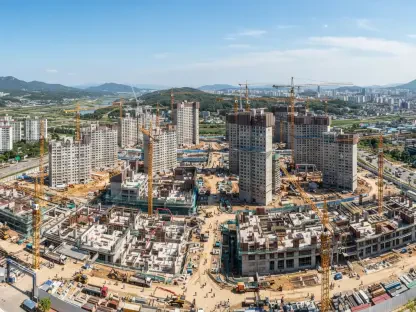

The landscape of Connecticut’s labor market has undergone a dramatic transformation that few economists would have predicted with such certainty back when the recessionary clouds first began to lift. By the time the state recorded 65,200 active workers in April 2024, it became clear that the long, arduous process of stabilization following the Great Recession and the subsequent pandemic-era volatility had finally paid off. Today, in 2026, the sector is defined by a powerful synergy between aggressive public infrastructure spending and a robust surge in private development. The journey to this point was characterized by extreme fluctuations, with the workforce plummeting to a low of 50,500 in 2010 before slowly climbing back through the 2010s. This current rebound appears significantly more aggressive and sustained than previous cycles, suggesting a permanent economic expansion rather than a temporary spike in activity. The state has successfully moved past the uncertainty of the early 2020s, building a foundation that now supports a wide range of large-scale projects and high-paying jobs.
The Catalyst: Public Infrastructure Modernization
Legislative Framework: Policy-Driven Progress
Central to this resurgence was a series of long-term public policy initiatives designed to modernize Connecticut’s aging transportation network. The 2015 “Let’s Go CT” initiative played a crucial role by focusing on the early planning and design stages of major projects, effectively creating a steady pipeline of work for the coming decade. When the federal Infrastructure Investment and Jobs Act was passed in 2021, the state found itself in a uniquely advantageous position, ready to deploy substantial funds toward “shovel-ready” projects. This foresight ensured that when federal capital became available, there was no delay in moving from concepts to active job sites. As a result, thousands of workers have been consistently employed on complex bridge replacements and highway expansions across the state. This legislative support has provided the predictable environment that construction firms need to invest in their own equipment and personnel, knowing that the work will remain steady for the foreseeable future.
Beyond just the immediate employment numbers, these legislative frameworks established a blueprint for how the state handles large-scale capital investments over multi-year cycles. By integrating state-level planning with federal funding opportunities, Connecticut has mitigated the boom-and-bust cycle that often plagues the heavy civil engineering sector. This approach has allowed for a more strategic distribution of resources, ensuring that rural bridge repairs receive as much attention as major urban highway interchanges. The reliability of this funding has also encouraged local municipalities to start their own local infrastructure upgrades, further broadening the impact of state-level policy. As these projects move from the drawing board to reality, they create a ripple effect throughout the regional economy, supporting suppliers, engineers, and maintenance crews. The success of these initiatives demonstrates the importance of early-stage planning and the ability to leverage federal partnerships to drive local economic growth and workforce development.
Institutional Evolution: Delivering Mega-Projects
A noticeable shift in the cultural and operational approach within the Department of Transportation has further streamlined the delivery of these massive public works projects. Officials have focused on matching federal grants with strategic state borrowing to greenlight complex, multi-year endeavors that were previously considered too expensive or logistically difficult. A prime example is the $712 million reconstruction of the Meriden interchange, a project that addresses a long-standing transit bottleneck while providing years of guaranteed labor for the local workforce. By adopting modern project management techniques and collaborative bidding processes, the state has been able to reduce delays and manage costs more effectively. This operational efficiency has made the state more competitive when applying for competitive federal grants, as federal agencies look for regions with a proven track record of successful project execution. These investments provide a stable baseline for the industry, protecting it from the volatility seen in the purely private market.
The modernization of the state’s transportation infrastructure is not just about moving vehicles; it is about creating an environment where commerce can thrive without the hindrance of crumbling roads. The commitment to these long-term public works has signaled to the broader business community that the state is serious about its economic viability. This has led to an increase in secondary construction projects, such as the development of logistics hubs and distribution centers that rely on efficient transit networks. Furthermore, the focus on sustainable and resilient infrastructure means that new projects are built to withstand the environmental challenges of the coming decades, reducing future maintenance costs and ensuring long-term reliability. By prioritizing these critical transit links, the state has laid the groundwork for a more integrated regional economy. This structural stability is a key reason why the construction sector has remained resilient even as other industries faced headwinds, providing a reliable source of high-quality jobs for thousands of residents.
Diversification: Expanding the Private and Cultural Landscape
Sector Growth: Healthcare and Housing Hubs
While public investments provide the industry’s floor, the private sector is currently driving the heights of this resurgence through massive investments in healthcare and residential housing. Construction firms across the state have reported dramatic revenue increases, fueled by an insatiable demand for specialized medical facilities and modernized hospital wings. Connecticut’s leading role in healthcare innovation has necessitated a physical expansion of its clinical and research spaces, resulting in several multi-million dollar contracts for local builders. Simultaneously, the state has led the nation in housing permit growth, reflecting a desperate need for new residential inventory to accommodate a growing workforce. Developers, who were previously sidelined by supply chain disruptions and price uncertainty, are now moving forward with residential projects as inflation has begun to stabilize. This surge in private activity complements the public works pipeline, creating a balanced market where commercial, residential, and industrial projects all compete for skilled labor and materials.
The diversification of private development has also extended into the technology and life sciences sectors, where new laboratories and data centers are becoming common features of the suburban landscape. These projects require highly specialized construction techniques and materials, which in turn drives innovation within the local building trades. The focus on high-density residential developments near transit hubs—a direct result of the improved public infrastructure—has further energized the urban cores of cities like Hartford, Stamford, and New Haven. This “transit-oriented development” model has successfully attracted younger professionals who value connectivity and modern amenities, further fueling the demand between 2026 and 2028 for new construction. As private capital continues to flow into these diverse projects, the construction industry has become a primary engine of the state’s broader economic growth. The synergy between public transit improvements and private real estate investment has created a virtuous cycle of development that shows few signs of slowing down in the current economic climate.
Workforce Shift: The Rise of Technical Careers
This sustained level of activity has profoundly changed how the modern workforce perceives manual labor and the skilled trades. Many young workers are now actively bypassing traditional four-year college degrees in favor of debt-free apprenticeships that offer competitive wages and immediate job security from day one. In an era dominated by concerns over artificial intelligence and the automation of office-based roles, the physical construction trades are increasingly viewed as resilient careers that cannot be easily replaced by software. This shift has led to a revitalization of vocational programs and trade schools, which are seeing record enrollment numbers as students recognize the value of specialized technical skills. The industry has responded by offering better benefits and career advancement paths, making the trades a viable long-term option for a new generation of workers. This cultural shift is essential for maintaining the momentum of the current boom, as a steady supply of new talent is required to fill the positions created by retiring veterans.
To ensure that this prosperity remained sustainable, industry leaders focused on diversifying the talent pool and modernizing training protocols. The expansion of the state’s economy by nearly $100 billion since 2018 demonstrated a fundamental shift in regional confidence, which necessitated a more inclusive approach to recruitment and workforce retention. Stakeholders prioritized the integration of advanced building technologies into apprenticeship curricula, preparing workers for the increasing complexity of green building standards and smart infrastructure. While the sector thrived at its highest level in sixteen years, maintaining this pace required a consistent flow of both public capital and a steady pipeline of new talent. Legislative bodies took steps to index infrastructure funding against material cost inflation, protecting the buying power of budgets from 2026 to 2028. By addressing these structural challenges early, the state secured its path toward long-term residential stability and industrial growth. The focus transitioned from merely filling jobs to building a resilient, tech-savvy workforce capable of sustaining the state’s physical and economic future.