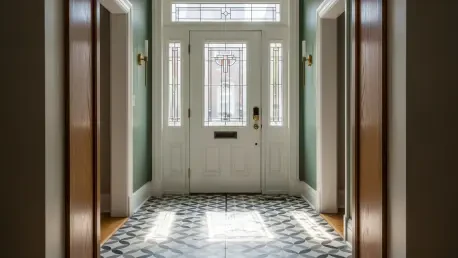

A sliver of stained glass caught the morning sun and threw a keyhole of light across an East Passyunk vestibule, and that small, shimmering gesture became the hinge on which a whole Philadelphia rowhome turned. It was more than a nostalgic flourish; it was a brief, a boundary, and—crucially—a promise that history could spark a future-ready interior without locking it into pastiche or sentimentality.
That door, a Tofani original prized for its decorative glass and keyhole motif, framed the challenge that re(work) Architecture & Design set out to solve: preserve a beloved neighborhood artifact while structuring a cohesive, mid-century modern interior suited to the demands of vertical city living. The result mattered beyond one address, speaking to how rowhouses adapt under pressure—narrow widths, long sightlines, and a hunger for light, storage, and outdoor access.
A Front Door Sets the Tone—How One Artifact Reoriented an Entire Home
The project began by amplifying the entry into a statement zone rather than a pass-through. Designers tuned the vestibule’s proportions and lighting so the keyhole glow read first, then receded, like an overture. “The door set the rules of engagement,” Sary Em said. “Every new move had to negotiate with that silhouette.”
From there, the interior pivoted toward streamlined mid-century geometry—clean planes, white oak warmth, and crisp reveal lines. Eric Heidel described the editing principle plainly: “We lifted the spirit, not the style guide.” That meant abstracting curves, echoing glass tones, and calibrating frequency so the keyhole appeared as a quiet refrain, not a theme-park chorus.
Why This Makeover Matters Now
Tofani doors are part of South Philly’s streetscape DNA, and reading one as both heritage and design opportunity set a preservation tone scaled to small-footprint homes. Rather than freeze an era, the team protected the artifact while modernizing how spaces connect, vent, and store.
Rowhouses face familiar pressures: narrow lots, stacked floors, and the expectation of outdoor relief. City data since 2026 showed permit applications for roof decks and third-floor additions up roughly 18%, reflecting a pivot toward vertical expansion and fresh air. Mid-century modern principles—honest materials, integrated storage, low-profile profiles—fit those constraints.
Moreover, the local craft economy turned constraint into engine. Upholsterers, stained-glass fabricators, cabinetmakers, and stone shops from nearby blocks shaped the work. Bespoke fabrication functioned as value—precise fit, durable finishes, and serviceable parts—rather than mere ornament.
Anatomy of the Redesign—Distinct Moves That Add Up
Structural edits unlocked livability on every level. The first floor opened for shared sightlines, yet zones stayed legible with built-in thresholds and layered lighting. The basement dig-out delivered headroom and a lounge pitched as “a South Philly bar with a Twin Peaks twist,” wrapped in oak paneling and checkered VCT for durability and mood.
Above, a third-floor expansion and roof deck pulled light and air through the stack, aligning with the broader trend of vertical additions reshaping rowhouse typologies. Materially, white oak served as throughline—floors, millwork, and paneling—while earthy greens and subtle pinks warmed a restrained palette. Zellige mosaics and checkered VCT introduced geometry without visual noise.
Room by room, the language held. Vintage family pieces landed in tailored white oak built-ins in the living room. The kitchen paired oak and painted cabinetry with soapstone counters and a zellige backsplash; the bathroom balanced white and green tile, brass lighting, and a quartzite-topped vanity. Storage hid along the length—window seats, wall bays, and landing nooks—to keep daily clutter out of sight.
Voices, Research, and On-the-Ground Insights
Craft partners anchored authenticity. A stained-glass artisan noted, “Matching the original glass tone meant mixing until the keyhole read warm at dusk, not just bright at noon.” A cabinetmaker added, “In 100-year-old walls, tolerances are earned—scribe, test, repeat—until doors swing true.”
Research echoed the design’s cohesion. Local building records since 2026 pointed to steady growth in roof decks and third-floor permits, mirroring homeowner demand for outdoor access. Real estate analyses associated cohesive, limited palettes and integrated built-ins with measurably higher resale performance in comparable markets, a function of clarity rather than trend-chasing.
Lived moments sealed the story. Guests paused at the vestibule as the keyhole light traced the tile. Game nights moved downstairs, where acoustic paneling kept laughter contained. In the kitchen, soapstone picked up a soft patina track by track, a daily ledger of use instead of damage.
Apply the Lessons—Strategies for Your Own Rowhome Refresh
A simple framework emerged: Anchor a single historic element; Translate its geometry and color into new applications; Unify with a tight material kit—say, white oak plus one stone and two paint families; Adapt the plan for real habits, not inherited patterns. Open sightlines while using built-in thresholds, lighting layers, and storage carved into thickness.
For durability, pick high-wear counters like soapstone or quartzite, seal VCT, choose replaceable hardware, and design service access into millwork. Keep bespoke work on budget with two bids per trade, mockups for stain, grout, and glass tone, plus shop drawings and approvals. Done thoughtfully, the house lived brighter, aged gracefully, and carried its keyhole story forward with restraint.