
As the skyline of Singapore continues its relentless ascent, the boots on the ground are increasingly being replaced by tracks and sensors, signaling a fundamental shift in how the city-state builds its future. The lack of after-sales support from international manufacturers often leaves Singaporean contractors with specialized machinery that is difficult to repair or update locally. This logistical hurdle persists even as the industry undergoes a pivotal technological metamorphosis driven by an acute labor shortage and a strategic national push toward automation. Historically reliant on a vast influx of migrant workers, the construction sector is increasingly looking toward robotics to ensure its long-term viability and operational stability. The central theme of this shift is the transition from labor-intensive, manual on-site work to a high-tech supervisory model where human operators manage autonomous systems from remote, controlled environments. By late 2025, the dependency on non-resident labor reached nearly 80%, a figure that highlighted a strategic vulnerability in the face of rising levies and regional competition for workers. Consequently, firms began to pivot toward silicon and steel to bridge the gap left by a shrinking pool of willing manual laborers who are moving toward more comfortable roles in other developing nations.
Government Mandates and Public Leadership
Driving Adoption: Policy and Procurement
Recognizing that the private sector is often hesitant to take the initial financial risk of unproven technology, Singapore’s public agencies have taken a proactive leadership role. The Building and Construction Authority and the Housing Board are no longer merely encouraging the use of robots; they are increasingly mandating it within their project frameworks to ensure a baseline of technological integration. Starting in late 2025, several agencies made the deployment of robotics a compulsory requirement for construction tenders to insulate national infrastructure from global labor fluctuations. This top-down approach ensures that automation is not just an elective luxury for the wealthiest firms but a standard operational requirement for any entity wishing to participate in the nation’s massive public housing and infrastructure pipeline. By embedding these requirements into the procurement process, the government has effectively created a guaranteed market for robotics suppliers, encouraging them to establish a more permanent and supportive presence within the local ecosystem.
Furthermore, the integration of robotics into the Housing Board’s Build-To-Order projects has served as a large-scale testing ground for various autonomous systems. These projects provide the necessary volume for contractors to justify the high initial capital expenditure, as the cost of the technology can be amortized across thousands of housing units. The government’s strategy also involves the use of “productivity-led growth” targets, which penalize firms that remain overly reliant on manual labor while rewarding those that invest in innovative assembly methods. This shift is designed to transform the construction site into a more controlled, factory-like environment where prefabricated components are assembled by precision machinery rather than being built from scratch in the field. As these public projects demonstrate the feasibility of automation, private developers are beginning to follow suit, realizing that the long-term savings in labor levies and insurance premiums outweigh the upfront costs of the hardware.
Specialized Applications: Field Implementations
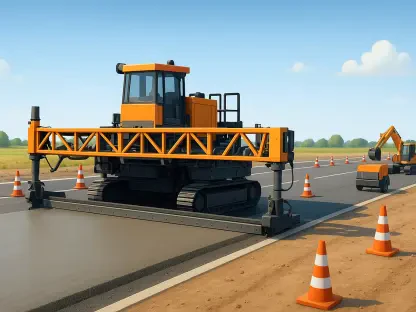
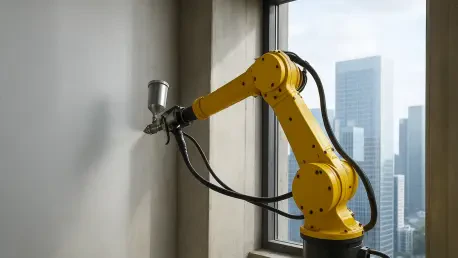
The deployment of robotics is not a monolithic trend but a collection of specialized applications tailored to specific construction phases, such as surface treatment and structural precision. For instance, painting robots allow a single operator to oversee multiple units, multiplying productivity by a factor of six while ensuring a uniform application of materials that human hands often struggle to replicate over long shifts. These machines are particularly effective in high-volume environments like parking garages and residential corridors, where repetitive tasks can be completed with mathematical consistency. Beyond simple aesthetic finishes, robotics are also being utilized for complex structural tasks, such as the precision grading of large surfaces to ensure proper drainage. At major infrastructure sites like NS Square, autonomous systems are employed to achieve levels of accuracy that manual “eyeballing” cannot match, particularly over vast spans where even a millimeter of deviation can lead to long-term maintenance issues.
In contrast to surface-level tasks, the Land Transport Authority has integrated specialized robots into its tunneling and drilling operations to remove workers from high-risk environments. These machines, such as robotic shotcrete applicators and concrete-breaking units, allow structural support to be applied to tunnel walls without placing human personnel in the path of falling debris or toxic fumes. This use of technology directly addresses the safety concerns that have historically made the industry unattractive to the local workforce while simultaneously increasing the speed of excavation. Moreover, the industry is experimenting with “ghost shift” operations, where autonomous robots move heavy materials across floors overnight. This allows human crews to start their specialized tasks immediately upon arrival the next morning, eliminating the logistical downtime typically spent on material transport. These applications represent a transition toward a hybrid workforce where machines handle the dangerous and repetitive, while humans focus on the complex.
Technical Barriers and Economic Hurdles
Financial Constraints: Market Limitations
Despite the clear benefits, robotics only account for approximately 5% of large-scale construction projects due to significant financial and technical hurdles that remain unresolved. The upfront cost of a single painting robot can range from $80,000 to $180,000, a figure that is often prohibitive for small and medium-sized enterprises with tight cash flows and limited access to credit. While government grants exist to offset these expenses, the disbursement process is frequently described as slow and administratively burdensome, forcing companies to carry the financial weight for several years. This financial pressure is compounded by the rapid pace of technological innovation, which often means that expensive equipment may become obsolete or require significant hardware upgrades within a short timeframe. For many contractors, the risk of investing in a machine that might be surpassed by a more efficient model in a few years is a major deterrent to widespread adoption.
Additionally, because Singapore is a relatively small market on the global scale, international manufacturers often prioritize larger regions when providing maintenance and software updates. This results in a lack of a robust local service ecosystem, making it difficult for contractors to find qualified technicians who can repair specialized machinery in the event of a breakdown. A single malfunctioning robot can stall an entire production line on a site, leading to costly delays that manual labor, for all its inefficiencies, does not typically face in the same catastrophic manner. The reliance on remote support from overseas headquarters often leads to downtime that erodes the productivity gains the robots were intended to provide. To combat this, some local firms have begun developing their own proprietary software and hardware modifications, but this requires an additional layer of technical expertise that few construction companies currently possess, creating a bottleneck that favors only the largest players in the industry.
Navigating Environments: Complex Worksite Logistics
Construction sites are inherently chaotic and unpredictable environments where robots often struggle with “edge cases” that a human worker would navigate intuitively. Technical trials have shown that while robots excel at repetitive tasks on flat, open surfaces, they often fail when faced with the irregularities of a dynamic site, such as plastering tight corners or navigating around uneven reinforcement bars. In several instances, the sheer weight of heavy robotic units has caused structural reinforcement bars to sag or shift before the concrete has set, highlighting a critical need for more agile and lightweight designs. These site-specific challenges require a level of spatial awareness and adaptability that current-generation autonomous systems are still developing. Consequently, many robots still require a human “minder” to be present at all times to clear obstacles or reset the system when it encounters an unfamiliar geometric configuration or a change in lighting conditions.
Furthermore, the integration of robotics requires a fundamental change in how sites are managed and organized, as traditional workflows are often incompatible with autonomous machinery. For a robot to function efficiently, the workspace must be mapped with extreme precision using Building Information Modeling data, and any deviation between the digital plan and the physical reality can cause the machine to stall. This necessitates a higher level of site cleanliness and organizational discipline than is typically found in traditional construction, where workers often move materials and tools fluidly. The transition to a robot-friendly site involves significant upfront planning and the installation of specialized sensors and markers to guide the machines. Until these digital-physical integrations become seamless, the time saved by the robot’s speed is often offset by the time spent preparing the environment for its operation. This has led to a cautious “trial and error” phase where contractors only deploy robots on sections of the site that can be strictly controlled.
Future Outlook and Industry Rebranding
Global Benchmarks: Learning from International Success
The vision for Singapore’s future is often compared to advancements in Japan, where projects like the Naruse Dam have served as a definitive proof-of-concept for the “workerless worksite.” In that specific project, a fleet of autonomous trucks and bulldozers operated for dozens of consecutive hours while being managed by operators located hundreds of miles away in a climate-controlled office. This level of remote, multi-unit coordination is the ultimate goal for Singaporean firms, as it would allow for continuous, 24-hour operation regardless of local weather conditions or immediate labor availability. By studying these international models, Singapore is looking to implement similar remote-control centers that allow a single technician to manage a fleet of machines across multiple sites simultaneously. This would not only maximize the utility of the equipment but also drastically reduce the number of personnel required to be physically present in hazardous or uncomfortable environments.
Moving beyond simple remote operation, the next phase of evolution involves the use of artificial intelligence to allow machines to communicate with one another to optimize site logistics. For example, an autonomous crane could potentially coordinate with a ground-based delivery robot to ensure that materials are placed exactly where they are needed without any human intervention. This interconnected ecosystem would function like a high-tech manufacturing plant, where the flow of materials and the progress of assembly are tracked in real-time by a central “digital twin.” Singaporean researchers are currently focusing on adapting these Japanese and European innovations to the unique constraints of dense, urban environments where space is at a premium. The goal was to create a modular, scalable system that could be deployed on everything from high-rise residential blocks to deep-underground infrastructure, ensuring that the city-state remained at the forefront of the global construction technology race.
Industry Rebranding: Attracting Modern Talent
A recurring sentiment among industry veterans is that robotics is the only way to rebrand construction for the digital age and finally attract tech-savvy Singaporeans to the sector. By turning construction sites into tech hubs where employees operate robots and analyze data rather than hauling bags of cement, business owners hoped to fundamentally change the industry’s social status. This shift in perspective was seen as essential for the survival of the sector, as the traditional manual roles continued to face a total lack of interest among the younger generation. The focus was shifted toward vocational training programs that emphasized robotics maintenance, data analytics, and digital project management, positioning construction as a high-value engineering discipline rather than a “3D” job. This rebranding was intended to draw in a new demographic of workers who were more comfortable with a tablet than a shovel, effectively bridging the gap between the technology and the labor market.
Industry leaders recognized that the transition toward a model where silicon and steel handled the “hard work” while humans provided strategic oversight was an inevitable evolution. Stakeholders identified that the long-term solution involved creating an ecosystem where local talent could thrive in supervisory roles, managing the very machines that were once viewed as a threat to job security. Collaborative efforts between the government and educational institutions established new certifications for “Robotics Site Managers,” ensuring that the workforce was prepared for the technical demands of 2026 and beyond. By focusing on the integration of lightweight, agile machinery and robust local support networks, the sector aimed to reduce its dependency on foreign labor while simultaneously increasing its overall output. Ultimately, the successful adoption of these technologies was seen as the only path toward maintaining the pace of national development in an increasingly labor-constrained global economy.