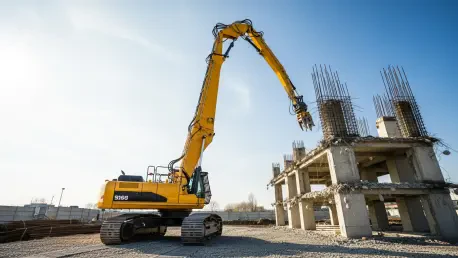

The demolition industry has reached a critical turning point where the sheer scale of modern infrastructure requires a level of engineering sophistication that was previously reserved for aerospace or deep-sea exploration. As urban landscapes become more crowded, the ability to dismantle massive steel and concrete structures without disturbing neighboring buildings has become the gold standard for high-tier contractors. Engineering firms are now focused on creating machines that can reach heights exceeding forty meters while maintaining the stability to handle multi-ton crushing tools. This evolution is driven by the need for safer, more efficient methods of deconstruction that minimize noise, dust, and vibration in sensitive environments. By integrating advanced telematics and real-time stability monitoring, these machines offer a level of situational awareness that ensures every movement is calculated and secure. This technological leap allows for the reclamation of valuable urban land through a process that is as much about surgical precision as it is about brute force.
Structural Engineering: Reach and Stability
Boom Versatility: Adapting to Structural Demands
At the heart of modern high-reach deconstruction is a versatile boom system that allows operators to adapt to varying building heights and structural materials with ease. The primary configuration features a modular design that supports multiple setups, including an ultra-high-reach attachment capable of extending to heights that were once only accessible via dangerous manual labor or specialized cranes. This system permits the use of heavy crushing tools even at significant elevations, which is essential for dismantling reinforced concrete skyscrapers. The transition between a high-reach setup and a heavy-duty shorter boom is facilitated by hydraulic pin-connection systems, reducing the downtime typically associated with equipment reconfiguration on a busy job site. By providing a stable platform for attachments weighing several tons, the machine ensures that deconstruction proceeds at a pace that matches modern project timelines while maintaining a focus on structural control and site safety.
Base Stability: The Extendable Undercarriage Design
Stability is the most critical factor when operating heavy machinery at extreme vertical extensions, as even minor shifts in the center of gravity can lead to catastrophic failures. To address this, the undercarriage of the latest high-reach excavators utilizes a hydraulic extension mechanism that widens the footprint of the machine during operation to provide a rock-solid foundation. When the tracks are fully extended, the lateral stability increases significantly, allowing the operator to maneuver heavy shears and crushers at high angles with complete confidence. Conversely, the ability to retract the undercarriage is vital for navigating narrow access roads and interior job site paths where space is at a premium. This dual-capability ensures that the machine remains a versatile asset from the moment it arrives on a low-loader to the final stages of site clearance. The integration of wide, heavy-duty crawler shoes further distributes the operating weight, protecting the ground surface while ensuring maximum traction.
Operational Mastery: Transport and Safety Protocols
Modular Efficiency: The Next Advance Framework
Moving a machine that weighs over one hundred tons across public highways and through congested city streets presents a significant logistical challenge for demolition firms. The modular system addresses this by allowing for the rapid disassembly of the main components, including the boom, counterweights, and even the undercarriage in some configurations. Each module is designed to fit onto standard transport trailers without exceeding weight limits or requiring excessive special permits that can delay a project by several weeks. This modularity means that a machine of this scale can be transported in several manageable loads and reassembled on-site using its own hydraulic systems and a minimal support crew. Once the main body is positioned, the quick-connect hydraulic lines and mechanical pins allow the boom to be attached and tested in a fraction of the time required by previous generations. This efficiency ensures that the equipment is productive for more hours, impacting the profitability of urban renewal.
Operational Security: Awareness and Conclusion
In the high-stakes environment of structural demolition, the safety of the operator and the surrounding ground crew was prioritized through the use of advanced sensor arrays and ergonomic cabin designs. The operator was positioned in a tilting cab that provided a clear line of sight to the tool at maximum height, reducing neck strain and improving overall situational awareness during long shifts. High-definition cameras and interference prevention systems provided real-time feedback on the position of the boom relative to the machine’s stability limits, issuing alerts before a dangerous condition occurred. These intelligent systems ensured that human error was mitigated by proactive machine intervention throughout the process. Contractors who invested in these high-reach technologies found that they could bid on more complex projects with lower insurance premiums and higher safety ratings. These advancements were essential in making deconstruction a predictable phase of the construction lifecycle, setting a new benchmark for industry standards.