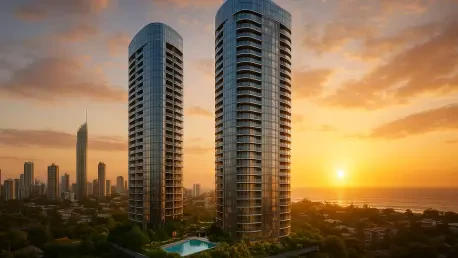

The $174 billion construction pipeline forecast for Queensland through 2030 positions projects like Cienna Varsity Ridge as critical components of the state’s broader infrastructure and housing strategy. The Gold Coast skyline is currently undergoing a monumental transformation, recently punctuated by the structural completion of this $250 million residential landmark. Developed by Homecorp, the project has officially reached its “topping out” milestone for two towers that rise twelve and fourteen storeys respectively. This structural peak is not merely a technical achievement; it represents a commercial phenomenon that saw all 289 residential units sell out well ahead of the anticipated delivery date. Located in the vibrant heart of Varsity Lakes, the development serves as a high-profile case study for modern urban density. It illustrates how strategic planning can align with aggressive market demand during a period where Southeast Queensland is experiencing a historic surge in migration. This milestone marks the shift toward a more permanent, high-capacity metropolitan environment.
Evolutionary Shifts in Regional Development and Urban Density
The project’s trajectory from its inception has been characterized by an unusual velocity that reflects the current urgency within the Australian property sector. After breaking ground in early 2025, the development was launched to a market that was already hungry for sophisticated residential solutions. By the third quarter of 2025, Cienna Varsity Ridge had secured its status as the best-selling residential project in the entire country. This rapid absorption suggests that the concept of “attainable luxury” has resonated deeply with a specific segment of the population that desires high-end aesthetics without the prohibitive costs associated with traditional premium real estate. The developer’s ability to move from planning to a total sell-out within such a compressed timeframe highlights a significant shift in buyer behavior. Investors and owner-occupiers alike are no longer waiting for completed structures but are instead committing to visions that promise a lifestyle integration long before the final brick is laid.
Urban planners and market analysts observe that the success of this development is rooted in its response to the specific demographic shifts occurring on the Gold Coast. The region is no longer just a destination for retirees or holidaymakers; it has become a primary hub for young professionals and families seeking a balance between work and leisure. This new demographic demands housing that facilitates a higher standard of living while being situated near central business districts and educational institutions like Bond University. The strategic placement of these two towers within Varsity Lakes allows for a walkable lifestyle that minimizes the reliance on traditional commuting. This approach to density—where residential volume is concentrated in areas with existing infrastructure—is becoming the blueprint for future developments across the state. By addressing the housing shortage through high-density vertical communities, the project mitigates the environmental impact of urban sprawl while meeting modern needs.
Redefining Residential Living Through Curated Amenities
Beyond providing a roof for hundreds of new residents, the development introduces a comprehensive lifestyle package designed to accommodate the permanent shift toward hybrid professional lives. The inclusion of dedicated co-working spaces within the residential footprint acknowledges that the modern workforce requires more than just a home office; it requires a professional environment that fosters productivity and networking without leaving the building. Furthermore, the integration of a private dog park addresses the rising trend of pet ownership in urban environments, ensuring that high-density living does not come at the expense of pet-friendly convenience. These practical additions are balanced by a suite of resort-style luxuries that elevate the daily experience of the inhabitants. Such amenities are no longer viewed as optional extras but as essential components of a competitive residential offering in a market where quality of life is the primary differentiator for discerning apartment buyers.
The social centerpiece of the development is found on the rooftop, where a meticulously landscaped BBQ and entertaining area provides residents with panoramic views stretching from the Surfers Paradise coastline to the Gold Coast Hinterland. This focus on communal spaces represents a broader design philosophy aimed at fostering connected communities rather than isolated living units. In addition to the rooftop hub, the towers feature a sophisticated pool deck, saunas, a state-of-the-art fitness center, and recreational rooms designed for both children and adults. By creating these shared environments, the project encourages social interaction among neighbors, which is a vital component of successful high-density urban living. This blend of functionality and leisure has set a new benchmark for vertical communities in the region, proving that lifestyle-oriented design can be scaled effectively. The focus remains on providing a “resort at home” feeling that serves the mental and physical well-being of the diverse group of residents.
Strategic Leadership and Economic Momentum
The success of Cienna Varsity Ridge is a direct reflection of the leadership provided by Homecorp’s CEO and Founder, Ron Bakir, whose two decades of experience have shaped the firm’s strategic direction. Now operating as a subsidiary of Prime Life Technologies—a heavyweight joint venture involving Toyota and Panasonic—Homecorp has access to the resources and institutional knowledge necessary to execute large-scale urban transformations. Bakir has consistently argued that increasing density is a responsibility that must be paired with an uncompromising commitment to liveability. He asserts that as the population grows, developers must create places where people can truly live well, rather than simply providing additional units to a ledger. This philosophy is evident in the project’s design, which prioritizes space, light, and community connectivity. The partnership with global tech and automotive giants further suggests that the future of housing will be increasingly defined by technological integration.
From a macroeconomic perspective, this development is a key player in a historic surge across the Queensland construction sector. For the first time, the state has approximately 50,000 new homes under construction simultaneously, representing a 25.6% increase in the housing pipeline compared to previous cycles. This growth rate outpaces every other state in Australia, signaling that Queensland has become the nation’s primary engine for residential development. The physical manifestation of this boom is most visible in the Gold Coast skyline, where a record 82 cranes were recently documented by industry indices. Nearly 90% of these cranes are dedicated to residential projects, highlighting the massive capital investment flowing into the region. This influx of activity is a necessary reaction to long-term demographic trends, as the city transitions from its historical identity into a sophisticated metropolitan hub that attracts significant talent and capital from both domestic and international sources.
Paving the Way for a Global Metropolitan Hub
Long-term projections indicate that the Gold Coast will require over 185,000 new homes by 2046 to accommodate a population that is expected to surpass the one-million mark. This immense requirement explains the aggressive development schedules and the scale of investment currently being pursued by firms like Homecorp. The company’s commitment to the region is exemplified by its $800 million pipeline, which includes other significant projects such as the Florence Residences and the Lýon Residences in Surfers Paradise. These developments are not isolated occurrences but are part of a coordinated effort to modernize the city’s residential stock and infrastructure. As the region prepares for future global events and continued migration, the emphasis on high-density, high-quality living spaces will only intensify. The success of the Varsity Lakes project provides a clear roadmap for how these future needs can be met without sacrificing the unique lifestyle appeal that makes the Gold Coast one of Australia’s most desirable locations.
The completion of the structural phase at Cienna Varsity Ridge established a new standard for urban excellence and market responsiveness. This project demonstrated that high-density living could successfully integrate luxury, community, and professional functionality into a single cohesive environment. By achieving a total sell-out during the early stages of construction, the development proved that there was a profound appetite for well-designed, attainable housing. The strategic leadership behind the project ensured that every square foot contributed to the overall well-being of the future residents, while simultaneously supporting the broader economic goals of the state. As the towers moved toward their final completion in mid-2027, they served as a testament to the maturation of the Gold Coast as a world-class metropolitan center. Stakeholders recognized that the success of this milestone reflected a broader trend toward sophisticated urban living that would continue to shape the region’s landscape and identity for decades to come.