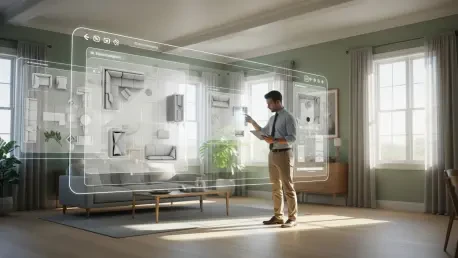

The landscape of residential property renovation has undergone a tectonic shift as sophisticated artificial intelligence platforms provide high-level aesthetic guidance that was previously restricted to the world’s most affluent homeowners. For decades, the process of creating a cohesive living environment was often hindered by the prohibitive costs of professional consultation, leaving the majority of individuals to navigate the complex world of textures, palettes, and spatial arrangements through little more than unguided intuition and impulse purchases. This lack of direction frequently resulted in spaces that felt disjointed or accumulated over time rather than intentionally planned and executed. Today, the rapid proliferation of consumer-facing AI tools is fundamentally dismantling these traditional barriers, offering professional-grade visualization and planning capabilities to anyone with a smartphone. By democratizing access to expert-level design principles, these technologies are empowering a new generation to approach their homes with confidence and artistic vision.
The Economics of a Surging Market
The digital transformation of the interior design sector is currently witnessing a period of explosive growth that significantly outpaces the broader $802 billion global home decor industry. While traditional retail and design services usually grow in tandem with housing turnover and interest rate fluctuations, the AI-driven segment is charting a much steeper trajectory as it scales from $1.39 billion in 2025 to an estimated $1.76 billion throughout 2026. This upward momentum is expected to carry the market toward a total valuation of $4.5 billion by the end of this decade, reflecting a profound shift in how consumers allocate their home improvement budgets. The surge is primarily driven by the increasing accessibility of generative models that can synthesize vast datasets of architectural styles and interior trends. As these tools become more intuitive, they are attracting a diverse user base that ranges from first-time homeowners to experienced real estate investors seeking to maximize property value.
Identifying Growth Trends and Consumer Behavior
Beyond the raw financial figures, the significance of this technological expansion lies in its ability to create an entirely new economic category rather than simply cannibalizing existing services. Artificial intelligence is performing a specific job that previously went entirely undone for the vast majority of households: providing a structured, professional-level planning phase for middle-income renovation projects. In the past, those who could not afford several thousand dollars in consulting fees would simply skip the design phase altogether, leading to inefficient spending and mismatched outcomes. By offering high-quality aesthetic guidance for a nominal subscription fee or even for free, AI platforms are tapping into a previously dormant segment of the market. This creates a rising tide for the entire decor industry, as better-planned rooms lead to more purposeful and frequent furniture purchases among consumers who now feel more confident in their creative choices.
The Shift Toward Individual Design Agency
This technological shift is driving a major economic realignment within the global home decor market by unbundling the design phase from the traditional procurement of furniture and materials. By separating high-level creative vision from the logistics of implementation, AI is shifting power away from elite gatekeepers and putting it directly into the hands of the individual homeowner. This democratization allows people to approach home improvement with a level of clarity that was previously out of reach for anyone without a significant liquid budget. Consequently, the industry is seeing a move toward more personalized and varied interior styles, as homeowners are no longer constrained by the limited portfolios of local design firms. This transition is also forcing traditional companies to reconsider their pricing models and service offerings to remain competitive in a landscape where sophisticated aesthetic advice is readily available to anyone with internet access.
Dismantling Traditional Gatekeeping
For most of modern history, the primary obstacle preventing the average person from accessing professional design services has been the substantial financial investment required for expert consultation. Industry data indicates that hiring a reputable interior designer typically costs anywhere from $2,000 for a minor consultation to over $15,000 for a full-room overhaul, with the average engagement fee settling at approximately $8,500. This pricing structure has inadvertently functioned as a form of quiet gatekeeping, effectively ensuring that only the top percentage of earners could enjoy the benefits of a professionally curated living environment. For a household earning the median income, these fees represent a significant portion of their annual savings, making professional design an unattainable luxury. This economic divide has long dictated the quality of domestic environments, where professional guidance was seen as a marker of status rather than a standard part of the home improvement process.
Overcoming the Financial Barrier to Professional Help
The financial friction becomes even more apparent when analyzing the standard ratios of home renovation spending across the country in the current market environment. Considering that a typical medium-scale home renovation budget often hovers around the $20,000 mark, the cost of a traditional designer would consume nearly 40% of the total funds before a single gallon of paint is purchased or a floorboard is laid. For the millions of homeowners attempting to refresh a single bedroom or a kitchen nook on a modest $1,500 budget, the idea of professional consultation is fundamentally incompatible with their financial reality. AI tools have moved aggressively into this vacuum, providing an automated alternative that delivers high-fidelity visual results at a fraction of the cost of a human consultant. By reducing the entry fee for design to zero, these platforms are ensuring that the quality of one’s home is no longer strictly determined by the size of their disposable income or firm proximity.
Bridging the Gap Through Instant Visualization
One of the most persistent challenges in home improvement is the imagination gap, which describes the difficulty many people face when trying to visualize how different colors and styles will interact. Recent consumer surveys reveal that approximately 67% of homeowners utilize AI tools specifically to mitigate this uncertainty and see a finished project before committing any financial resources. Humans often struggle to mentally translate a small paint swatch or a single piece of furniture into a cohesive whole-room environment, a psychological hurdle that frequently results in expensive mistakes and the dreaded buyer’s regret. By providing a realistic preview of a space, AI serves as a critical bridge between a conceptual idea and a finished physical reality. This visual clarity allows homeowners to experiment with bold choices that they might otherwise be too intimidated to try, ultimately leading to more satisfying and personalized living spaces that reflect their unique tastes.
The Intersection of Digital Tools and Human Expertise
While the aesthetic capabilities of generative AI are undeniably impressive, the technology still faces significant technical limitations that prevent it from replacing the expertise of human professionals. Current models are primarily optimized for image generation rather than the production of technical blueprints or construction-ready documents. They often fail to account for precise structural measurements, the location of electrical wiring, or the presence of load-bearing walls that are crucial for any major renovation. Furthermore, artificial intelligence cannot manage the physical logistics of a project, such as coordinating with local contractors or ensuring that a large sectional sofa can actually fit through a narrow urban hallway. These practical, real-world constraints require a level of spatial awareness and problem-solving that remains uniquely human. Consequently, AI is currently best viewed as a powerful conceptual partner rather than a comprehensive replacement for a general contractor.
Navigating Current Limits and Professional Adoption
Rather than rendering professional designers obsolete, these digital tools are facilitating a fundamental evolution in how the design industry operates by serving as a sophisticated starting point. Many professionals are now integrating AI into their initial workflows, using it as a rapid prototyping tool to help clients narrow down their aesthetic preferences before the expensive work begins. Homeowners who have used AI tools often arrive at a designer’s office with a much clearer understanding of their own style and more realistic expectations of what they want to achieve. This synergy is effectively widening the gate of the design world, allowing professional firms to focus on high-level execution and complex problem-solving while the AI handles the basic visualization tasks. This transition is making the entire industry more efficient, allowing design services to be offered at different price points and ensuring that millions of people can finally bridge the gap between their ideal home and reality.
Strategic Pathways for Future Design Implementation
The democratization of professional design through artificial intelligence represented a pivotal moment for the global home decor market as it transitioned into a more accessible era. By removing the financial and psychological barriers that once limited high-quality aesthetics to the wealthy, these tools allowed individuals to take full agency over their personal environments. Homeowners who adopted these technologies found that they could make more informed purchasing decisions, reducing waste and increasing the long-term value of their properties through better-planned improvements. Moving forward, the most successful strategy for any individual embarking on a home renovation journey involved a hybrid approach that leveraged AI for rapid ideation while seeking human expertise for technical execution. As these tools continue to refine their spatial accuracy, the focus should shift toward ethical sourcing and sustainable materials to ensure that the ease of design does not compromise overall environmental health.