
Luca Calarailli is a titan in the construction world, recognized for bridging the gap between classical architectural integrity and cutting-edge technological integration. With the massive $1 billion North Station Draw One Bridge project on the horizon, his insights into the complexities of modernizing century-old transit hubs are invaluable. This discussion explores the transition from 1930s-era infrastructure to sophisticated vertical lift spans, the strategic maneuvering required to expand rail capacity, and the logistical challenges of keeping a major metropolis moving during construction.
Replacing 1930s-era bascule bridges with modern vertical lift spans involves significant technical shifts. What are the primary structural advantages of vertical lift systems in dense urban waterways, and how do you manage the demolition of century-old infrastructure without halting current rail traffic?
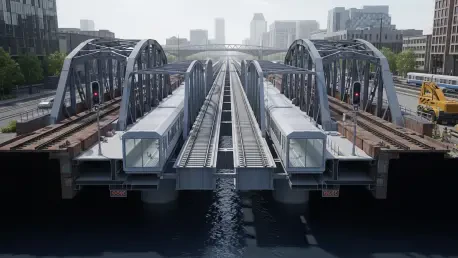
Vertical lift spans are transformative for dense urban waterways like the Charles River because they offer a consistent, predictable clearance for maritime traffic without the heavy counterweights and massive footprints of old bascule bridges. By moving the span straight up, we reduce the mechanical complexity and the risk of “sticking” that often plagues 90-year-old infrastructure, which was built with far less resilient materials. Regarding demolition, the strategy is surgical; we utilize off-peak hours and meticulous staging to ensure that the 100,000 daily commuters don’t face a wall of construction. It is a rhythmic dance of removing rusted steel while simultaneously preparing the new foundations, ensuring the rail artery stays open even as we excise its heart to make way for the new spans.
Utilizing a design-build framework allows for Alternative Technical Concepts to reduce in-water work and simplify staging. How do these concepts specifically streamline the construction of new platforms and control facilities, and what metrics do you use to measure the success of these unconventional engineering solutions?
The beauty of the design-build framework, especially with Alternative Technical Concepts (ATCs), is that it empowers us to rethink the environmental footprint of the project. For the North Station expansion, ATCs allow us to minimize the physical “wet” construction—the actual work in the water—which significantly protects the aquatic ecosystem while speeding up the timeline for building the new Platform F. We measure success not just in dollars saved, but through “interference hours”—a metric that counts every minute a passenger or a vessel is delayed—and by the precision of the new Tower A control facility’s integration. Success is achieved when we deliver a system that is equal to or better than the original requirements while cutting down on the invasive staging that usually bogs down such massive civil endeavors.
Expanding rail capacity from four to six tracks across the Charles River requires extensive signal and track modernization. Can you walk us through the step-by-step integration of positive train control systems during this expansion, and what specific challenges arise when working across three different city jurisdictions simultaneously?
Moving from four tracks to six across the Charles River is like performing heart surgery while the patient is running a marathon. The integration of Positive Train Control (PTC) is the most critical technical layer, involving a phased rollout of sensors and signaling software that ensures automated safety overrides are functional before any new track goes live. Dealing with three distinct city jurisdictions—Boston, Cambridge, and Somerville—adds a layer of logistical chess, as each has its own zoning, noise ordinances, and environmental standards that must be harmonized. We have to synchronize every concrete pour and signal test across these city lines to ensure the $1 billion investment results in a seamless, unified transit corridor rather than a fragmented one.
Maintaining service for over 100,000 daily commuters while constructing a $1 billion bridge project over several years is a massive logistical feat. What anecdotal lessons have been learned from past high-stakes bridge rehabilitations, and how do you balance aggressive construction timelines with the need for transit access?
Balancing an aggressive timeline that stretches to the fall of 2032 with the needs of 100,000 daily riders requires a philosophy of “invisible construction.” Drawing from high-stakes rehabilitations like the $320 million share of the Vincent Thomas Bridge project, we’ve learned that communication and redundancy are your best tools. If one section of the rail is being modernized, the other tracks must operate at peak efficiency, which often means working in the dead of night under stadium lighting to keep the morning commute sacred. It is an emotional commitment as much as a technical one, knowing that any slip-up impacts the livelihoods of thousands, so we build in massive buffers and utilize pre-fabricated components to ensure the site remains as active as possible without disturbing the peace.
What is your forecast for the future of large-scale bridge infrastructure in aging American transit hubs?
My forecast for the future of large-scale bridge infrastructure in aging American transit hubs is a shift toward “smart modularity,” where we prioritize structures that can be easily upgraded as technology evolves. We are moving away from the “build it and forget it” mentality of the 1930s toward dynamic systems that integrate digital monitoring for real-time structural health updates. As we see with this $1 billion investment in Massachusetts, the trend will favor multi-modal designs that handle increased rail capacity while simultaneously serving as high-tech communication conduits. Ultimately, the next decade will be defined by how well we can modernize our heritage infrastructure without erasing the transit history that built these cities.