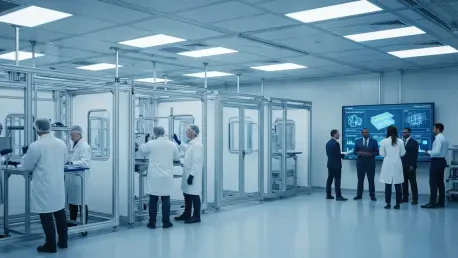

The precision required to manufacture life-altering medical technologies and high-tech semiconductors necessitates an environment where even a single microscopic particle can compromise the integrity of an entire production line. As the global demand for controlled environments continues to escalate, companies must evolve beyond their original frameworks to manage increasingly complex logistical and engineering requirements. Guardtech, a prominent force in the cleanroom construction sector, has recognized this necessity by implementing a comprehensive leadership transition designed to fortify its operational foundation. This shift involves moving from a founder-led model toward a more robust, multi-tiered corporate structure that emphasizes specialized expertise. By promoting Mark Wheeler to the position of Managing Director, the firm signals a commitment to leveraging decades of industry-specific knowledge to navigate the sophisticated demands of the Life Sciences and high-tech engineering markets during this pivotal stage of expansion.
Structural Evolution: A New Era of Executive Management
The transition of leadership at the helm of Guardtech represents a deliberate move to balance legacy with modernization, ensuring that the company remains agile as it scales its operations. Mark Wheeler, who previously served as the Commercial Director, has officially stepped into the role of Managing Director, succeeding his father, Ray Wheeler, who will now serve as Chairman. This internal progression is supported by the continued presence of Conor Barwise as Projects Director, completing a senior leadership trio that possesses a deep understanding of the firm’s heritage and technical capabilities. The elevation of Mark Wheeler is not merely a change in title but a strategic alignment of his twenty years of experience in the cleanroom industry with the company’s broader goals. His background, which includes significant roles in international sales and marketing before joining the family business in the early 2000s, provides the necessary perspective to lead the firm through its next phase of development within a highly competitive international landscape.
To support this executive core, the firm has established a new management tier consisting of four Associate Directors who oversee Finance and HR, Manufacturing, Operations, and Commercial departments. This structural refinement is specifically engineered to stabilize the internal workings of the company as it manages a significantly larger workforce and a more diverse project portfolio. By delegating specific departmental responsibilities to these specialized directors, the senior leadership can focus on high-level strategy and long-term partnerships rather than day-to-day administrative tasks. This decentralized approach ensures that as the organization grows, it maintains the efficiency and quality control that clients expect in the contamination control industry. Such a robust framework is essential for handling the complexities of modern construction projects, where regulatory compliance and technical precision are non-negotiable requirements for success in providing environments for scientific innovation.
Strategic Identity: Consolidating the Brand Portfolio
Parallel to the leadership changes, a significant rebranding initiative has been launched to streamline the company’s market presence and clarify its service offerings. The organization has reverted from using the name “Guardtech Group” to simply “Guardtech,” a move intended to simplify brand recognition while still housing a comprehensive family of specialized sub-brands. This identity shift allows the company to present a unified front to the market while highlighting the distinct capabilities of its subsidiaries. For instance, Cleanroom Solutions remains the primary vehicle for large-scale, turnkey construction projects, while Guardtech Cleanrooms focuses on versatile modular systems. This clarity in branding helps potential clients quickly identify the specific division that meets their needs, whether they require a massive permanent facility or a smaller, specialized modular setup that can be integrated into existing infrastructure without the need for extensive structural renovations or prolonged downtime.
Beyond the primary construction divisions, the company continues to develop its niche subsidiaries to address the evolving needs of the scientific community. Cleancube offers mobile container facilities that provide rapid deployment capabilities, while Isopod focuses on rapid-assembly pods that offer flexibility for smaller research labs. Additionally, the portfolio includes Guardware for cleanroom hardware and Isoblok for pre-fabricated systems, ensuring that the company can provide a truly comprehensive contamination control solution. By maintaining these specialized brands under the singular Guardtech umbrella, the firm demonstrates its ability to serve as a one-stop provider for the Life Sciences sector. This integrated approach not only simplifies the procurement process for clients but also ensures that all components of a cleanroom environment—from the structural walls to the internal hardware—are designed and manufactured to the same high standards of quality and performance.
Financial Momentum: Sustaining Growth in Specialized Sectors
The financial trajectory of the organization serves as a testament to the effectiveness of its recent restructuring and product innovation strategies. Since the beginning of its modernization efforts several years ago, the firm has transformed from a modest operation with approximately ten employees and a turnover of £2.5 million into a major industry player. By the current period, the company has reached a projected turnover of £25 million, supported by a dedicated staff of 70 professionals. This exponential growth follows a strong performance in the previous year, where the firm achieved a turnover of £17.7 million. Such rapid scaling was made possible through a series of successful acquisitions and the steady integration of new technologies into their service offerings. The ability to maintain this momentum during a time of global economic shifts highlights the resilience of the cleanroom sector and the company’s effective positioning as a critical partner for high-growth industries like biotechnology and electronics.
In light of these developments, the leadership transition provided a necessary framework for maintaining operational excellence amidst rapid expansion. Industry participants and engineering firms had to recognize that successful growth in high-tech construction required more than just technical skill; it demanded a sophisticated management structure capable of supporting large-scale, multi-disciplinary projects. By formalizing the roles of Associate Directors and streamlining the brand identity, the organization established a blueprint for other specialized firms looking to transition from small-scale businesses to national leaders. Future growth in this sector depended on the ability to provide reliable, high-quality environments that allowed scientific innovators to push the boundaries of what was possible. Consequently, the firm’s strategic focus on internal stability and market clarity ensured it stayed at the forefront of the cleanroom industry, providing the essential infrastructure for the next generation of scientific and engineering breakthroughs.