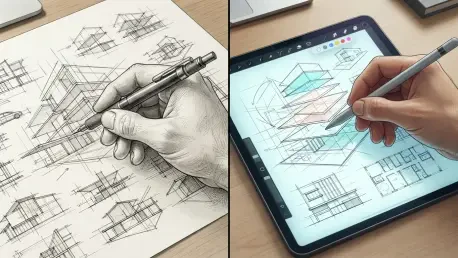

Professional circuit board design in the late 1970s relied on four-to-one scaling and photographic reduction to minimize human error during the physical taping of layouts. This painstaking process required engineers to spend hours hunched over light tables, meticulously placing black crepe tape and donut-shaped pads onto stable polyester film. The objective was to create a master artwork that was physically manageable; by working at a larger scale, a slight tremor in a designer’s hand became negligible once the camera reduced the image to its actual size. This era of manual craftsmanship in electronics meant that the quality of a circuit board was directly tied to the physical dexterity and patience of the drafter. However, as integrated circuits grew in complexity, the sheer volume of connections began to outpace the limitations of physical media. The transition toward digital systems was not merely a convenience but a necessity for survival in a rapidly advancing technological landscape, where the cost of a single error in a manual layout could derail months of development work. Even so, the initial high cost of entry for computer-aided design meant that only the largest corporations could afford the hardware, leaving smaller firms to innovate within the constraints of more modest equipment.
The Architecture of Longevity and Efficiency
Strategies for Code Sustainability and Performance
As hardware transitioned from simple instrument controllers to more robust desktop computers, the fundamental logic of engineering software had to evolve to ensure long-term viability. One of the most critical breakthroughs in this evolution was the implementation of spatial indexing and bounding-box culling. In the early days of computing, redrawing an entire design file for every minor change was a resource-intensive task that could slow a system to a crawl. By assigning a spatial “extent” or a bounding box to every drawn item, software could ignore any data that sat outside the current screen view. This efficiency allowed designers to manage increasingly complex projects on hardware that would otherwise have been overwhelmed by the volume of geometric data. Even today, as processing power has increased exponentially, the core principle of only processing what is visible remains a cornerstone of high-performance design environments, ensuring that software remains responsive even when handling massive datasets.
The longevity of engineering software also relies heavily on the human readability of its underlying code. Moving away from the cryptic, abbreviated variable names of the early computing era toward highly descriptive naming conventions and extensive documentation allowed codebases to survive across generations. When developers in the 1980s chose to prioritize clarity over the minimal memory savings of short names, they were unknowingly preparing their work for the age of artificial intelligence. This foresight meant that legacy logic remained understandable not only to the original authors decades later but also to modern language models that can now parse and translate that logic into contemporary programming languages. A commitment to structural clarity ensures that the core mathematical principles of a program are never lost during the transition between different hardware architectures or operating systems. This practice of writing code for the next human reader, rather than just the machine, has proven to be the ultimate safeguard for technical intellectual property.
Bridging the Gap Between Design Eras
The journey from the Hewlett-Packard HP-85, with its 613-kilohertz clock speed, to the gigahertz processors of 2026 highlights a significant shift in engineering priorities. In the early years, the primary challenge was achieving accurate results with extremely limited resources. Engineers discovered that while processing speed was a luxury, mathematical accuracy was a non-negotiable requirement for precision manufacturing. This led to the development of software that prioritized binary-coded decimal arithmetic and built-in engineering graphics to ensure that a circle remained a circle, regardless of the zoom level. This focus on accuracy over raw speed created a foundation of trust between the engineer and the digital tool, proving that a well-designed program could revolutionize the workflow of a small firm even without the backing of a million-dollar minicomputer. The success of these early systems demonstrated that the value of a tool lay in its ability to solve specific, high-precision problems rather than its general-purpose computing power.
Maintaining a software ecosystem over several decades required a unique partnership between the developer and the end-user. Some users utilized the same design software for over thirty years, eventually reaching a point where they modified the source code themselves to add modern outputs like Gerber files for circuit board manufacturing. This level of user engagement was only possible because the software was built on a modular, transparent architecture that encouraged exploration rather than hiding behind proprietary barriers. By providing a stable platform that could be adapted as industry standards changed, the software became a living tool that grew alongside the engineer’s career. This transition from a static product to an evolving design environment showcased the importance of flexibility in engineering tools. It proved that the most resilient software is that which allows the user to bridge the gap between legacy designs and modern manufacturing requirements without losing the integrity of the original geometric data.
The Modern Era of Artificial Intelligence Integration
Redefining the Role of the Engineer in Software Development
The current landscape of software development has been radically transformed by the integration of large language models and artificial intelligence. In this modern workflow, the professional engineer has transitioned from a manual coder into a role more akin to a producer or director. By using AI to translate 1980s Pascal logic into modern programming languages, developers can preserve decades of refined engineering wisdom while modernizing the interface and delivery. This shift has compressed development timelines from months to minutes, allowing for the rapid implementation of complex features that were previously too labor-intensive to code by hand. The engineer now provides the directional intent and the architectural oversight, while the AI manages the technical execution of the syntax. This partnership allows for a level of experimentation and feature density that was once impossible for small teams, effectively leveling the playing field between independent developers and large software houses.
Beyond mere translation, the use of AI in modern development environments has introduced a new standard for software stability and testing. Modern testing suites can now run thousands of automated checks in seconds, ensuring that rapid AI-generated features do not compromise the stability of the existing codebase. This allows for a “fail fast” approach to feature development where new ideas can be prototyped, tested, and refined in a single afternoon. The ability to iterate at this speed means that engineering tools can evolve in real-time to meet the changing needs of the industry. This high-speed development cycle is supported by the same principles of documentation and clarity that were established decades ago, proving that the most advanced AI tools still require a logical and well-structured foundation to be effective. The modern engineer must therefore be as skilled in prompt engineering and logic oversight as their predecessors were in manual drafting and physical film reduction.
Innovations in Interactive Design Systems
Modern systems have moved beyond static menus and mouse-driven interfaces to embrace a more intuitive and interactive user experience. The integration of voice control and natural language processing allows engineers to navigate complex menus or generate intricate geometric structures simply by describing them. For example, a user can now dictate a command to create a bolt circle flange with specific dimensions, and the software will execute the construction in real-time. This reduces the cognitive load on the designer, allowing them to focus on the creative aspects of engineering rather than the mechanics of the software interface. Voice prompts and guidance systems further lower the barrier to entry for new users, providing step-by-step assistance through multi-click operations. This transformation turns the software into a collaborative partner that understands the context of the task and provides the necessary tools and information exactly when they are needed.
The final evolution of this digital journey is the unification of disparate data types within a single design file. In the current engineering environment, photographs, spreadsheets, and design geometry live together, enabling automatic updates to bills-of-materials and hole schedules. This level of integration ensures that the digital twin of a product is always accurate and up-to-date, reflecting changes across all associated documents instantly. This approach aligns with the concept of “ephemeralization,” where the goal is to do more with less, eventually achieving maximum output with minimum physical and temporal investment. The 45-year evolution of CAD demonstrated that while hardware and languages were transitory, the fundamental principles of geometry and efficiency remained constant. The industry transitioned toward a model where the value of creative output far outweighed the diminishing physical costs of production. Ultimately, the survival of legacy logic proved that clear documentation was the most durable asset an engineer could create, providing a roadmap for navigating the complexities of AI-driven design while preserving the accuracy required for precision manufacturing.