
The mortality rate in European construction remains volatile because sites involve multiple contractors and heavy machinery in constantly changing configurations. For decades, the industry relied on manual oversight and reactive safety protocols that only addressed hazards after an incident occurred. However, the current shift toward a tech-driven paradigm is fundamentally altering how risk is managed across the continent. By integrating smart sensors, high-speed data networks, and predictive analytics, construction sites are transforming into intelligent ecosystems. This evolution is not merely about compliance but about creating a proactive environment where danger is neutralized in real-time. As the European Union continues to push for safer work standards, these digital tools are proving to be the essential bridge between theoretical safety regulations and the complex reality of active job sites. This systemic shift represents a new era for workers, where technology prioritizes human life through an invisible, protective digital layer.
Integrating Safety through Digital Platforms
Developing the Resilient Construction Site Ecosystem
The REN+HOMES initiative serves as a primary example of how digital safety ecosystems can be scaled across diverse project environments. By developing the Resilient Construction Site platform, the project addressed the problem of data fragmentation where safety, noise, and waste sensors previously operated in isolation. This platform synthesizes various data streams into cohesive dashboards that provide site managers with a comprehensive overview of both worker safety and environmental conditions. The synthesis of this information allows for a more holistic approach to hazard identification, moving beyond simple checklists toward a dynamic, data-driven management style. When managers can see the interplay between environmental factors and worker positioning, they can make informed decisions that prevent accidents before they manifest. This platform represents the first major step in unifying disparate technologies into a single, functional interface for site safety supervision.
The project’s focus on small-scale renovations ensures that these digital tools are tested in the most resource-constrained environments, proving their viability for larger infrastructure projects. Small and medium enterprises often lack the massive overhead required for bespoke safety systems, making the scalable nature of the RCS platform particularly valuable. By proving that low-cost sensors and cloud-based analytics can function effectively on a renovation site in a crowded urban center, the initiative has lowered the barrier to entry for the wider industry. These environments often present unique hazards, such as restricted space and proximity to the public, which require highly precise monitoring. Testing in such settings has allowed developers to refine the user interface, ensuring it is intuitive for workers who may not have extensive technical training. This democratization of high-tech safety tools is a crucial component of the current digital transition within the European building sector.
Enhancing Worker Protection with Real-Time Monitoring
One of the most critical components of modern safety platforms is the deployment of wearable sensors and perimeter tracking systems. For example, crane operators often face significant blind spots, but integrated Safety Dashboards now provide haptic and visual alerts to both operators and ground workers when a high-risk zone is breached. These systems use ultra-wideband technology to track the location of personnel relative to heavy moving parts with centimeter-level accuracy. Instead of relying on hand signals or radio communication, which can be obscured by site noise or poor visibility, the system provides an immediate physical warning through vibrating vests or helmet-mounted lights. This direct intervention bypasses the delay of human reaction times and ensures that workers are aware of threats even if they are focused on a task. The technology effectively creates a virtual “safety bubble” around dangerous equipment, moving safety from a procedural obligation to an automated technical reality.
Beyond physical collision prevention, environmental monitoring modules track atmospheric conditions such as extreme heat and hazardous gas levels. When safety thresholds are crossed, the system automatically triggers administrative controls, such as mandated breaks or the temporary shutdown of specific equipment, turning abstract environmental data into immediate health interventions. This is particularly vital as regional climates become more unpredictable, leading to increased risks of heat exhaustion and respiratory issues on outdoor sites. By monitoring heart rates and body temperatures through connected wearables, the platform can detect early signs of physiological stress before a worker even realizes they are in danger. These proactive health measures are integrated into the daily workflow, ensuring that safety is not sacrificed for productivity. The result is a work environment where the health of the individual is continuously supported by an intelligent monitoring network that acts as a silent guardian.
Automation and Virtual Site Management
Advancing Safety through Digital Twins and Robotics
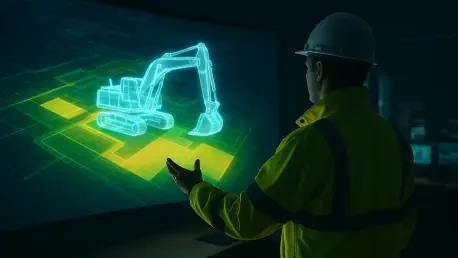
The Beeyonders project represents a leap forward in heavy infrastructure safety by utilizing digital twins, which are virtual replicas of physical construction sites. By syncing autonomous machinery, such as loaders and excavators, with drone surveillance and worker wearables, safety becomes an inherent prerequisite of the workflow. In this model, machines do not merely react to obstacles; they continuously recalculate their paths based on the real-time positions of workers and other equipment. The digital twin acts as the central brain of the operation, simulating thousands of possible interactions every second to identify the safest and most efficient path forward. This level of simulation allows for the planning of complex maneuvers in a virtual space before they are executed in the physical world. It minimizes the chance of human error and ensures that every movement on the site is coordinated through a high-precision, automated oversight system.
Interestingly, this high level of precision has also been shown to improve operational efficiency, resulting in measurable reductions in energy consumption and material waste. When autonomous machines operate with perfect spatial awareness, they perform tasks more quickly and with fewer unnecessary movements. This synergy between safety and productivity challenges the old industry assumption that rigorous safety protocols necessarily slow down project timelines. On the contrary, the use of robotics and digital twins allows for a more streamlined construction process where risks are engineered out of the environment from the start. By reducing the number of personnel required in high-risk zones and delegating dangerous tasks to autonomous systems, the industry is effectively lowering the statistical probability of workplace injuries. This shift toward automation is not about replacing human labor but about shielding workers from the most hazardous aspects of the modern construction project.
Overcoming Structural and Economic Barriers
While the benefits of Smart Sites are evident, several hurdles remain that prevent widespread adoption across Europe. The industry often struggles to turn isolated pilot programs into integrated, repeatable workflows, largely because construction is a project-by-project business. Each site has its own unique geometry, local regulations, and contractor mix, making it difficult to apply a “one size fits all” digital solution. Furthermore, the sector is dominated by small and medium enterprises that operate on thin profit margins, making the high upfront cost of AI platforms and sensors difficult to justify. To overcome this, there is a growing trend toward “Safety as a Service” models, where companies can lease equipment and software for the duration of a specific project. This reduces the capital expenditure required to modernize and allows smaller firms to access the same level of protection as major international contractors, fostering a more equitable safety standard across the board.
Regulatory fragmentation also poses a challenge, as digital tools configured for one country’s safety laws may require extensive recalibration to comply with the standards of another member state. A sensor that meets German industrial safety requirements might not be automatically certified for use in France or Italy without additional testing. This lack of harmonization slows the cross-border deployment of innovative technologies and increases the cost for developers who want to scale their solutions. However, the European Union is currently working toward a unified digital framework for construction safety, which aims to standardize data protocols and equipment certification. By creating a common market for safety technology, the EU hopes to accelerate the adoption of these life-saving tools and ensure that a worker in Madrid has the same digital protection as one in Warsaw. This regulatory alignment is essential for building a truly resilient and technologically advanced European construction sector.
Realizing the Vision of the Smart Site
The transition toward an intelligent, communicative construction ecosystem marked the end of an era defined by reactive accident reporting and manual oversight. Developers successfully integrated safety platforms with Building Information Modeling to create a single digital thread that connected the design phase directly to on-site execution. This holistic approach allowed safety engineers to identify potential hazards in the blueprint long before the first excavator arrived at the job site. By 2026, the industry had moved away from treating safety as a secondary checklist, instead making it a foundational element of the digital architectural plan. The functional tools required for this shift, such as connected vests and integrated haptic dashboards, proved their worth in hundreds of real-world trials across the continent. These technologies provided the data necessary to refine safety protocols and ensure that every worker was protected by a network of real-time, preventative digital interventions.
As the industry achieved greater levels of digitalization, the ultimate goal of the Smart Site became a reality where technology operated silently in the background. The successful implementation of these systems ensured that the value of human life was prioritized above all other project metrics, guaranteeing that every worker could return home safely. Pilot programs demonstrated that the combination of artificial intelligence and robotic automation could reduce fatal accidents by significant margins, fundamentally changing the risk profile of the building trade. This evolution did not just improve statistics; it fostered a new cultural mindset where safety and efficiency were seen as two sides of the same coin. By embracing these digital advancements, the European construction sector established a global benchmark for occupational health and safety. The industry moved forward into a more sustainable and secure era, leaving behind the outdated practices that had once made construction one of the most dangerous professions in the modern world.