
Monumental’s unique ‘Robotics-as-a-Service’ model effectively eliminates the financial and technical risks for builders who are often hesitant to adopt unproven technologies. The construction industry has long struggled with a widening gap between the demand for new infrastructure and the availability of skilled labor, particularly in the specialized field of masonry. By securing thirty-two million dollars in its latest funding round, the Amsterdam-based company is now positioned to deploy its fleet of autonomous bricklaying robots across the Atlantic to address the chronic labor shortages in the United States. This expansion marks a pivotal moment where traditional craftsmanship intersects with high-level automation, allowing contractors to maintain rigorous schedules without the typical delays associated with human resource constraints. The capital injection is not merely a financial milestone but a validation of a system that treats robotics as a utility rather than a capital-heavy purchase.
Technology Integration: Mobile Autonomy in Complex Environments
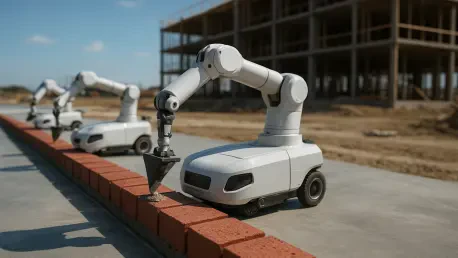
The core technology behind these masonry robots involves a sophisticated blend of computer vision, real-time sensor fusion, and agile mobility that allows the units to navigate rugged construction sites without human intervention. Unlike previous generations of stationary robotic arms that required complex setups and protective fencing, these autonomous platforms are designed to move freely around the perimeter of a building. They use advanced algorithms to account for the minute variations found in bricks and mortar, ensuring that every layer is placed with millimeter precision. This level of adaptability is crucial because construction sites are notoriously unpredictable environments where ground conditions and structural alignments can change daily. By utilizing a fleet of smaller, nimble robots instead of a single massive machine, the system maintains high levels of operational uptime. If one unit requires maintenance, others continue the work, preventing the entire project from grinding to a halt.
Beyond simple brick placement, the software stack governing these machines integrates directly with Building Information Modeling (BIM) data to translate digital blueprints into physical structures with flawless accuracy. This digital-to-physical pipeline reduces the likelihood of costly human errors that often lead to rework and material waste. The robots are equipped with specialized end-effectors capable of applying mortar and placing bricks in various patterns, including complex decorative bonds that would typically require a master mason’s extensive time and focus. As the robots handle the repetitive and physically demanding tasks, human workers are liberated to focus on quality control and site management, creating a collaborative environment where technology augments human expertise. This shift also addresses significant safety concerns, as the most hazardous aspects of wall construction are now handled by machinery. The result is a more controlled and predictable construction cycle.
Economic Transformation: Scaling the Service Framework
The most significant hurdle to robotic adoption in the building sector has traditionally been the staggering upfront cost of purchasing and maintaining hardware. Monumental solves this dilemma through its Robotics-as-a-Service (RaaS) framework, where developers pay based on the volume of work completed rather than owning the machines themselves. This operational expenditure model aligns the interests of the technology provider with the contractor, as the robot manufacturer is responsible for deployment, maintenance, and software updates. By charging a rate comparable to or lower than traditional human labor costs, the company makes the transition to automation a logical financial decision rather than a risky experimental investment. This approach is particularly attractive to mid-sized firms that may not have the capital reserves to invest millions in proprietary tech but still face the same pressures to increase productivity. The flexibility of the RaaS model also allows for rapid scaling across the various project phases.
This financial innovation is paired with a logistics strategy that emphasizes localized support and rapid response times as the company enters the North American market. Moving from the relatively compact urban environments of Europe to the sprawling construction landscapes of the United States requires a robust infrastructure for transporting and servicing robotic fleets. The recently raised capital will fund the establishment of regional hubs across several key American states where housing demand is highest. These centers will act as the operational heart for the company, housing maintenance crews and data analysts who monitor robot performance in real-time. By providing a turnkey solution that includes both the hardware and the specialized operators required to manage the fleet, the company effectively removes the learning curve for general contractors. This ensures that the integration of robotics does not disrupt existing site workflows but instead complements them as the technology begins to mature and expand.
Strategic Implementation: Practical Evolution and Future Prospects
The successful deployment of autonomous masonry solutions throughout the current year demonstrated that the construction industry was ready for a fundamental shift in how physical labor was managed. Builders who integrated these robotic fleets into their workflows saw immediate improvements in project timelines, often completing the structural envelopes of buildings weeks ahead of original estimates. The focus moved toward creating more sustainable construction sites by minimizing the physical footprint of heavy machinery and significantly reducing the waste associated with manual mortar application. Stakeholders prioritized the adoption of standardized digital blueprints to ensure that the robots operated at peak efficiency, which in turn encouraged a broader modernization of project management software across the board. The transition proved that automation did not replace the need for skilled labor but rather changed the nature of the work, requiring a new generation of technicians capable of overseeing complex systems.
Strategic planners identified that the most effective way to capitalize on this automation was to integrate robotic workflows into the early design phases of a project. By doing so, architects and engineers ensured that the masonry requirements aligned perfectly with the operational capabilities of the autonomous units. The industry also recognized the importance of creating a centralized data repository where the performance metrics of these robots could be analyzed to refine future construction schedules. This data-driven approach allowed for more precise resource allocation and significantly reduced the likelihood of project overruns. Ultimately, the successful integration of these systems depended on a willingness to rethink traditional site logistics and embrace a more technological foundation for construction operations. The shift toward this model provided a blueprint for how other sectors of the trade could transition toward higher levels of efficiency while maintaining a commitment to quality and structural integrity in every new build.