
Construction firms across the United States are currently navigating a monumental shift where the historical reliance on disconnected spreadsheets and manual site reports has finally been replaced by comprehensive digital ecosystems. The sheer complexity of modern infrastructure projects necessitates a level of precision that only fully integrated software suites can provide, ensuring that every stakeholder from the architect to the subcontractor remains perfectly aligned throughout the project. As project timelines tighten and material costs fluctuate unpredictably, the ability to synthesize data from multiple sources into a single source of truth has become the primary differentiator between profitable ventures and catastrophic failures. This technological maturation represents more than just a convenience; it is a fundamental reconfiguration of how the physical world is built, maintained, and optimized for long-term sustainability. By eliminating the silos that previously plagued the industry, organizations are now achieving unprecedented levels of efficiency and transparency that were simply impossible only a few years ago. The convergence of cloud computing, edge processing, and high-speed connectivity has turned every job site into a data-rich environment that provides actionable insights at every stage of the build.
Seamless Coordination Through Unified Data Streams
Field-to-Office Connectivity: Bridging the Digital Divide
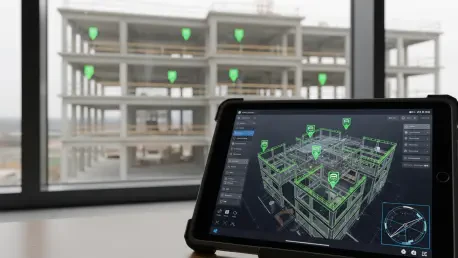
The integration of mobile-first platforms with backend project management systems has fundamentally altered the daily workflow of site supervisors and project managers. Instead of waiting for weekly progress meetings to identify bottlenecks, teams now rely on real-time telemetry from wearable devices and autonomous site scanners that feed directly into central databases. This immediate visibility allows for proactive adjustments to labor allocation, ensuring that specialized trades are only deployed when the necessary site conditions have been met. Furthermore, the synchronization of field observations with the Building Information Modeling software ensures that any discrepancies between the design and the actual construction are flagged within minutes. This rapid feedback loop reduces the likelihood of costly rework, which has historically accounted for a significant portion of project overruns across the commercial sector. By maintaining a continuous flow of high-fidelity information, construction firms are effectively neutralizing the traditional communication barriers that often led to delays and disputes. The result is a more disciplined approach to execution where every person on the ground is connected to the master plan.
Supply Chain Automation: Synchronizing Material Logistics
Extending this connectivity to the broader supply chain has empowered procurement departments to navigate global logistics with a level of agility that was previously unattainable. Integrated software now links directly with material suppliers and logistics providers, offering a granular view of the shipping status and inventory levels for critical components. When a delay occurs at a regional distribution center, the system automatically recalibrates the project schedule and alerts the relevant onsite teams to shift focus to alternative tasks. This level of automated coordination minimizes idle time and ensures that the delivery of materials is timed precisely with their installation, reducing the need for extensive onsite storage. Moreover, the inclusion of financial tracking within these unified systems allows for automated payment processing based on verified project milestones. As a result, the entire construction ecosystem operates as a cohesive unit, where every participant has access to the specific data points required to perform their role with maximum efficiency and minimal administrative overhead. This synchronization ensures that the rhythm of construction is never broken by preventable logistical failures or data gaps.
Predictive Intelligence and the Digital Twin Lifecycle
Predictive Insights: AI and Scheduling Efficiency
Advanced algorithms are now being utilized to analyze vast datasets from ongoing projects to predict potential schedule slips before they manifest as actual delays. By examining historical performance metrics, weather forecasts, and labor market trends, integrated platforms provide project managers with probabilistic models that highlight high-risk activities. These predictive tools go beyond simple Gantt charts by offering dynamic scenarios that help teams prepare for various contingencies. For instance, if the system detects a trend of decreasing productivity in a specific trade, it can suggest interventions such as additional training or adjustments to the crew size. This transition from reactive troubleshooting to proactive risk management has significantly increased the reliability of project completion dates. Furthermore, the ability to simulate the impact of design changes in real-time allows for more informed decision-making during the pre-construction phase. This ensures that the finalized plans are not only structurally sound but also optimized for the current economic and environmental conditions affecting the job site, providing a clear path to success.
Asset Lifecycle Management: The Role of the Digital Twin
The lifecycle of a building no longer ended with the handover of keys, as integrated software maintained a living digital twin that served as a permanent record of the structure’s DNA. This digital replica contained comprehensive data on every component, from the manufacturer of the HVAC system to the specific batch of concrete used in the foundation. During the operational phase, Internet of Things sensors embedded within the building fed performance data back into the digital twin, allowing facility managers to monitor energy consumption and structural integrity in real-time. This continuous monitoring enabled predictive maintenance strategies that identified equipment failure risks weeks before a breakdown occurred, thereby extending the lifespan of the building’s critical systems. When renovations or repairs were required, contractors accessed the digital twin to understand exactly what lay behind walls or under floors without the need for invasive investigations. This holistic approach to data management ensured that the value of the information captured during construction persisted throughout the entire life of the asset, providing long-term benefits to owners and occupants. The industry moved toward a model where the digital information was as valuable as the physical materials.