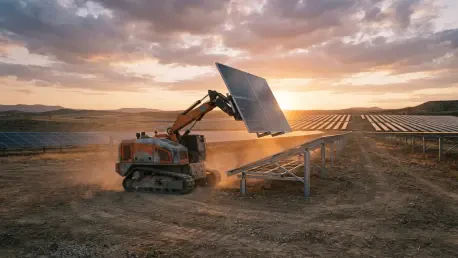

The transition of robotics from indoor manufacturing to outdoor infrastructure projects represents a fundamental evolution in how solar arrays are built. As global energy demands shift toward renewable sources, the sheer scale of utility-sized solar farms has outpaced the capacity of traditional manual labor. In the current landscape of 2026, the industry has turned to sophisticated artificial intelligence to solve the bottleneck of physical construction. These massive energy installations often span thousands of acres, requiring the precise placement of millions of glass modules in environments that are far from the sterile, predictable floors of an automotive factory. By integrating computer vision and machine learning, developers are now able to tackle the logistical nightmare of hauling and mounting panels across uneven dirt and varying grades. This move toward outdoor automation represents a critical pivot that ensures green energy infrastructure can keep pace with the aggressive decarbonization targets set by modern economies.
The Gibson City Milestone: Testing AI in Rugged Environments
The practical application of this technology was recently demonstrated at the 270-megawatt Gibson City Solar Project in Illinois, a facility developed by Earthrise Energy that serves as a blueprint for the future. In a collaboration between the robotics firm Gritt and the engineering giant Burns & McDonnell, AI-driven systems were deployed to manage the grueling task of lifting and positioning heavy solar panels. Unlike traditional industrial robots that are bolted to a floor and follow a pre-programmed path, these mobile units must account for the high variability of a live construction site. They navigate around human crews, avoid stationary obstacles, and adjust their grip on heavy materials based on real-time sensor feedback. This site served as a vital testing ground, proving that artificial intelligence could handle the unpredictability of shifting weather conditions and the complex topography of a rural Midwestern landscape while maintaining the high degree of accuracy required for electrical alignment.
A distinctive feature of this technological shift is the emphasis on retrofitting existing construction equipment rather than manufacturing specialized, proprietary robots. By applying AI software and robotic attachments to standard machinery like forklifts and skid steers, the industry has bypassed the massive capital expenditure typically associated with new hardware. This “retrofit-first” approach allows construction firms to upgrade their current fleets, transforming standard utility vehicles into autonomous agents capable of delicate assembly work. This strategy not only lowers the barrier to entry for smaller contractors but also ensures that the machinery remains familiar to the mechanics and technicians already working on-site. The software layer provides the intelligence necessary to interpret the environment, while the ruggedized hydraulic systems of the original machines provide the raw power needed to move heavy glass and steel. This synergy between proven mechanical hardware and cutting-edge software is what defines the current era of infrastructure automation.
Scaling up Operations: From Prototypes to Gigawatt Capacity
The economic viability of these robotic systems is now being realized as developers look toward massive scaling efforts that were previously deemed logistically impossible. With recent funding rounds securing $32.4 million for Gritt, the focus has shifted from experimental pilots to widespread industrial deployment across the United States. Currently, three of the top ten solar engineering firms have integrated these AI solutions into their standard workflows to combat chronic labor shortages and rising insurance costs. The goal is ambitious yet attainable: the installation of six million solar panels, representing approximately 2.8 gigawatts of capacity, over the next two years starting from 2026. This level of throughput is only achievable because robots do not suffer from the fatigue or heat-related stress that often slows down human crews during peak summer construction months. By maintaining a constant pace of installation, project managers can now offer much more predictable timelines to investors and utility companies awaiting the power.
The successful integration of AI on solar farms demonstrated that the barriers between digital intelligence and physical labor were largely a matter of sensor sensitivity and algorithmic adaptability. As these systems matured throughout 2026, the focus moved from merely completing tasks to optimizing the entire construction lifecycle through data-driven insights. For industry leaders, the next logical step involved applying these autonomous frameworks to other large-scale projects, such as data center foundations and heavy transit infrastructure. Organizations that prioritized the adoption of flexible, retrofitted robotic platforms found themselves better equipped to handle the fluctuations of the global labor market. It became clear that the key to longevity in the green energy sector was not just the installation of panels, but the implementation of a scalable, tech-heavy logistics chain. Successful firms recognized that the future of infrastructure required a workforce capable of managing automated fleets, ensuring that human strategy remained the core of the industry.