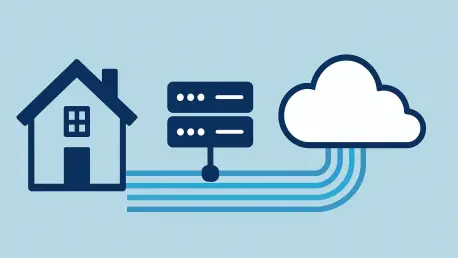

Cloud-based infrastructure offers homeowners access to enterprise-grade GPUs and TPUs that would otherwise be financially inaccessible for a typical household budget. This technological shift marks a profound transition from the rudimentary voice-controlled assistants of a decade ago to the sophisticated generative systems that now permeate modern living spaces. In 2026, the central question for any smart home enthusiast is no longer about which features to adopt, but where the actual processing takes place. As these systems move from simple command-and-control tasks to complex cognitive reasoning, the architectural debate between cloud-dependent nodes and localized physical servers has reached a fever pitch. Homeowners must now decide whether to entrust their personal data to a remote corporate data center or invest in a private computing hub. This choice determines the very nature of human-machine interaction, dictating not only the speed of responses but the ultimate sovereignty of the digital household environment.
Evaluating Cloud-Based Infrastructure
Scalability and Resource Accessibility
Modern large language models require immense computational throughput that far exceeds the capabilities of standard consumer electronics found in high-street stores. By utilizing cloud-based environments, users can tap into clusters of high-end processors or specialized tensor units that would be cost-prohibitive to purchase and maintain in a domestic setting. This elastic approach allows a home AI to perform intensive tasks such as real-time language translation or complex visual scene analysis without causing local hardware to overheat or fail. The scalability of the cloud ensures that as models grow in complexity, the homeowner does not need to constantly upgrade their physical devices.
Furthermore, the financial model of cloud-based AI presents a compelling argument for users who prioritize operational flexibility over permanent capital investment. The shift toward a pay-as-you-go structure means that high-stakes training sessions, such as feeding a model thousands of family photos to recognize specific relationships, can be performed in minutes. This efficiency is achieved by distributing the workload across thousands of parallel processor cores, a feat impossible for a standalone home server. While subscription fees can accumulate, they often pale in comparison to the electric bill and cooling requirements of running an enterprise rack in a residential closet.
Reliability and Storage Capacity
Reliability remains a cornerstone of the cloud-centric approach, as professional data centers are designed with multiple layers of redundancy that no single residence can replicate. These facilities feature backup power generators and industrial-grade cooling systems that ensure the AI remains online even if the local neighborhood experiences a power outage. For users who rely on AI for critical functions such as monitoring elderly relatives or managing high-stakes home security, this uptime is non-negotiable. If a local device fails, the intelligence behind the system remains safely housed in the cloud, ready to be re-linked to a replacement unit instantly.
The storage capacity offered by cloud providers is another pivotal factor in the architectural decision, particularly as home AI systems begin to collect more granular data. A truly intelligent home needs to store years of behavioral patterns and environmental sensor logs to provide accurate long-term analysis and predictive modeling. Cloud storage removes physical constraints, offering virtually limitless space that expands automatically as the system’s needs grow. This vast archive is essential for AI models that learn through longitudinal observation, allowing the system to identify subtle changes in a household’s routine or detect early signs of appliance wear without the user managing complex arrays.
The Case for Physical Local Servers
Privacy and Real-Time Performance
Despite the power of the cloud, physical local servers are gaining traction among users who view data privacy as an absolute priority for a domestic space. Keeping sensitive audio recordings and private video feeds within the physical walls of the home creates a closed-loop ecosystem that is inherently more secure. This architecture ensures that intimate household details never traverse the public internet, effectively bypassing the risks associated with third-party data breaches. In an era where data is often harvested for model training without explicit consent, a local server acts as a digital fortress. It provides the homeowner with absolute certainty regarding who has access to their information.
Performance metrics also favor local processing, specifically when considering the latency involved in real-time home automation tasks. For an AI to be truly useful in a domestic setting, it must respond to commands in milliseconds, whether it is adjusting lighting based on movement or identifying a person at the door. Sending data to a remote server creates a noticeable delay that can frustrate users and undermine the utility of the system. A local server eliminates this round trip, processing information on-site and triggering actions almost instantaneously. This responsiveness is critical for safety-oriented applications, such as automatic shut-off valves or emergency alerts that require execution.
Operational Sovereignty and Control
Operational sovereignty is perhaps the most significant philosophical advantage of maintaining a physical server within the home environment. Relying on cloud services means that the functionality of a house is tethered to the stability of an internet service provider and the financial health of a tech giant. If a service provider experiences a significant outage, a cloud-dependent home can be rendered dysfunctional overnight. In contrast, a local server ensures that the system remains fully operational regardless of the external network status. This offline capability is essential for core domestic functions like climate control and door locks, which must remain reliable 24 hours a day.
For the technically inclined developer, local hardware offers a level of customization and granular control that cloud platforms simply cannot permit. A local server serves as a dedicated sandbox where users can deploy open-source models and tune specific software frameworks to suit their exact needs. This level of transparency allows the homeowner to audit the code running their home, ensuring there are no hidden data-tracking mechanisms. Moreover, local servers allow for the integration of diverse hardware from different manufacturers without being forced into a single ecosystem’s walled garden. This freedom to experiment leads to a more robust AI experience that grows alongside the family.
Synthesizing the Future of Home AI
Comparing Efficiency and User Intent
When analyzing the efficiency of these two models, it becomes clear that the choice often hinges on the specific intent behind the smart home’s design. While cloud servers excel at massive computations, they are often less efficient for the repetitive, low-power tasks that characterize daily life. A local server can handle routine automation—such as managing energy usage—with a much smaller carbon footprint than a remote supercomputer. This efficiency is not just about power; it is also about the stability of intent. Cloud providers frequently update their terms of service, but keeping the logic local ensures that the system’s behavior remains consistent and predictable regardless of corporate shifts.
The tension between user privacy and the technical demands of generative AI has created a landscape where ownership of intent is more valuable than ever. Many major tech companies have begun mandating cloud integration for their most advanced features, often removing the ability for users to opt out of data collection. Building a home AI on a local foundation provides a necessary counterbalance to this trend, allowing users to choose which tasks require cloud intervention. This hybrid thinking allows for a more ethical implementation of technology, where the AI serves as a tool for the individual. This deliberate architectural choice reinforces the concept of the home as a private sanctuary.
Navigating the Model Gap and System Maintenance
Acknowledging the model gap is essential for anyone designing a home AI architecture, as there is currently a divide between what consumer hardware can handle and what the cloud can offer. The most sophisticated large language models are still too resource-intensive to run locally with high speed on a standard domestic server. This reality often forces homeowners to adopt a tiered approach, where a local hub manages the day-to-day operations while the cloud is called upon for deep-reasoning tasks. Navigating this gap requires a sophisticated software layer that can intelligently route requests based on their complexity and the privacy of the data involved in the specific query.
However, the transition to a local server model introduces a new set of challenges regarding system administration and maintenance that many users might find daunting. When a homeowner chooses to host their own AI, they effectively become the IT department for their own residence. If a hard drive fails or a software update breaks a critical link, the responsibility for the repair rests entirely on the user’s shoulders. Unlike the cloud, where maintenance is handled by professional teams, a local system requires active monitoring and periodic hardware upgrades to remain effective. This administrative burden can be significant, requiring a certain level of technical literacy to ensure the system stays secure.
Defining the Robust Architectural Strategy
The most effective architectural strategy for a modern home AI evolved into a hybrid model that prioritized a physical local server as the primary hub. This approach allowed the system to manage routine automation and sensitive data processing on-site, ensuring that the house remained functional and private at all times. Homeowners who adopted this strategy successfully shielded their most intimate details from unnecessary external exposure while still enjoying the benefits of a smart environment. By treating the cloud as an auxiliary resource, users were able to call upon massive computational power only when a specific task truly demanded it. This tiered architecture offered the best of both worlds.
The analysis concluded that the most effective next steps involved auditing existing smart devices to identify dependencies on external servers. To achieve a more resilient architecture, it was determined that individuals should have prioritized hardware that supported local APIs and open-source integration. This transition frequently involved replacing cloud-locked cameras with local-first alternatives to consolidate control. Investing in high-performance local compute units ensured that the home was ready to handle increasingly complex AI models as they became more optimized. Ultimately, the goal was to create an environment where the brain of the home was as secure and permanent as its foundation.