
The rapid expansion of the digital landscape has fundamentally altered the trajectory of American manufacturing, turning once-niche industrial suppliers into critical linchpins of the global tech infrastructure. As artificial intelligence and cloud computing demand more physical space and power, the construction of data centers has surged, creating a “gold rush” atmosphere for manufacturers of everything from corrugated metal hoses to high-voltage switchgear. In this discussion, we explore how traditional industrial players are navigating this unprecedented demand, the massive capital investments required to keep pace, and the complex logistical challenges of a market where lead times are stretching into years. We look at the strategic pivots companies are making to survive the heat of the AI boom while balancing the needs of their legacy customers.
The shift toward data center infrastructure has been described by some as a “dam being removed from a river” because of the sheer volume of orders. From your perspective, how has this sudden demand transformed the operational reality for manufacturers who traditionally served the steel or petrochemical sectors?
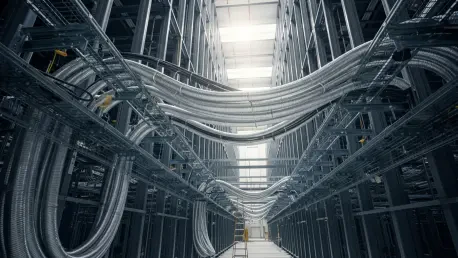
The transformation we are seeing is nothing short of historic, moving from a steady trickle of interest to a literal deluge of orders that has caught many by surprise. Five years ago, a manufacturer of corrugated metal hoses might have spent their days worrying about the next petrochemical plant or steel mill, but today, those same leaders are walking the floors of supercomputing trade shows. At Southeastern Hose, for example, the VP of operations noted that their revenue grew 25% last year and is on track for another 40% jump this year, with two-thirds of that money coming directly from data center projects. This isn’t just a slight uptick; it’s a complete reorientation of their business model to support the exhaust and cooling needs of massive server farms. When you see a company expanding its facility by 40,000 square feet just to keep its head above water, you realize that the scale of this “boon” is forcing manufacturers to work at a pace they have never experienced in their forty-year histories.
We are seeing staggering financial reports, with semiconductor and electrical companies posting double-digit revenue gains. How are these firms managing the “race to ramp up capacity” when the investments required are so capital-intensive?
The financial stakes are incredibly high, and companies are responding with multi-million dollar bets that they hope will pay off for decades. Siemens recently invested $165 million to expand its North and South Carolina facilities, alongside a $190 million site in Fort Worth, Texas, specifically to meet the electrification needs of data centers. To manage the risk of such massive capital expenditures, they are moving away from one-off orders and instead locking hyperscale customers into two- to three-year contracts with guaranteed volumes. This shared risk allows them to build dedicated, high-volume factories that focus on a “low-mix” of standardized products, which is a massive departure from the highly customized, variable-volume production of the past. When you look at players like ABB, where orders in the data center vertical have grown more than 200% in just twelve months, the priority becomes speed to market and the ability to scale infrastructure like switchgears and sensors before the next generation of chips makes current designs obsolete.
As chips become more powerful and energy-intensive, they are generating immense amounts of heat that traditional air cooling cannot handle. What opportunities does this “thermal crisis” create for manufacturers specializing in liquid cooling and flow management?
This is perhaps the single biggest opportunity we will see in our lifetimes because the physical limitations of air are being reached by advanced GPUs. Liquid cooling is no longer a luxury; it is a necessity for the next generation of AI infrastructure, which is why companies like Krohne have seen the data center vertical grow to represent 20% of their business almost overnight. Their flowmeters are now essential for measuring the precise movement of water as it flows in cool to the chip and returns warm to be recirculated. We are seeing a wave of strategic acquisitions in this space, such as Eaton’s $9.5 billion purchase of Boyd’s thermal business, which allowed them to pivot from air-only solutions to advanced liquid cooling. Even Vertiv is integrating these systems into their “OneCore” units, combining power modules and chillers into a single system to help hyperscalers deploy capacity faster and more efficiently.
The supply chain seems to be under immense pressure, with record-high prices for copper and silver and lead times for electrical equipment reaching up to a year. How are manufacturers navigating these bottlenecks without derailing their construction schedules?
The logistical hurdles are significant, as low-voltage equipment now carries a nine-month lead time, while medium-voltage gear can take a full year to arrive on site. This is compounded by the fact that silver prices are averaging double what they were last year, and copper is hitting record highs, which directly impacts the cost of the contacts and wiring inside every switchboard. To combat this, companies like Future Form are working directly with mills to secure cold-rolled steel orders one to two years in advance, trying to steer clear of the volatility found in the import market. Some manufacturers are even using AI to predict their own business needs, creating a feedback loop where the very technology housed in data centers is being used to plan the production of the components needed to build more data centers. Meanwhile, certain high-bandwidth memory components are already sold out through the end of the year, forcing a situation where AI infrastructure is prioritized over consumer electronics because the profit margins—roughly 60% compared to 20% for standard DRAM—are simply too high to ignore.
Labor remains a perennial challenge in the industrial sector, yet the data center boom requires a massive influx of talent. What innovative strategies are being used to staff these new mega-factories and construction sites?
The competition for talent is fierce, especially since data centers are “sucking up” almost all the available electrician talent, with the Bureau of Labor Statistics predicting 81,000 annual openings in that field through 2034. To bridge this gap, Siemens has launched training programs that take workers from the retail and food delivery sectors and put them through intensive manufacturing skills courses to staff their new 500,000-square-foot facility in Texas. Other companies are turning to technology to reduce their reliance on manual labor, such as Future Form, which has invested heavily in automation and smart manufacturing to keep their workforce lean while their volume goes “gangbusters.” They even brought a 3D printer online in April to produce smaller parts at a much faster rate, which allows them to scale production without a proportional increase in headcount. It is a dual approach: aggressively training the local community while simultaneously automating as many repetitive shop-floor tasks as possible.
With companies like Eaton and Nucor creating dedicated business units for data centers, are we seeing a permanent shift in the manufacturing landscape, or is there a risk of alienating the traditional customer base?
There is a very real tension there, as long-term customers in the steel or HVAC industries are finding themselves competing for the same manufacturing capacity as tech giants who are willing to pay almost anything to be first in line. Nucor’s establishment of “Nucor Data Systems” and Eaton’s new business segment show that they are betting on the long-term nature of this demand, but it requires a delicate balancing act to avoid “screwing over” legacy clients. Manufacturers are having difficult conversations with their older customers, explaining that the market has fundamentally shifted and that the workload for things like metal hoses or power distribution has reached historic levels. The risk is that if the AI bubble bursts, these manufacturers might find themselves with overextended facilities and a disgruntled group of traditional clients who felt ignored during the boom years. However, most experts argue that even if the AI hype cools, the underlying need for cloud storage and internet backbone will keep these facilities relevant for a decade or more.
Beyond the walls of the factory, there is growing concern about the strain data centers place on the power grid and local water resources. How do these external pressures influence the decisions manufacturers make regarding where and how they build?
The environmental and social pressure is mounting, as global power demand from data centers is projected to rise 50% by next year and a staggering 165% by 2030. This creates a situation where industrial electricity rates are climbing in nearly every region of the U.S., which impacts the bottom line for every manufacturer, not just those in the data center vertical. In drought-prone areas, the massive water requirements for cooling systems are driving up local rates and causing friction with residents, which could eventually lead to legislative pushback or construction delays. Manufacturers have to account for this by designing more efficient products, like the liquid-to-chip systems that use less water than traditional evaporative cooling towers. If community resistance grows too strong, the “race to ramp up” could hit a wall of red tape, making it vital for manufacturers to stay diversified so they aren’t entirely dependent on a single sector that might face regulatory hurdles.
What is your forecast for the data center manufacturing market over the next decade?
I anticipate that the current breakneck growth rate of 15% to 20% will continue through 2028 or 2029, followed by a transition into a more mature, steady-state growth phase of about 6% to 8% as we reach 2030. While some fear an AI bubble, the reality is that data centers have become the indispensable backbone of the modern global economy, serving as the foundation for the cloud and every digital service we use. Manufacturers who have invested in liquid cooling and modular power systems will likely see a “plateau of productivity” rather than a crash, because even when new construction slows, the replacement cycle for consumable parts like hoses and sensors will provide a guaranteed stream of business. We may see a strategic pivot toward upgrading existing facilities with more efficient technology rather than just building new ones, but the requirement for this infrastructure is not going away; it is simply becoming a permanent, high-priority pillar of the American industrial landscape.